预约演示
更新于:2026-09-09
Siltuximab
司妥昔单抗
更新于:2026-09-09
概要
基本信息
最高研发阶段批准上市 |
首次获批日期 美国 (2014-04-23), |
最高研发阶段(中国)批准上市 |
特殊审评孤儿药 (美国)、孤儿药 (韩国)、临床急需境外新药 (中国) |






登录后查看时间轴
结构/序列
Sequence Code 87889L
来源: *****
Sequence Code 1215539H
来源: *****
关联
45
项与 司妥昔单抗 相关的临床试验NCT07709000
A Phase 2, Open-label, Multicenter Study to Determine the Safety, Tolerability, and Efficacy of MK-1045 in Participants With Hematologic Malignancies
Researchers are looking for new ways to treat people with B-cell cancers. In this trial, researchers will look at chronic lymphocytic leukemia (CLL) and small lymphocytic lymphoma (SLL). These are blood cancers that affect B-cells in the blood, bone marrow, or lymph nodes.
The goals of this trial are to learn about:
* The safety of MK-1045 and if participants tolerate it. Tolerate means participants will receive trial treatment unless they need to stop treatment due to health problems.
* The number of participants who respond. Respond means the number of cancer cells goes down or signs of cancer go away.
The goals of this trial are to learn about:
* The safety of MK-1045 and if participants tolerate it. Tolerate means participants will receive trial treatment unless they need to stop treatment due to health problems.
* The number of participants who respond. Respond means the number of cancer cells goes down or signs of cancer go away.
开始日期2026-09-11 |
申办/合作机构 |
NCT07570173
A Phase 2/3, Randomized, Open-Label, Comparison Study of MK-1045 Versus Blinatumomab in Participants With Relapsed or Refractory CD19+ B-Cell Acute Lymphoblastic Leukemia (B-ALL)
Researchers are looking for new ways to treat people with relapsed or refractory B-cell acute lymphoblastic leukemia (R/R B-ALL) that is CD19 positive using a medicine called MK-1045. MK-1045 is an immunotherapy, which is a treatment that helps the immune system fight cancer. This trial will compare MK-1045 to a standard immunotherapy called blinatumomab. The goals of this trial are to learn if more people who receive MK-1045 have no cancer cells in their bone marrow compared to people who receive blinatumomab and if people who receive MK-1045 live longer compared to people who receive blinatumomab.
开始日期2026-05-18 |
申办/合作机构 |
CTIS2024-510924-38-00
IL-6 aGVHD Siltuximab: A phase II study to assess the efficacy and tolerability of siltuximab plus corticosteroids in first line treatment of grade III/IV acute graft versus host disease of the liver of/and the gastro-intestinal tract.
开始日期2025-11-19 |

100 项与 司妥昔单抗 相关的临床结果
登录后查看更多信息
100 项与 司妥昔单抗 相关的转化医学
登录后查看更多信息
100 项与 司妥昔单抗 相关的专利(医药)
登录后查看更多信息
324
项与 司妥昔单抗 相关的文献(医药)2026-08-01·AMERICAN JOURNAL OF HEMATOLOGY
Real‐World Usage and Outcomes of Different Siltuximab Dosing Frequency in Idiopathic Multicentric Castleman Disease
Letter
作者: Estevez, Maria Santiago ; Asad, Hakeem ; Dispenzieri, Angela ; Nishimura, Yoshito ; Habermann, Thomas
2026-07-01·INTERNAL MEDICINE JOURNAL
Australian clinical practice guideline: diagnosis and treatment of idiopathic multicentric Castleman disease
Review
作者: Radeski, Dejan ; Rischmueller, Maureen ; Hoi, Alberta ; Lade, Stephen ; Prince, H. Miles ; Leslie, Connull ; Wallington‐Gates, Craig ; Ng, Jun Yen ; Talaulikar, Dipti ; Caterson, Hugh C. ; Harrison, Simon J. ; Weber, Nicholas ; Hissaria, Pravin ; Bryant, Adam ; Perram, Jacinta ; Bosco, Annmarie ; Giri, Pratyush
Abstract:
Idiopathic multicentric Castleman disease (iMCD) is a rare condition. The pathogenesis is incompletely understood; however, interleukin‐6 (IL‐6) is a major mediator. The clinical presentation is heterogeneous, from mild constitutional symptoms to severe multi‐organ failure. The diagnosis is challenging, as it incorporates clinicopathologic criteria and requires careful evaluation to exclude various systemic disorders. Targeting IL‐6 activity forms the cornerstone of modern therapy for iMCD, with siltuximab recommended as first‐line therapy. Rituximab‐based regimens are recommended for second‐line therapy. However, many patients do not achieve adequate responses with limited evidence to guide further therapy. In the context of these substantial challenges, herein we provide a multidisciplinary Australasian clinical practice guideline to characterise clinical and pathological features, summarise treatment pathways and discuss clinical outcomes of the condition. The objective is to develop a multidisciplinary clinical practice guideline in the diagnosis and management of iMCD in Australia.
2026-07-01·HEMATOLOGICAL ONCOLOGY
Sustained Complete Response in Refractory Idiopathic Multicentric Castleman Disease Following a Single CD19 CAR T‐Cell Infusion: A Case Report With Mechanistic Insight
Letter
作者: Han, Xuelin ; Zhang, Lu ; Duan, Minghui ; Zhang, Yajing ; Cheng, Fangfang ; Zhang, Ting ; Chang, Alex Hongsheng ; Deng, Jing ; Deng, Biping
ABSTRACT:
Idiopathic multicentric Castleman disease (iMCD) is rare and life‐threatening; although siltuximab is standard first‐line therapy, a substantial proportion of patients are refractory or experience relapse. We report a 31‐year‐old woman with HHV‐8–negative iMCD with idiopathic plasmacytic lymphadenopathy (IPL; iMCD‐IPL), intractable to five prior lines of therapy, who declined siltuximab and enrolled in ChiCTR1900025419. After fludarabine/cyclophosphamide lymphodepletion, she received 1 × 10
6
CAR
+
T cells/kg of autologous CD19 CAR T cells on day 0. Grade 1 cytokine release syndrome (
Tmax
38.2°C) resolved with supportive care; no ICANS occurred. CAR transgene levels expanded (peaking on day +11) and remained detectable through day +58, and flow cytometry showed CD19
+
B‐cell depletion from day +7 to day +198. By day +198, she met CDCN criteria for complete biochemical and clinical response with normalization of inflammatory markers and hematologic recovery. Panhypogammaglobulinemia was managed with intravenous immunoglobulin replacement. At > 12 months post‐infusion, she remains in complete, treatment‐free remission. This observation supports a B‐cell–centric model for refractory iMCD‐IPL and motivates prospective evaluation of CD19 CAR T‐cell therapy.
96
项与 司妥昔单抗 相关的新闻(医药)2026-09-08
北京必诺达 · 注册科学观察
栏目三 · 全球争议聚焦(第二期) | 第 012 期 · 2026-09-08IL-6 单抗的噩梦:把 CRP 压到谷底、把 MACE 留在原地,以及一场被机制写好的败局
——从 ZEUS 中性(7·31)到 9·7"三连败",一个把炎症生物标志物"灭火"却救不了"结局"的药物类,与 IL-6 双信号悖论如何埋下整场噩梦;本期更新诺和诺德 9 月 7 日再终止两项 III 期、全球热议"六周崩塌"栏目三 · 全球争议聚焦一分钟速读
发生了什么(两次冲击,六周崩塌):2026-07-31,诺和诺德宣布抗 IL-6 单抗 ziltivekimab 的 III 期 ZEUS 未达主要终点(HR 0.99,95% CI 0.88–1.11)。2026-09-07(Endpoints 率先报道;公司 9 月 4 日已通知研究者),诺和诺德宣布提前终止其心衰领域的另外两项 III 期 HERMES(NCT05636176) 与 ATHENA(NCT06200207)——数据监测委员会(DMC)认定二者"成功的可能性微乎其微",理由是与 ZEUS 取得不同结果的可能性很低。至此,ziltivekimab 的 III 期"三连败",整个心血管抗炎管线只剩急性心梗后的 ARTEMIS 一项,2027 上半年读出。 这是全球第一次正面检验"抑制 IL-6 通路能否转化为更少心血管事件"的大型结局试验,以及它后续被 DMC 一锤定音的连环失败。
为什么重要:IL-6 曾被视为 CANTOS(抗 IL-1β)成功之后最被看好的"心血管抗炎下一站"。ZEUS 阴性 + 六周后 HERMES/ATHENA 因同一理由被提前叫停,意味着这个"把炎症生物标志物降下来就能降事件"的假说,在 IL-6 这条路上第一次被大规模证伪、且被 DMC 直接判定"翻盘无望";而它降 CRP 的幅度(RESCUE II 期最高 92%)与 Lp(a) 那期我们讲过的"降标志物不降事件"几乎同构。这是继 Lp(a) 之后,本栏目第二次撞上同一类陷阱:生物标志物被驯服,结局纹丝不动;而这次,连"换人群翻盘"的窗口也在六周内被 DMC 关上。
最深的裂缝在机制:IL-6 有"经典信号"(膜受体、限免疫细胞与肝细胞、偏修复/抗炎)与"反式信号"(可溶性受体+IL-6、几乎作用于所有细胞、偏促炎/慢性)两条路。托珠单抗类抗 IL-6R 药把两条路一起堵死——等于顺手关掉有益的修复臂;更反直觉的是,阻断受体反而让游离 IL-6 升高,你看到的 CRP 下降只是"下游读数变好看",真正的细胞因子没被压住。这场噩梦,从分子设计那一刻就被写好了。
接下来看谁:诺和诺德仅剩 ARTEMIS(急性心梗后再灌注炎症窗口) 一项 III 期,预计 2027 上半年读出;它换的是人群(急性高炎相),不是分子。而真正可能"破局"的方向,是选择性阻断反式信号、保留经典信号的 olamkicept(sgp130Fc,奥拉奇西普)——它在溃疡性结肠炎 II 期已显示疗效且感染/穿孔信号更轻,提示"精准打促炎臂"或许才是出路。
中国位置:托珠单抗已国产化并有多家生物类似药;中国内地参与了 HERMES(CTR20233203,境内目标入组 254、公开登记显示约 65% 完成、全球约 4,899/5,600),意味着国内临床站点与受试者直接卷入了这场"六周崩塌";天境生物(I-Mab)的 olamkicept 与 Ferring 合作推进,是中国在"选择性反式信号"这一下一代机制上的稀缺身位;IL-6 通路在自免(RA、GCA、NMOSD)的成熟应用,则为国内生物制品注册积累了可直接复用的 ADA/感染风险管理经验。
---一、事件:7 月 31 日,IL-6 通路第一次被大规模"证伪"
2026 年 7 月 31 日,诺和诺德以新闻稿形式公布 ziltivekimab 的 III 期 ZEUS 试验未达主要终点。首席科学官 Martin Holst Lange 的原话值得逐字读:*"ZEUS 旨在检验抑制 IL-6 通路能否把心血管炎症的降低转化为更少的主要心血管事件。尽管 ziltivekimab 产生了预期的生物学效应,但这并未带来该人群中的 MACE 获益。"*
试验骨架(NCT05021835):
要素
设计
规模
>6,300 例,事件驱动、双盲、安慰剂对照
人群
已确诊 ASCVD + CKD + 系统性炎症(hsCRP ≥2 mg/L)
干预
ziltivekimab 15 mg 每月皮下注射 vs 安慰剂,叠加标准治疗
主要终点
3 点 MACE:心血管死亡、非致死性心梗、非致死性卒中(Cox 回归)
结果
HR 0.99(95% CI 0.88–1.11)——与安慰剂无异
药效学
游离 IL-6 与 hsCRP 如期降低(靶标结合确认)
安全性
严重感染比例高于安慰剂;总 AE/SAE/全因死亡相近
后续
HERMES/ATHENA 已于 2026-09-07 提前终止(futility);ARTEMIS(急性心梗后)进行中,预计 1H 2027 读出
这串数字的物理含义:HR 1.0 就是两组事件率完全相同;0.88–1.11 的置信区间意味着"最好的情况也就降 12%,最坏的情况反而升 11%"——而 CI 这么窄,恰恰说明不是试验太小、效力不足而漏掉真实效应,而是真没效应。诺和诺德将因此计提 2026 年三季度非现金减值,但强调不影响 2026 年调整后营业利润指引。
入组人群的"三重叠加"是刻意的:CKD 患者炎症持续升高、心血管风险灾难性,又因秋水仙碱经肾排泄毒性而无法使用——ziltivekimab 每月一针、不经肾清除,本是最理想的填补者。结果它精准命中了靶点,却没命中终点。
9 月 7 日:数据监测委员会一锤定音,HERMES 与 ATHENA 提前终止。 ZEUS 阴性仅一个多月后,ziltivekimab 的心血管故事迎来更重的一击。诺和诺德于 9 月 4 日通知研究者、9 月 7 日由 Endpoints News 率先披露:因独立数据监测委员会(DMC)审查"全部数据"后认定两项研究"成功的可能性微乎其微",公司提前终止了 HERMES 与 ATHENA 两项 III 期。DMC 给出的理由直白——"不大可能取得与 ZEUS 不同的结果"(low likelihood of a different outcome from ZEUS)。换言之,ZEUS 的失败不是孤立的一次读不出,而是被 DMC 当作"足以预判后续"的先验证据。
要素
HERMES(NCT05636176)
ATHENA(NCT06200207)
人群
心衰伴心血管炎症(HFmrEF/HFpEF)
同(HFmrEF/HFpEF),聚焦症状/功能
主要终点
至首次心衰事件(心血管死亡、心衰住院或紧急就诊)复合的时间
健康状态/生活质量(心衰特异性)
规模
全球目标约 5,600(含中国内地 CTR20233203;境内目标 254)
目标约 680
结局提前终止(futility)提前终止(futility)
后续
所有受试者按计划随访至 3 个月访视
同
这把"换人群翻盘"的最后一线希望掐在了读出之前。此前 TD Cowen 已直言 HERMES/ARTEMIS 的成功概率"需大幅下调",HSBC 称 ZEUS 失利"降低了药物市场潜力、提高了在研研究风险"——9 月 7 日的终止印证了这些担忧。至此,诺和诺德 2020 年以 7.25 亿美元首付款(潜在总额超 21 亿美元) 收购 Corvidia 换来的这款"每月一针、全人源抗 IL-6 配体"心血管资产,在 III 期阶段三连败,仅剩 ARTEMIS 一项尚未揭盲。专家视角
:DMC 用"与 ZEUS 取得不同结果的可能性很低"叫停两项试验,是统计学上很重的判断——它意味着 HERMES/ATHENA 的中期数据已不足以支撑"翻盘"的希望,而非单纯"还没到时候"。对注册人,这暴露了心血管抗炎项目一个残酷的现实:当你有三个同机制的后期试验,一个阴性后,另两个的"独立性"会被 DMC 重新评估——它们共享同一靶点、同一生物标志物逻辑,ZEUS 的失败会被顺推为对它们的先验。换句话说,"多线并行"不会天然分散风险,当机制假说出问题时,它们会一起塌。这也提示:同类在研项目在规划 CVOT 组合时,应预设"首个阴性后的中止阈值与决策树",而不是把希望平均押在多张牌上。专家视角
:读这份新闻稿,最刺眼的是"产生了预期的生物学效应,但没带来 MACE 获益"这句话本身——它把整场噩梦浓缩成一句话:靶标结合(target engagement)不等于临床获益(clinical benefit)。这在心血管抗炎领域不是第一次(CANTOS 之前秋水仙碱 CIRT 阴性、他汀加抗炎 STABILITY 阴性),但 IL-6 的特殊之处在于,它的生物标志物(hsCRP)与事件的"因果链"看起来比谁都硬。ZEUS 告诉我们:看起来硬,不等于真的在因果通路上。对后来者的含义是——不要再用"我把 hsCRP 降了多少"来替自己证明"我会降事件",这两件事在 IL-6 这条路上已经被拆开了。二、拆解:为什么"灭火"救不了"结局"——IL-6 双信号悖论
在完整数据公布前做机制归因也有风险,但 ZEUS 之前的临床前与早期临床 already 把一条最被低估的解释摆上了台面:IL-6 不是一条信号,是两条,而且它们的"好坏"恰好相反。
经典信号(classical signaling):IL-6 结合到膜结合 IL-6R——这个受体只长在免疫细胞(T 细胞、中性粒细胞、巨噬细胞)和肝细胞等少数细胞上。信号经 gp130 → JAK-STAT,且通常被 SOCS 负反馈"自动收尾"。这一路总体偏抗炎、组织修复、再生——比如肠道上皮靠它维持屏障、肝脏靠它启动急性期反应。
反式信号(trans-signaling):IL-6 先和可溶性 IL-6R(sIL-6R)结合,再去激活广泛表达 gp130 的细胞(内皮细胞、成纤维细胞、平滑肌)。这一路几乎作用于全身细胞,驱动慢性炎症、促 Th17、抑制调节性 T 细胞(Treg)——是 RA、IBD、动脉粥样硬化斑块不稳的核心推手。
噩梦的第一层:抗 IL-6R 药把两条路一起堵死。 托珠单抗结合 sIL-6R 与 mIL-6R,等于同时关掉"促炎的 trans"和"修复的 classical"。你以为在灭火,其实把消防通道也焊死了——这也是为什么托珠单抗在 IBD 会因阻断经典信号增加肠道穿孔风险(与 olamkicept 的选择性反式阻断形成鲜明对比,见第六节)。
噩梦的第二层(最反直觉):阻断受体,游离 IL-6 反而升高。 IL-6R 本身是清除循环 IL-6 的一条途径。Kleveland 等的 NSTEMI 研究观察到:托珠单抗组IL-6 与 IL-6R 水平升高、CRP 却下降。机制上,CRP 是肝细胞经 IL-6R 信号产生的,受体被占→ CRP 下降;但 IL-6 本身的清除被阻→游离 IL-6 上升。于是你监测到的 CRP 下降,只是"下游读数变好看",真正的细胞因子没被压住。 这解释了 COVID 与心血管试验里一个反复出现的怪象:CRP 漂亮地掉了,结局却不动——因为 CRP 从来不是那条"因",它只是"果"的一个代理。
噩梦的第三层:靶点在上游,却未必更可控。 IL-6 处在炎症级联上游(IL-1β → IL-6 → CRP),逻辑上"比 CANTOS 更上游、该更有效"。但 ZEUS(HR 0.99)连 CANTOS(canakinumab 抗 IL-1β,HR 0.85、MACE 降 15%)都没追上。这提示:ASCVD 的残余炎症风险,未必由"IL-6→CRP 这一条"单独驱动;血管钙化、矿代谢、内皮功能障碍、贫血等多条通路在 CKD 人群里叠加,单掐 IL-6 一条,救不了全局。专家视角
:把三层叠起来,我的判断与 Lp(a) 那期高度一致——这更像"机制与人群错配",不是"靶点完全无效"。理由有三:其一,IL-6 的促炎因果证据(遗传学、流行病学、斑块内表达)强度不弱,只是它同时背着一条修复臂,粗暴全阻断会自伤;其二,若靶点彻底无效,更可能看到安全性异常而非"降了 CRP 但事件平"这种典型"信号被中和"形态;其三,真正干净的反式选择性抑制剂(olamkicept)在 IBD 显示疗效且感染/穿孔更轻,反证"促炎臂该打、修复臂不该打"。当然,这仍是基于已披露片段的推断——最终裁决要等 2026 学术会议上的亚组(极高炎症 / 重肾损)与组分数据。三、争议:靶点错了,还是药打错了
ZEUS 之后,行业迅速分化为三派,与 Lp(a) 那期的"降幅不够 / 假说存疑 / 试验设计"三派异曲同工。
"靶点无效派":连上游都失败了,炎症假说该降温。 这一派拿 CANTOS 做标尺:IL-1β 阻断能降 15% MACE,更上游的 IL-6 反而 0 效应,说明"ASCVD 残余风险由可成药炎症通路驱动"的假说被高估;ACC 在 2025 年 10 月还呼吁把炎症纳入风险评估,ZEUS 让这句话"适用性下降"。他们还指出,连秋水仙碱(LoDoCo2 后 2023 年首个获批用于 CV 预防的抗炎药)在 2024 CLEAR SYNERGY 都失败了——抗炎这条路整体忽明忽暗。
"机制错配派":不是 IL-6 无效,是'全阻断受体'打错了地方。 这一派认为 ZEUS 否定的是"非选择性 IL-6 抑制",不是"IL-6 通路"。核心论据就是第二节的双信号:托珠单抗/siltuximab 全阻断,连修复臂一起关、还让游离 IL-6 反升;若只打 trans-signaling,或许既压慢性炎症又不伤修复。olamkicept 的 IBD 数据是他们最有力的现成证据。
"患者选择·时机派":人群和窗口错了。 这一派把 COVID 与心血管两场失败串起来看——COVID 里托珠单抗只在合并激素、且早期(高炎症相)使用才显效,单用亚组死亡反而更高;心血管里 ZEUS 选的是"已充分治疗、斑块已成形"的二级预防人群,干预太晚、窗口太窄。他们主张把 IL-6 抑制前移到一级预防、或精准锁定"炎症真的驱动事件"的亚组(如极高 hsCRP 或特定转录组特征),而非广谱压制。
值得注意的是,这场争议同样外溢出了 IL-6 本身:它重新点燃了"炎症到底是心血管事件的可治疗原因,还是仅仅一个风险标志"的古老辩论——而 ZEUS 目前更偏向"标志"那一侧。专家视角
:对做注册的人,三派之争的真正价值不在站队,而在它复述了本栏目上上期已点破的老问题——生物标志物的"可测量改变"与临床终点的"可证明获益"之间,需要几重证据桥接? LDL-C 之所以能当替代终点,是因为他汀/非他汀在数十项试验里反复验证了"降 LDL-C 即降事件";hsCRP 从未完成这一验证,ZEUS 反而是"降 CRP 不降事件"最干净的一次反面教材。这并非说抗炎无效(CANTOS 已证明确实可以),而是说:不能因为'我把一个炎症标志物降了',就默认'我能降 MACE'——每一个新通路都要自己把这座桥走完。 对国内企业,这意味着以"炎症生物标志物降幅"支持上市的路径,必须先在 Pre-IND/Pre-III 与监管就"降幅阈值—人群界定—确证性义务"达成书面共识。四、全球声音:从 COVACTA 到 ZEUS,再到 9·7"三连败"全球热议
ZEUS 公布后,把"COVID 时代的 IL-6 乱局"与"心血管时代的 IL-6 折戟"放在一起,能看清一条完整的"期望—失望—再期望—再失望"曲线。按来源分层:
通讯社/行业媒体层:把 ZEUS 放进诺和诺德的资产负债表与"抗炎叙事"里读。 TechTimes(2026-07-31)的标题直白——《ziltivekimab 砍掉炎症,却没砍掉心梗》;它把 ZEUS 与 CAST(1989,抗心律失常药压制早搏却增死亡率)、torcetrapib(2006,升 HDL 却增心血管死亡)并列,归入"被验证却无效的替代终点"经典失败类。CardiacWire 则称"ZEUS 告诉我们有炎症可能根本不是答案",并指出 ACC 2025 年 10 月关于炎症纳入风险评估的声明"现在适用性下降",同时强调"对科学是胜利——结果这么平,正好干净地回答了假说"。
企业层:诺和诺德把"生物学效应确认"与"无 MACE 获益"分开讲。 Martin Holst Lange 的表述刻意把 target engagement 与 clinical benefit 切开(见第一节);公司同步宣布 HERMES/ARTEMIS 不受影响、继续推进,并把减值限制在"非现金、Q3 2026",护住 2026 利润指引——典型的"科学失败、财务隔离"话术。(这一"继续推进"的承诺在 9·7 被 DMC 推翻:HERMES/ATHENA 提前终止,只剩 ARTEMIS。)
临床/指南层:炎症是否可治疗原因,重新开放辩论。 多数学者回到"hsCRP 是风险标志而非可改变驱动"的谨慎结论;CANTOS 的 colchicine 对照(LoDoCo2 阳、CLEAR SYNERGY 阴)被用来说明"抗炎整体不一致",不能单凭 IL-6 一役定论。
把 COVID 四试验摆在一起,更触目:
试验
设计人群
结果
对 IL-6 的含义RECOVERY
(n=4,116)
住院 COVID 肺炎,多合并激素
28 天死亡 30.7% vs 34.9%(托珠单抗 vs 常规),显著;出院 19 天 vs >28 天
阳性,但获益限于合并激素者EMPACTA
(n=389)
低氧、少数族裔为主
机械通气或死亡 12.0% vs 19.3% 安慰剂
阳性(软复合)COVACTA
(n≈452)
重度肺炎
临床状态 OR 1.19(0.81–1.76)p=0.36;死亡 19.7% vs 19.4%阴性
(自家关键试验)REMDACTA
(n=649)
托珠单抗+瑞德西韦
无显著差异
中性
这套对照本身就是噩梦的注脚:同一分子,在 RECOVERY 阳性、在 COVACTA 阴性;FDA 于 2022-12-21 正式批准托珠单抗用于住院成人 COVID-19(需合并全身性激素+需呼吸支持),依据的是 RECOVERY/REMAP-CAP 的阳性,而非自家 COVACTA。一个"自家关键试验阴性、靠别人阳性获批"的药物,从诞生起就背着争议。专家视角
:四方声音在"归因"上不一致(企业怪人群、机制派怪受体、临床派怪标志),但在"下一步盯什么"上高度一致:ARTEMIS/HERMES 的人群切换、以及 ZEUS 的亚组与组分数据。这恰恰只有 2026 学术会议的完整森林图能回答。换言之,未来数月全球对 IL-6 心血管适应症的定价与注册预期,将由几张图决定——这也解释了为何本期把"完整数据未披露"列入解读边界,数据公布前任何"通路已死"或"假说无恙"的断言都应视为立场而非结论。
9·7 之后:全球媒体与分析师的"噩梦"叙事。 HERMES/ATHENA 终止的消息在 9 月 7 日引爆全球医药媒体——Endpoints News 率先披露、Reuters 与 STAT News 跟进(标题"Novo scraps two more heart drug trials, further dimming growth beyond obesity")、FirstWord Pharma 与 Clinical Trials Arena(Yahoo 转载)逐条拆解;中文侧丁香园 Insight 数据库、药时空(网易)及多家财经医药号以"21 亿美元买入,III 期临床三连败"为题刷屏。叙事高度一致:这不是一次试验失败,而是一套"用抗炎防心梗"战略的六周崩塌——7 月 31 日 ZEUS 中性、9 月 7 日 HERMES/ATHENA 被 DMC 叫停,从"三个后期试验"到"只剩 ARTEMIS 一个",速度快到让研究者错愕。被反复引用的一句总结是:"这场赌 IL-6 抗炎能防心梗的局,不是以一声巨响收场,而是以数据监测委员会的一纸 futility 叫停收场。"
分析师的反应把"战略级"定性说得更直白:ZEUS 公布当日诺和诺德股价已跌约 8.7%–10%(Jefferies 称跌幅"与资产权重不相称",因 ziltivekimab 对组合贡献本就很小);TD Cowen、HSBC 等随即在 ZEUS 后下调对 HERMES/ARTEMIS 的成功概率。9 月 7 日终止后,Reuters 用"further dimming growth beyond obesity"点破要害——在 GLP-1(Wegovy/Ozempic)之外重建心血管增长极的企图再遭重挫。更宏观的回响来自 Novartis 同期一款心血管抗炎药晚期失败(降低死亡/心梗/卒中风险未达),与 ziltivekimab 形成"双杀",让"炎症假说能否支撑心血管终点"这一根本问题被重新推上全球辩论桌。对注册人,这场"全球热议"最有价值的一课是:当一个机制假说的多个后期试验被同一逻辑串联时,任何一项的失败都会被市场与监管顺推为对整个赛道的质疑——提前准备好"机制差异化叙事"(如选择性反式信号 vs 全阻断)与"人群分层证据",是抵御这类连带冲击的唯一缓冲。五、格局:四款已上市 + 在研全景
药物
企业
靶点
已披露降幅/效应
状态与时点托珠单抗
(Actemra)
罗氏/中外制药/基因泰克
抗 IL-6R(s+m)
CRP 显著降;游离 IL-6 可反升
已上市(RA/GCA/sJIA/pJIA/SSc-ILD/CRS/COVID);多家生物类似药(Tofidence/Biogen 2023)sarilumab
(Kevzara)
再生元/赛诺菲
抗 IL-6R
CRP 降
已上市(RA);曾试 COVID(阴性)satralizumab
(Enspryng)
中外制药
抗 IL-6R
—
已上市(AQP4+ NMOSD)siltuximab
(Sylvant)
杨森
抗 IL-6 配体
—
已上市(多中心 Castleman);非选择性ziltivekimab
诺和诺德
抗 IL-6 配体
RESCUE hsCRP 最高 −92%;ZEUS HR 0.99III 期三连败
:ZEUS 阴性(2026-07-31)+ HERMES/ATHENA 提前终止(2026-09-07);仅 ARTEMIS 待 1H 2027olamkicept
(奥拉奇西普)
Ferring / 天境生物选择性反式信号
(sgp130Fc)
UC II 期应答 58.6% vs 34.5%
II 期(IBD);半衰期 ~3.4 天待优化clazakizumab
云顶新耀/OPKO
抗 IL-6
CKD 透析 hsCRP 降
在研(透析炎症)
olokizumab / sirukumab
多家中止
抗 IL-6 / IL-6R
—
部分开发中止
两条技术路线的取舍已经清晰:抗 IL-6R(托珠单抗类)全阻断经典+反式,感染与穿孔风险更高;抗 IL-6 配体(siltuximab/ziltivekimab)仍非选择性;选择性反式信号(olamkicept)是机制上升级的方向——前提是把它在心血管人群里的价值也验证出来。诺和诺德的减值与如今仅剩的 ARTEMIS"赌人群不赌分子",让 2027 上半年成为这条赛道的下一个、也可能是最后一个判决日。
中国的身位:IL-6 通路在国内并非空白——托珠单抗原研(雅美罗)已上市多年,百奥泰、海正、中信国健等多家生物类似药已获批或报产,自免(RA/GCA)适应症为国内积累了可直接复用的 ADA 与感染风险管理经验;satralizumab(安斯泰来,NMOSD)已在国内获批;olamkicept(天境生物 I-Mab 与 Ferring 合作)是我们在"选择性反式信号"这一下一代机制上的稀缺身位,其 UC II 期由中国团队牵头、数据直接在中文人群产生,若推进心血管验证,国内注册可凭"机制差异化"而非"降幅对标"另辟路径;clazakizumab(云顶新耀/OPKO,透析炎症)则把 IL-6 通路延伸到CKD 场景。对国内企业,ZEUS 的启示是双面的:一方面,"降 hsCRP 即降事件"的路径在 IL-6 上被证伪,以炎症标志物为主要终点的心血管申报须更谨慎;另一方面,"选择性反式信号"若被 olamkicept 验证,反而可能让中国在下一代机制上抢到与全球同步的起跑线。值得一提的是,中国内地直接参与了 HERMES(CTR20233203)——境内目标入组 254 例、公开登记显示境内已入组约 166(约 65%)、全球约 4,899/5,600(约 87%)——这意味着这场"六周崩塌"里也有中国受试者的贡献,国内研究者亲历了 DMC futility 叫停的全过程,对"同机制多试验被先验串联"的风险有了第一手认知。六、前瞻:走出噩梦的三条生路
生路一:把"全阻断"换成"精准打促炎臂"。 olamkicept 的逻辑最干净——只拦 trans-signaling,保留 classical 的修复/屏障功能。IBD II 期(中国中山一院陈旻湖牵头,91 例)600 mg 每两周:临床应答 58.6% vs 34.5% 安慰剂、临床缓解 20.7% vs 0、黏膜愈合 34.5% vs 3.4%,且未观察到严重感染、肠道穿孔、中性粒或血小板下降。这提示"精准抑制促炎臂"可能同时拿到疗效与更好的安全边际——恰是托珠单抗在 IBD 折戟的反面。其短板是半衰期仅约 3.4 天,需改进 PK 才能商业化。若心血管也能复制这一"选择性"逻辑,ZEUS 的败局或许不是 IL-6 的终点,而是"错误打法"的终点。
生路二:把干预前移、把人群做窄。 与 Lp(a) 那期"前移到一级预防"同构:ARTEMIS(急性心梗后再灌注炎症窗口)正是在换人群——心梗后早期炎症窗口可能比 ZEUS 的"已治疗、斑块成形"二级预防人群更接近"炎症真在驱动事件"的场景;HERMES(心衰)本也在此列,却已于 9·7 被 DMC 提前终止——换人群能否翻盘,如今全部押在 ARTEMIS 一项上。biomarker-guided 选择(hsCRP ≥2 之外,叠加转录组/蛋白组特征锁定"炎症驱动型"亚组)是另一把钥匙。
生路三:时机与联合,而非单打。 COVID 已给出模板——托珠单抗只在早期高炎症相、合并激素时有效。心血管若重来,给药时机(如心梗再灌注后促炎峰)、与 SGLT2i/GLP-1(额外抗炎)的协同,可能比"全年每月压抑 IL-6"更聪明。CANTOS 用"hsCRP ≥2"筛人已证明分层有效,IL-6 这条路应更激进地用基线炎症分层。
两个待验证变量(与 ZEUS 完整数据绑定):①极高炎症 / 重肾损亚组是否获益——若有,则"人群错"成立,赛道可自救;②降幅—获益的剂量效应——若 hsCRP 降得越多事件越少,则"更深抑制"有意义;若各层平坦,则整个 IL-6 剂量逻辑要重估。专家视角
:给 ziltivekimab 的持有者一句实在话——别只押"我降 CRP 更多"。ZEUS 已证明"降 CRP"与"降 MACE"在 IL-6 路上被拆开;真正要赌的是 ARTEMIS 这一项人群切换能否翻盘。而对机制派,olamkicept 是更值得跟踪的"对照组":如果选择性反式信号在心血管也拿到阳性,那 ZEUS 的失败会被重新叙述为"全阻断打法之过",而非"IL-6 之过"——这会是整个赛道最关键的叙事反转。七、安全:被低估的"第二层噩梦"——机会性感染黑框
如果说"降标志物不降事件"是 IL-6 单抗的第一层噩梦,那么安全性黑框就是长期被疗效叙事掩盖的第二层。
黑框警告( serious infections ):托珠单抗类产品增加严重甚至致死感染风险——活动性 结核(TB,可肺外)、侵袭性真菌(念珠菌、曲霉、肺孢菌)、细菌/病毒/机会性病原。多数发生者在合并 MTX 或激素;用药前(除 COVID 外)及治疗期间应查潜伏 TB,阳性先治。这是所有 IL-6/IL-6R 抑制剂的类效应。
FAERS 信号:基于真实世界数据的研究显示,托珠单抗药物不良事件(ADE)累及 27 个系统器官分类(SOC),数量最多的三位是感染及侵染类、各类检查、肌肉骨骼结缔组织疾病——感染稳居榜首,与黑框一致。
其他雷区:胃肠道穿孔(IBD/憩室炎背景尤甚,且与阻断经典信号伤肠道屏障的机制呼应)、脱髓鞘疾病、转氨酶升高、中性粒细胞/血小板下降、脂质升高;CYP450 相互作用是极易被漏看的临床药理陷阱——IL-6 会下调 CYP450 活性,抑制 IL-6 后 CYP 活性"反弹"升高,导致 CYP3A4/2C9/2C19 底物(如口服避孕药、阿托伐他汀/洛伐他汀、华法林、苯妥英)代谢加快、暴露下降、失效;活疫苗禁忌。
GCA 的"治标"困局:托珠单抗在巨细胞动脉炎能快速控症,但停药后复发率高——它压制症状而非治愈,长期用药又把感染风险持续暴露。这恰是 IL-6 单抗"用得越久、矛盾越显"的缩影。
最讽刺的一笔:一个因 COVID 肺炎被全球抢购、最终拿到 COVID 适应症的药物,其黑框里写着的恰恰是下呼吸道感染相关机会性病原——当你用它在病毒肺炎里"灭火"时,它同时削弱了抗感染这道墙。专家视角
:安全这层噩梦对注册人的含义最务实——炎症抑制类药物的获益-风险,必须用"长期暴露"而非"短期终点"来衡量。ZEUS 里严重感染已高于安慰剂,只是总死亡相近;但在慢病长期用药场景,感染风险的累积曲线会被拉长。这意味着同类药的 RMP(风险管理计划)不能停在"上市前黑框",而要落到上市后的 TB 筛查依从、机会性感染监测、疫苗接种状态管理,以及 CYP450 联用提醒。对国内生物类似药,这恰是"平价替代"之外最该补齐的能力——安全性数据库与 RMP 执行力,往往比价格更难抄。八、对注册人的六条启示注册知识库提示
:治疗用生物制品(IL-6/IL-6R 单抗多为人源化或全人源 IgG)的免疫原性(ADA)评价是审评高频追问点。按本地现行管理,单抗通常按治疗用生物制品 1 类/3 类(类似药)申报,ADA 检测须采用桥接 ELISA 或电化学发光(ECL)法,并完成全面方法学验证(特异性、灵敏度、选择性、药物耐受性);因 IL-6 通路药常长期给药,须预设采样时点评估 ADA 发生率、滴度动态与ADA 对 PK/PD 及疗效的中和关系,并论证高游离药物浓度对检测的干扰(药物耐受性)。常见重大缺陷:ADA 方法未验证或缺乏药物耐受性验证(M2);长期给药品种未提供 ADA 与疗效/安全关联的分析(M2)。对照 ZEUS——诺和诺德未披露脱落率与 ADA 状态,这恰是后续解读"是否部分人群因 ADA 失应答"的关键缺口。注册知识库提示
:IL-6 抑制剂携带严重感染黑框,RMP 与上市后安全性研究是注册不可分割的一部分。审评关注:① 潜伏 TB 筛查与预防性治疗的前置流程是否写进说明书与 RMP;② 机会性感染(真菌/肺孢菌)的监测时点与停药规则;③ 活疫苗禁忌与疫苗接种状态管理;④ 长期用药的安全性数据库规模是否足以检出罕见感染。参照依据包括 ICH E2E(药物警戒计划)与《生物制品上市后变更/风险管理》相关技术要求。常见缺陷:RMP 仅泛泛列风险、缺乏可执行的筛查/监测 SOP 与责任时点(M1);未说明长期暴露下感染累积风险的量化估计(M1)。对照 IL-6 类——其黑框与 FAERS 27 SOC 信号,决定 RMP 必须把"感染"置于首位而非附录。注册知识库提示
:细胞因子释放综合征(CRS)与 IL-6 阻断的关系,是细胞治疗品种注册的必答题。托珠单抗是 CAR-T 重度/危及生命的 CRS 标准解救药,但审评会追问两点:其一,给药时机与剂量是否基于体重/年龄分层、是否在淋巴清除化疗后合理窗口;其二,IL-6 阻断是否削弱 CAR-T 抗瘤扩增——早期研究多提示及时使用不损扩增,但"延迟或反复使用是否影响持久性"仍是争议点,须在 CAR-T 品种的说明书与临床考量中说明。本地细胞治疗产品申报(如 CAR-T 类)须把 CRS 分级管理与托珠单抗使用路径作为关键内容。对照 ZEUS 的 CRP 悖论——CRS 里 IL-6 是"真凶",阻断它对症;心血管里 IL-6 是"代理读数",阻断它无效,同一分子在不同场景的因果地位天差地别,注册论证须分别对待。注册知识库提示
:以炎症生物标志物(hsCRP)降幅支持上市时,必须清醒——hsCRP 从未被确立为心血管替代终点。ZEUS 提供了最干净的反面证据:hsCRP 降了 90%+,MACE 一个没少。这与上上期 Lp(a) 同源:生物标志物与结局的因果桥接必须自己走完。审评关注点(M1/M2/M4):终点选择依据是否充分、是否有临床证据支持;试验设计是否科学、样本量是否充足;统计是否可靠。常见重大缺陷:以生物标志物降幅替代临床终点却无替代终点验证(M1);未与监管就"降幅阈值—人群—确证性 CVOT"达成书面共识(M1)。对国内炎症类在研药(如 clazakizumab、olamkicept 若进心血管),务实做法是 Pre-III 沟通一次问透这三件事,而非默认"降 CRP 就能批"。注册知识库提示
:IL-6 抑制带来的 CYP450 相互作用是临床药理模块易被忽视的发补点。机制:炎症状态(IL-6)下调 CYP450(尤其 3A4/2C9/2C19)活性;阻断 IL-6 后 CYP 活性回升,使经这些酶代谢的药物暴露下降、疗效减弱。审评要求在说明书"药物相互作用"项明确:与 CYP3A4 底物(口服避孕药、他汀、钙通道拮抗剂)、CYP2C9(华法林、苯妥英)、CYP2C19 联用时的剂量调整建议;并要求在临床药理研究中评估 IL-6 抑制对敏感底物 PK 的影响(M3)。常见缺陷:仅泛述"注意联用"而未给具体底物清单与剂量建议(M3);未提供自身 CYP 表型恢复的时间窗数据(M3)。对国内生物类似药,这恰是"与原研一致"之外需本地化补全的一块。注册知识库提示
:真实世界安全性与 FAERS 类信号的利用,是炎症生物制品生命周期管理的基础能力。对 IL-6 类,建议注册早期即规划:① 基于本地人群的长期安全性随访(感染、肝酶、血象、脂质);② 与已上市同类(托珠单抗原研及类似药)的安全性桥接与差异化论证;③ 若进军心血管等慢病长期适应症,须预设比自免更大的安全性数据库与更长的随访。参照依据包括 ICH E2E 与《真实世界研究支持药物研发与审评》相关技术原则。对照 ZEUS——严重感染已现信号但总死亡持平,慢病长期暴露下该信号如何演变,只能靠 RWE 回答。九、解读边界(请连同正文一并阅读)
1. ZEUS 关键数据未披露:诺和诺德未公布各组事件数、中位治疗时长、脱落率、主要终点各组分结果,以及极高炎症/重肾损等预设亚组是否获益。因此无法区分"曲线完全重叠"(提示通路或人群问题)与"差一点达标"(提示幅度或窗口问题)。本文第二节的机制归因是基于设计与机制的推断,不是结论。 2. HERMES/ATHENA 已因 futility 提前终止(2026-09-07):二者不再按原定计划读出;仅 ARTEMIS 预计 1H 2027 公布,本文关于"换人群能否翻盘"均为预期,非结果。DMC 叫停依据为"与 ZEUS 取得不同结果的可能性很低",但具体中期数据(事件数、HR 估计)诺和诺德尚未披露,本文未就此做量化推断。 3. olamkicept 仅为 II 期证据:UC II 期 91 例、半衰期约 3.4 天,其"选择性反式信号更安全"的判断需更大样本与更长随访验证;其心血管价值尚未被任何试验检验。 4. COVID 四试验结论不一:RECOVERY/EMPACTA 阳性、COVACTA/REMDACTA 阴性;FDA 2022-12-21 批准基于阳性试验,COVACTA 为自家阴性关键试验——本文如实并列,不作"有效/无效"定论。 5. 双信号机制为学界共识但仍有细节争议:经典信号"修复"、反式信号"促炎"的二分是主流框架,但具体组织(如脑、肿瘤)中 IL-6 的可塑角色仍在研究中(如 2026-09 Queensland 脑所综述提及 trans-signaling 与神经退行病的关联);本文机制部分用于解释,不替代原始文献。 6. 国内数据多未完全公开:olamkicept 与 Ferring/天境的合作进展、clazakizumab 国内状态等以公开登记与已披露信息为准;托珠单抗生物类似药竞争格局以公开报道为准。 7. 市场与财务为媒体/企业口径:减值 Q3 2026 非现金、利润指引不受影响等为诺和诺德披露;相关销售预期非监管口径。 8. 分析师与媒体观点为转述:RECOVERY/COVACTA 等数据引自 NEJM/Lancet 及 FDA 标签;ZEUS 引自 Novo Nordisk 新闻稿与 TechTimes/CardiacWire/HCPlive/pharmadevicenews 报道;Martin Holst Lange 等表态为原话转述,代表其立场而非本刊结论。数据来源
Novo Nordisk 新闻稿(2026-07-31,GlobeNewswire:ZEUS phase 3 topline)、ClinicalTrials.gov(NCT05021835 ZEUS / NCT06118281 ARTEMIS / NCT05636176 HERMES / NCT06200207 ATHENA / NCT05485961 POSIBIL6-ESKD)、Lancet(Ridker 等 RESCUE 2021;RECOVERY 2021)、NEJM(COVACTA;EMPACTA)、FDA 标签与批准史(Actemra/Tofidence;EUA 2021-06-24;正式批准 2022-12-21;儿科批准 2025-08-08)、DailyMed(ACTEMRA / TOFIDENCE 黑框与 Indications)、CMS COVID-19 Monoclonal Antibodies、TechTimes(2026-07-31 ZEUS)、CardiacWire(ZEUS 评论)、HCPlive(ZEUS)、pharmadevicenews(ZEUS)、Frontiers in Cardiovascular Medicine(IL-6 in atherosclerosis 2026)、MDPI JCM(IL-6 pathway anti-inflammatory atherosclerosis 2025)、Cell Immunity(sIL-6R buffer 2020)、Biology Insights(sIL-6R)、Queensland Brain Institute(trans-signaling 2026-09)、人民网/中山一院(olamkicept UC II 期 2023-03-08)、DovePress(olamkicept/trans-signaling IBD)、Patsnap Synapse(olamkicept)、ACC 2025 炎症风险评估声明、本地注册知识库。来源分级:A=监管/企业/期刊原始文件;B=权威医药媒体与行业数据库。本栏目由北京必诺达生物医药科技有限公司注册科学团队整理,仅供医药专业人士参考,不构成诊疗或投资意见。
2026-09-07 更新来源(HERMES/ATHENA 提前终止):Endpoints News(2026-09-07 率先披露)、Reuters(2026-09-07 "Novo scraps two more heart drug trials, further dimming growth beyond obesity")、STAT News(2026-09-07)、FirstWord Pharma(2026-09-07 "Novo's hopes for ziltivekimab dwindle as two heart failure studies stopped early")、Clinical Trials Arena / Yahoo(2026-09-07 "Novo Nordisk's ziltivekimab stumbles again on pair of Phase III terminations")、丁香园 Insight 数据库(2026-09-07 中文报道,含 HERMES CTR20233203 入组进度)、药时空/网易(2026-09-07 "21 亿美元买入,III 期临床三连败")、Novo Nordisk 致研究者通知(2026-09-04)。上述均为 B 级媒体/企业口径,关键事实(试验编号、终止理由、DMC 裁定)以 ClinicalTrials.gov 登记与诺和诺德披露为准。
---
关注「北京必诺达 · 注册通」,做中国最专业的公众号。栏目三「全球争议聚焦」专注那些还没有标准答案、却直接影响注册决策的争议性议题:把证据摊开、把分歧讲透、把可执行的应对留下。若本期对你有帮助,欢迎转发给同行——专业判断,值得被更多人看见。
2026-08-29
·证券之星
证券之星消息,近期百济神州(688235)发布2026年半年度财务报告,报告中的管理层讨论与分析如下:发展回顾:一、报告期内公司所属行业及主营业务情况说明 (一)主要业务、主要产品或服务情况 1.我们的商业化及注册阶段产品 我们对以下自主研发的抗肿瘤药物进行商业化: 百悦泽(泽布替尼) 百悦泽是下一代、口服的BTK小分子抑制剂,其设计主要通过优化生物利用度、半衰期和选择性,实现对BTK蛋白完全、持续的抑制。凭借与其他获批BTK抑制剂相比差异化的药代动力学特征,百悦泽已被证明能在多个疾病相关组织中抑制恶性B细胞增殖。百悦泽是全球获批适应症最广泛的BTK抑制剂,同时也是唯一一款给药灵活,可每日一次,也可每日两次的BTK抑制剂。FDA于2025年6月批准了片剂剂型,这为患者提供了更多的便利和更高的灵活性。 百悦泽已获批用于5项适应症,即CLL/SLL、WM、R/RMCL、R/RMZL和R/RFL,并在超过80个市场获批,在约60个市场纳入报销范围。 在美国,百悦泽于2019年11月获得FDA加速批准,用于治疗既往至少接受过一种治疗的MCL成年患者。此后根据与伊布替尼的头对头试验结果获批用于治疗WM患者,随后又获得加速批准用于治疗既往至少接受过一种抗CD20治疗的R/RMZL患者。2023年1月,根据两项3期试验结果,百悦泽获批用于治疗初治和复发性CLL或SLL成年患者。百悦泽是唯一一款在所有患者群体(包括携带17p/TP53的高危患者)中对比伊布替尼取得无进展生存期(PFS)优效性的BTK抑制剂。2024年3月,百悦泽联合奥妥珠单抗获得FDA加速批准用于治疗R/RFL患者。2025年6月,FDA批准百悦泽的薄膜包衣片剂剂型用于所有已获批适应症。 在欧洲,百悦泽获得欧盟委员会(EC)批准,用于治疗既往接受过至少一种治疗或一线治疗不适合化学免疫治疗的WM成人患者,以及用于治疗R/RMZL患者和CLL患者。2023年11月,EC批准百悦泽联合奥妥珠单抗用于治疗既往接受过至少两线系统性治疗的R/RFL成人患者。百悦泽已成为欧洲获批适用患者人群最广泛的BTK抑制剂。2025年8月,EC批准百悦泽的薄膜包衣片剂剂型用于所有已获批适应症。 在中国,百悦泽已获得中国国家药品监督管理局(NMPA)批准,用于治疗CLL/SLL以及WM成人患者,并取得附条件批准,用于治疗R/RMCL以及3LFL成人患者。目前,百悦泽获批的适应症已全部纳入国家医疗保障局(NHSA)发布的国家基本医疗保险、工伤保险和生育保险药品目录(NRDL)。 百悦泽于2024年12月在日本获批用于治疗WM和CLL/SLL患者。 百泽安(替雷利珠单抗) 百泽安是一款针对免疫检查点受体程序性细胞死亡蛋白1(PD-1)的人源化IgG4单克隆抗体,其设计旨在最大限度地减少与Fcγ受体(FcγR)结合(FcγR被认为在激活巨噬细胞吞噬作用中发挥重要作用),并尽可能减少其对T效应细胞的负面影响。 百泽安已在多个地区获得批准上市,包括欧盟/欧洲药品管理局(EMA)(包括27个国家和地区以及冰岛和挪威)以及北美、欧洲、亚太和其他市场的23个国家和地区。 2021年,百泽安用于PD-L1高表达的局部晚期或转移性UC二线治疗的适应症纳入NRDL。2022年,局部晚期不可切除或转移性非鳞状非小细胞肺癌(NSCLC)一线治疗、局部晚期不可切除或转移性鳞状NSCLC一线治疗和转移性肝细胞癌(HCC)二线治疗纳入NRDL。2023年,驱动基因阴性/未知的局部晚期或转移性NSCLC二线治疗,转移性MSI-H实体瘤二线治疗、局部晚期或转移性食管鳞状细胞癌(ESCC)二线治疗和复发或转移性鼻咽癌(NPC)一线治疗纳入NRDL。2024年,PD-L1高表达的局部晚期不可切除或转移性胃或胃食管结合部腺癌(G/GEJA)一线治疗和不可切除的局部晚期、复发性或转移性ESCC一线治疗纳入NRDL。2025年,一线转移性G/GEJA一线治疗(无论PD-L1表达状态如何),广泛期小细胞肺癌(ES-SCLC)一线治疗和不可切除或转移性HCC一线治疗纳入NRDL。2026年,可切除的II期和IIIA期NSCLC的围手术期治疗纳入NRDL。 百悦达(索托克拉) 百悦达是一款新一代且具有同类最优潜力的B细胞淋巴瘤2(BCL2)抑制剂,具有独特的药代动力学和药效学特征。早期药物开发的临床前及临床研究显示,百悦达是一款具有高效力和高特异性潜力的BCL2抑制剂,并表现出半衰期短且未观察到药物蓄积的药代学特征。百悦达在包括CLL在内的多种B细胞恶性肿瘤中表现出良好的临床活性。 百悦达已获得美国FDA加速批准,用于治疗既往接受过至少两线系统治疗(含BTK抑制剂)的R/RMCL成人患者。百悦达在中国也已获批,用于治疗R/RMCL和既往接受过至少包含BTK抑制剂在内的一种系统治疗的CLL/SLL成人患者。 从安进获得授权许可的产品 根据安进的独家授权许可,我们目前正在中国对以下抗肿瘤药物进行商业化: 安泰适 安泰适(IMDELLTRA,注射用塔拉妥单抗,tarlatamab)是一款靶向DLL3和CD3的双特异性T细胞衔接器抗体。该产品在中国获得二线和三线及以上的两项广泛期小细胞肺癌(ES-SCLC)适应症批准,可用于既往至少接受过1种系统性治疗(包括含铂化疗)失败的ES-SCLC成人患者。 安加维 安加维(XGEVA,地舒单抗,denosumab)是一款RANK配体(RANKL)抗体抑制剂,在全球范围获批用于预防实体瘤骨转移及多发性骨髓瘤(MM)引起的骨相关事件(SRE),以及治疗成人和骨骼发育成熟的青少年患者的骨巨细胞瘤(GCTB)。安加维已在全球超过70个国家获得批准。在中国,安加维已于2019年5月获附条件批准用于GCTB适应症(已转为常规批准),于2020年11月获附条件批准用于SRE适应症。我们于2020年7月开始在中国销售安加维。2020年12月,我们宣布安加维用于治疗GCTB的适应症纳入国家医保目录,并于2023年成功续约。自2024年1月起,SRE适应症也被纳入国家医保目录。 倍利妥 倍利妥(BLINCYTO,注射用贝林妥欧单抗,blinatumomab)是一款靶向CD19和CD3的双特异性T细胞衔接器抗体。该产品目前已在60个国家获批用于治疗急性淋巴细胞白血病(ALL)患者。在中国,倍利妥已于2020年12月获附条件批准用于治疗R/RALL成人患者(已转为常规批准),并于2022年4月获附条件批准用于治疗儿童R/R前体B细胞ALL。我们于2021年8月开始商业化倍利妥。 凯洛斯 凯洛斯(KYPROLIS,卡非佐米注射液,carfilzomib)是一款蛋白酶体抑制剂,已在超过60个国家获批用于治疗R/RMM。凯洛斯于2021年7月在中国获批用于治疗R/RMM患者,我们于2022年1月开始商业化凯洛斯。凯洛斯在中国获批的适应症从2023年3月开始纳入国家医保目录。 其他获得授权许可的产品 根据EUSAPharma(Recordati旗下公司)的独家授权许可,我们在中国对以下药物进行商业化: 萨温珂 萨温珂(SYLVANT,注射用司妥昔单抗,siltuximab)是一款白细胞介素-6(IL-6)拮抗剂,已获批准作为人类免疫缺陷病毒(HIV)呈阴性及人疱疹病毒-8(HHV-8)呈阴性的特发性多中心Castleman病(iMCD)患者的治疗方案。萨温珂于2021年12月在中国获批用于治疗HIV阴性和HHV-8阴性的MCD成人患者,该疾病也称为iMCD。自2024年1月起,萨温珂被纳入国家医保目录。 凯泽百 凯泽百(QARZIBA,达妥昔单抗β,dinutuximabbeta)是一款人鼠嵌合单克隆GD2抗体,获得NMPA附条件批准用于治疗12月龄及以上的高危神经母细胞瘤患者,这些患者既往接受诱导化疗后至少达到部分缓解,且随后接受过清髓性治疗和干细胞移植治疗,也可用于伴或不伴有残留病灶的R/R神经母细胞瘤患者。我们于2021年12月开始商业化凯泽百。 根据百奥泰的独家授权许可,我们在中国对以下产品进行商业化: 普贝希 普贝希是一款由百奥泰生物制药股份有限公司开发的安维汀(贝伐珠单抗)生物类似药。安维汀在中国已获批用于治疗转移性结直肠癌、晚期、转移性或复发性非小细胞肺癌、复发性胶质母细胞瘤、肝细胞癌、上皮性卵巢癌、输卵管癌或原发性腹膜癌、宫颈癌患者。 普贝希于2021年11月在中国获得NMPA批准并于2021年末上市,用于治疗晚期、转移性或复发性非小细胞肺癌和转移性结直肠癌。后于2022年4月获批新增复发性胶质母细胞瘤、上皮性卵巢癌、输卵管癌或原发性腹膜癌和宫颈癌适应症。 我们已获得在中国(包括港澳台地区)对普贝希进行开发、生产及商业化的权利。 根据绿叶制药的独家授权许可,我们在中国对以下产品进行商业化: 百拓维(注射用戈舍瑞林微球) 百拓维(注射用戈舍瑞林微球)是一款由绿叶制药开发的全球首个且唯一获批上市的戈舍瑞林长效微球制剂。依托其创新微球制剂,百拓维可以在保证有效性和安全性的同时显著提升患者体验。百拓维已于2023年6月在中国获得NMPA批准,用于需要雄激素去势治疗的前列腺癌患者,该适应症于2023年纳入NRDL。百拓维也已于2023年9月在中国获得NMPA批准,用于可用激素治疗的绝经前期及围绝经期妇女的乳腺癌(BC)患者,该适应症于2024年纳入NRDL。 2.我们的产品管线 3.我们的商业化及临床阶段候选药物 下文列示我们的商业化及临床阶段候选药物及部分临床试验的临床数据说明。我们过往已经并拟继续在我们的新闻稿中及/或向美国证券交易委员会(SEC)、香港联合交易所有限公司(香港联交所)及上海证券交易所(上交所)提交的公告中提供我们候选药物临床试验的临床数据及/或主要结果,相关文件副本可在本公司网站“投资者专区”部分查阅。 血液肿瘤 百悦泽(泽布替尼),一款BTK抑制剂 我们目前正在全球开展广泛的关键性临床项目,以评估百悦泽用于治疗多种B细胞恶性肿瘤的疗效。百悦泽在患者外周血、骨髓及淋巴结隔室中可持续24小时进行BTK靶点抑制。百悦泽是唯一一款对比亿珂(伊布替尼,一款已获批的BTK抑制剂)用于治疗R/RCLL取得无进展生存期优效性结果的BTK抑制剂。 临床开发最新进展与药政状况 百悦泽全球临床开发项目迄今已在全球超过30个国家和地区超过45项试验中入组7900多例患者。百悦泽已在全球超过80个市场获批,全球已有超过30万例患者接受治疗。 在一线CLL患者中进行的SEQUOIA试验的长期结果证明了百悦泽的持续临床获益,强化了其作为单药治疗或联合维奈克拉在CLL一线治疗中的差异化特征。我们在2026年美国临床肿瘤学会(ASCO)和欧洲血液学协会(EHA)年会上,公布了SEQUOIA试验78个月的长期随访数据,持续展现百悦泽在治疗初治成人CLL患者中具有持久的PFS获益。 在一线MCL初治患者中进行的MANGROVE试验显示,百悦泽联合利妥昔单抗,相较苯达莫司汀联合利妥昔单抗,可使疾病进展或死亡风险降低43%(HR=0.57;p<0.0001),达到PFS主要终点。MANGROVE是首个在MCL一线治疗中推动无化疗治疗标准的3期临床试验,有望降低患者多年来因化疗带来的输注负担。我们预计将于2026年下半年在美国、欧洲、中国和日本递交用于MCL成人患者一线治疗的上市申请。 在R/RFL患者中进行的ROSEWOOD试验是比较泽布替尼联合奥妥珠单抗(ZO)与奥妥珠单抗单药治疗的随机2期试验。最终分析证实ZO具有良好的风险获益特征,ZO组的客观缓解率(ORR)和完全缓解(CR)率随时间推移而改善且缓解持久,相较于O组PFS获益持续存在。ZO组的安全性特征可控,未发现新的安全性信号。该详细数据已在2025年ASH年会上公布。 在CLL/SLL患者中进行的ALPINE试验结果表明,与伊布替尼相比,与早期疾病进展相关的症状恶化风险降低;更新的详细数据已在2025年ASH年会上公布。 基于迄今为止的临床数据,我们认为百悦泽具备同类最佳特性,我们已针对多种适应症开展广泛的全球关键性项目,并已有5项适应症在全球获得药政批准。目前正在进行中的3期试验包括: ·MANGROVE试验:一项泽布替尼联合利妥昔单抗对比苯达莫司汀联合利妥昔单抗治疗不适合干细胞移植初治MCL患者的全球随机试验(NCT04002297)。 ·MAHOGANY试验:一项泽布替尼联合抗-CD20对比来那度胺联合利妥昔单抗治疗R/RFL或MZL患者的试验(MAHOGANY)。 ·SEQUOIA:一项在既往未经治疗的CLL或SLL患者(包括无17p缺失患者[队列1]和17p缺失患者[队列2和队列3])中比较泽布替尼与苯达莫司汀联合利妥昔单抗的全球3期试验。队列1的患者以1:1的比例随机分配至泽布替尼组(A组)或苯达莫司汀+利妥昔单抗组(B组)。随机化将按年龄、Binet分期、免疫球蛋白可变区重链(IGHV)突变状态和地理区域进行分层。队列2的患者接受泽布替尼治疗。队列3的患者接受泽布替尼联合维奈克拉治疗(NCT03336333)。 我们还在进行几项联合治疗试验,以探索百悦泽用于治疗MCL、MZL和CLL/SLL的疗效,包括一项与百悦达联合用于CLL/SLL患者一线治疗的3期试验。我们将继续探索百悦泽与百悦达和tacabrutideg(BTKCDAC)联合用药的机会。 我们将继续在全球范围内推进百悦泽的药政批准。 市场机会 根据灼识咨询的报告,全球BTK抑制剂市场规模在2028年将达到约170亿美元;中国BTK抑制剂市场规模在2028年将达到约85亿元人民币。 百悦达(索托克拉),一款BCL2小分子抑制剂 百悦达是一款差异化的BCL2抑制剂,其设计旨在具有比维奈克拉更高的效力和选择性,半衰期较短且无药物蓄积。我们已针对不同适应症和不同联合治疗入组了2500多例患者,我们相信所获得的有效性信号和安全性数据持续印证了该药物在临床前试验中表现出的同类最佳潜力。 百悦达在中国的获批基于同步递交的两项试验数据,百悦达在这两项试验中展现出深度且持久的缓解以及可控的耐受性。在R/RMCL患者接受320mg百悦达治疗的1/2期单臂试验(n=103)中,独立审查委员会(IRC)评估的总缓解率(ORR)为52.4%(95%CI,42.4~62.4)。在R/RCLL/SLL患者接受百悦达治疗的2期开放性试验(n=100)中,IRC评估的ORR为77%。 百悦达在美国的获批基于R/RMCL的2期试验(NCT05471843)的有效性和安全性数据,该试验达到了其主要终点ORR,且多个次要有效性终点展现出良好结果,包括CR率、缓解持续时间(DOR)和PFS。安全性特征显示总体耐受性良好,毒性可控。 百悦达多项潜在注册性试验已完成入组或即将完成入组。一项在R/RWM患者中进行的百悦达单药治疗和与百悦泽联合用药的2期试验(NCT05952037)和一项在初治CLL/SLL患者中比较百悦达联合百悦泽与维奈克拉联合奥妥珠单抗的3期试验(NCT06073821)已完成入组。另外一项根据TNCLL适应症注册要求开展的百悦达联合百悦泽对比百悦泽单药治疗的2期试验也完成了入组。一项正在进行的1/1b期试验(NCT04277637)的初步结果已在2025年ASH年会上公布。百悦达联合奥妥珠单抗在TNCLL/SLL患者中总体耐受性良好,未因TEAE而终止百悦达治疗或导致死亡。在百悦达剂量递增期间,未发生实验室或临床TLS事件。320mg百悦达展现出令人鼓舞的抗肿瘤活性,血液uMRD4发生率较高,且发生在早期,随时间推移而加深。具有C15MRD评估结果(使用NGS或FC方法)的所有患者均达到uMRD4,并维持缓解状态。 一项正在进行的百悦达单药治疗以及与卡非佐米和地塞米松多种药物联合用药治疗t(11;14)阳性R/RMM患者的1b/2期试验(NCT04973605)的初步结果也在2025年ASH年会上公布。百悦达联合治疗展现出可耐受的安全性特征和令人鼓舞的抗骨髓瘤疗效,在既往接受过多线治疗的t(11;14)阳性R/RMM患者中,ORR为84%,CR/sCR率为32%。 基于这些令人鼓舞的结果,百悦达项目正在稳步推进,EMA和其他药品监管机构目前也正在审核百悦达治疗R/RMCL的1/2期试验数据。 市场机会 根据灼识咨询的报告,全球BCL2抑制剂市场规模在2028年将达到约57亿美元;中国BCL2抑制剂市场规模在2028年将达到约16亿元人民币。 Tacabrutideg,一款靶向BTK的CDAC Tacabrutideg是一款口服、具有血脑穿透性、靶向BTK的CDAC,其设计旨在促进野生型和突变型BTK的降解或分解,包括那些往往会使疾病进展的患者出现BTK抑制剂耐药的BTK类型。Tacabrutideg是目前临床开发进度最快的BTK降解剂。迄今为止,已有1000多例患者在该药物的全球CaDAnCe临床开发项目中接受了治疗。FDA在2024年授予tacabrutideg快速通道认定,用于治疗既往接受过至少两线治疗(包括BTK抑制剂和BCL2抑制剂)的R/RCLL/SLL成年患者以及R/RMCL成年患者。2025年7月,我们获得了EMA对tacabrutideg的PRIME认定,用于治疗既往接受过BTK抑制剂治疗的WM患者。 公司已在2025年ASH年会上公布在R/RCLL/SLL患者中正在进行的1期试验CaDAnCe-101最新的有效性和安全性结果。数据表明,tacabrutideg具有可耐受的安全性特征,并且在既往接受过多线治疗的患者中显示出稳健且深度的缓解。 该试验的2期扩展队列正在入组接受过BCL2抑制剂和BTK抑制剂定向治疗的R/RCLL患者(NCT05006716),3项3期试验(NCT06846671、NCT06970743、NCT06973187)也正在进行中,旨在支持CLL后线治疗的申报,如果数据支持,有望在2026年递交针对R/RCLL的加速批准申请。2025年10月,我们完成了CaDAnCe-304试验首例受试者入组,该试验是我们在R/RCLL患者中进行的与匹妥布替尼的头对头试验。我们还有一项平台试验(NCT06634589)正在入组中,该试验旨在针对多种B细胞恶性肿瘤生成具有战略意义的联合治疗数据。我们已启动一项2期临床试验队列,用于治疗R/RMZL及Richter转化。 市场机会 根据灼识咨询的报告,全球BTK抑制剂耐药后市场规模在2028年将达到约28亿美元;中国BTK抑制剂耐药后市场规模在2028年将达到约5亿元人民币。 实体肿瘤 百泽安(替雷利珠单抗),一款抗PD-1抗体 百泽安是一款针对免疫检查点受体PD-1的人源化单克隆抗体,已在全球的关键性临床试验中进行评估。 我们已在全球范围完成超过15项肺癌、肝癌、尿路上皮癌和鼻咽癌的注册性临床试验,其中包括11项3期随机试验和4项2期试验,以支持全球药政递交。我们在HER2+胃食管腺癌(GEA)、尿路上皮癌、胃癌和实体瘤有4项正在进行的试验: ·3期试验HERIZON-GEA-01评估了HER2靶向双特异性抗体百赫安(泽尼达妥单抗)联合化疗,联合或不联合百泽安用于HER2阳性局部晚期或转移性GEA的一线治疗。 ·一项在中国进行的评估替雷利珠单抗联合顺铂或卡铂联合吉西他滨治疗局部晚期或转移性尿路上皮癌患者的3期确证性试验(NCT03967977)。 ·一项在不可切除或转移性胃或胃食管结合部(GEJ)腺癌患者中对比替雷利珠单抗皮下注射联合化疗和静脉输注联合化疗的全球3期试验(NCT07043400)。 ·一项评估百泽安用于MSI-H/dMMR实体瘤患者的中国2期临床试验(NCT03736889)。 值得一提的是,HERIZON-GEA-01试验数据已发表在《新英格兰医学杂志》,百赫安联合百泽安与化疗在HER2阳性GEA一线治疗中展现出具有统计学显著性的总生存期改善,较对照组延长7个月。该研究在ASCO年会的口头报告强调,无论入组患者的肿瘤PD-L1表达状态如何,包括肿瘤PD-L1<1%的患者,都观察到一定的治疗获益趋势。在亚洲,GEA疾病负担较高,而我们在亚洲拥有百赫安(不包括日本和印度)和百泽安的权利。基于这些数据,美国FDA已批准百泽安联合百赫安与化疗,用于局部晚期不可切除或转移性HER2阳性GEA成人患者的一线治疗。我们也已向中国NMPA药品审评中心(CDE)递交百泽安联合百赫安与化疗的补充BLA。我们还计划与许可区域的监管机构合作,以加快在这些市场的监管申报。 我们已在超过33个国家和地区开展了百泽安单药治疗或联合治疗的临床试验,入组超过15800例受试者,其中超过5000例受试者来自于中国以外地区。这些试验包括9项多地区注册试验,旨在获得全球药政批准。迄今为止,我们的试验数据表明,百泽安总体耐受性良好,并且在多种肿瘤类型中表现出抗肿瘤活性。 市场机会 根据灼识咨询的报告,全球PD-1/PD-L1抑制剂市场规模在2028年将达到约1164亿美元;中国PD-1/PD-L1抑制剂市场规模在2028年将达到约1065亿元人民币。 肺癌 BGB-58067,一款MTA协同PRMT5抑制剂 BGB-58067是一款在研MTA协同PRMT5抑制剂,正作为单药治疗针对MTAP缺失的晚期或转移性实体瘤患者在一项1期临床试验(NCT06568614)中进行评估。 BG-T187,一款抗EGFR×MET×MET三特异性抗体 BG-T187是一款在研抗EGFR×MET×MET三特异性抗体,正作为单药治疗或联合其他药物针对晚期实体瘤患者在一项1期临床试验(NCT06598800)中进行评估。 BG-C0902,一款EGFR×MET×MET三特异性ADC BG-C0902是一款在研EGFR×MET×MET三特异性ADC,正作为单药治疗或联合其他药物针对晚期实体瘤患者在一项1期临床试验(NCT07181681)中进行评估。 BON-110,一款抗PD-1×VEGF-A×CTLA-4三特异性抗体 BON-110是一款在研抗PD-1×VEGF-A×CTLA-4三特异性抗体,已启动首次人体试验。我们与华辉安健达成一项独家选择权协议,获得该药物在全球范围的许可权。 胃肠道癌 百赫安(泽尼达妥单抗),一款靶向HER2的双特异性抗体 百赫安(泽尼达妥单抗)是一款靶向HER2的新型在研双特异性抗体,已在美国、欧盟、中国、加拿大和其他市场获批用于既往经治、不可切除或转移性HER2阳性(IHC3+)胆道癌(BTC)成人患者。百赫安目前正在ZymeworksInc./JazzPharmaceuticalsplc(“Jazz”)公司进行后期临床开发。我们在亚洲(不包括日本和印度)、澳大利亚和新西兰拥有百赫安的开发和商业化权利。3期HERIZON-GEA-01试验数据已发表在《新英格兰医学杂志》,百赫安联合百泽安与化疗在HER2阳性GEA一线治疗中展现出具有统计学显著性的总生存期改善,较对照组延长7个月。该研究在ASCO年会的口头报告强调,无论入组患者的肿瘤PD-L1表达状态如何,包括肿瘤PD-L1<1%的患者,都观察到一定的治疗获益趋势。基于这些数据,美国FDA已批准百泽安联合百赫安与化疗,用于局部晚期不可切除或转移性HER2阳性GEA成人患者的一线治疗。我们也已向中国NMPA药品审评中心(CDE)递交百泽安联合百赫安与化疗的补充BLA。我们还计划与许可区域的监管机构合作,以加快在这些市场的监管申报。 2025年5月,中国NMPA附条件批准了百赫安单药用于治疗既往接受过全身治疗的HER2高表达(IHC3+)的不可切除局部晚期或转移性胆道癌(BTC)患者。2025年6月,Jazz宣布百赫安用于2LBTC的上市许可申请获得EMA的附条件批准。我们会继续与Jazz共同参与一项确证性试验(NCT06282575),评价百赫安用于HER2+BTC受试者的一线治疗。 2026年1月,百赫安的新药上市申请(NDS)获得加拿大卫生部批准,用于单药治疗既往经治、不可切除的局部晚期或转移性HER2阳性(IHC3+)BTC成人患者。此次获批是通过加拿大卫生部的附条件合规通知通道授予。 BGB-B2033,一款抗GPC3×4-1BB双特异性抗体 BGB-B2033是一款在研抗GPC3×4-1BB双特异性抗体,正作为单药治疗或联合替雷利珠单抗和贝伐珠单抗针对选定晚期或转移性实体瘤患者在一项1期临床试验(NCT06427941)中进行评估。2025年12月,FDA授予BGB-B2033快速通道认定,用于治疗既往全身治疗期间或之后出现疾病进展的HCC成人患者。我们预计将于2026年下半年启动BGB-B2033的3期关键性试验。 BG-C477,一款抗CEAADC BG-C477是一款靶向CEA的在研ADC,正作为单药治疗针对选定晚期实体瘤患者在一项1期临床试验(NCT06596473)中进行评估。 BG-C137,一款抗FGFR2bADC BG-C137是一款靶向FGFR2b的在研ADC,正作为单药治疗针对晚期实体瘤患者在一项1期临床试验(NCT06625593)中进行评估。 BGB-26808,一款HPK-1抑制剂 BGB-26808是一款第二代HPK-1抑制剂,具有不同于BGB-15025的支架结构,正作为单药治疗或联合替雷利珠单抗针对晚期实体瘤患者在一项1期临床试验(NCT05981703)中进行评估。乳腺癌/妇科癌 BGB-43395,一款CDK4抑制剂 BGB-43395是一款在研CDK4抑制剂,正在一项联合来曲唑的3期试验中进行评估,用于激素受体阳性(HR+)及人表皮生长因子2阴性(HER2-)转移性乳腺癌成人患者的一线治疗。 市场机会 根据灼识咨询的报告,全球乳腺癌CDK4/6抑制剂市场规模在2028年将达到约172亿美元;中国乳腺癌CDK4/6抑制剂市场规模在2028年将达到约59亿元人民币。 BG-C9074,一款抗B7-H4ADC BG-C9074是一款靶向B7-H4的在研ADC,正作为单药治疗或联合替雷利珠单抗针对晚期实体瘤患者在一项1期临床试验(NCT06233942)中进行评估。我们预计将于2026年下半年启动BG-C9074的3期关键性试验。我们从映恩生物制药(苏州)有限公司获得BG-C9074授权许可。 BG-75098,一款CDK2CDAC BG-75098是一款在研CDK2CDAC,正作为单药和与BGB-43395和氟维司群联合用药在晚期实体瘤受试者的一项1期临床试验(NCT07226349)中进行评估。 BG-75202,一款KAT6A/B抑制剂 BG-75202是一款在研赖氨酸乙酰转移酶(KAT6A/B)抑制剂,正作为单药和与其他治疗联合用药在乳腺癌和其他晚期实体瘤受试者的一项1期临床试验(NCT07222267)中进行评估。 BGB-21447,一款BCL2抑制剂 BGB-21447是一款在研BCL2抑制剂,目前正作为单药在一项针对乳腺癌和其他实体肿瘤的1期临床试验(NCT05828589)中进行评估。在临床前研究中,相较索托克拉,BGB-21447展现出更多强效性和选择性,并有更长半衰期。 BGB-B445,一款抗Claudin6×CD3双特异性抗体 BGB-B445,一款抗Claudin6×CD3双特异性抗体BGB-B445是一款在研抗claudin6×CD3双特异性抗体,正作为单药在晚期或转移性实体瘤的一项1期临床试验(NCT06803680)中进行评估。 BGB-45035,一款靶向IRAK4的CDAC BGB-45035是一款靶向白细胞介素-1受体相关激酶4(IRAK4)的在研CDAC,正作为单药治疗在用于健康受试者和特应性皮炎或结节性痒疹患者的1期临床试验(NCT06342713)中进行评估。 Tacabrutideg,一款靶向BTK的CDAC Tacabrutideg正在一项在成人慢性自发性荨麻疹患者中进行的1期临床试验(NCT07005713)中进行评估。 4.我们的临床前项目 我们在设计小分子抑制剂和生物制剂方面拥有深厚的专业知识,并且是蛋白降解、双特异性抗体和三特异性抗体以及ADC的新兴领导者。 过去十年,我们的临床前研发平台已研究出超过35款临床阶段药物,包括多款已获得商业批准的自主研发分子。在2024年和2025年,我们将18个NME推进到临床阶段。我们的药物发现引擎以可应用于肿瘤及其他领域的多种药物技术平台为基础,涵盖从抗肿瘤药物的早期发现到商业化的全流程技术系统。我们目前有超过70个临床前项目,并且我们相信其中大部分具有同类最佳或同类首创的潜力。 我们预计在未来12个月内可将我们的临床前候选药物中的多款药物候选物推进至临床试验阶段。我们相信,我们有机会整合管线中的产品。我们也可能尝试开发伴随诊断,以助于确定最有可能从我们药物及候选药物中获益的患者。 (二)主要经营模式 我们是一家覆盖早期药物发现、临床前研究、全球临床试验、自主规模化药物生产与商业化全链条的全球肿瘤创新公司,成立以来建立了完善的组织架构,拥有独立完整的研发、临床、采购、生产、销售等体系。我们主要经营模式具体如下: 1.研发模式 我们创新药物的研发流程包括临床前研究阶段、临床试验阶段、上市申请阶段、产品上市及上市后持续研究阶段。 我们以差异化的生物学假设设计每个研究项目,并以此打造了多款商业化已获批药物,以及一系列在主要肿瘤类型中具有联合用药潜力和纵深能力的完全自主拥有的管线。我们对小分子、嵌合式降解激活化合物(CDAC)蛋白降解剂、双特异性抗体、三特异性抗体以及ADC等多种技术平台进行了投入,不断追求创新,这让我们能够充分运用多种分子类型,并以紧迫性和敏捷性推进科学进步。我们的研究和创新能力不断优化,旨在以高产出和高成本效益的方式为患者带来高质量且具有影响力的药物。 我们建立独特的全球研发“快车道”以应对日益严峻的行业挑战并提升研发回报。我们在全球六大洲建立起了一支规模性全球临床团队,让我们能够在基本无需依赖CRO的情况下开展临床试验。我们已建立起一支高效且具有成本效益的肿瘤研究团队,这让我们能够持续创新并保持市场领先地位。 2.采购模式 我们下设采购部,按照GMP的要求对我们生产过程中所需的起始物料、辅料、包装材料,以及合同研发服务等进行采购。 秉承“公平及公开”原则,我们已制定《全球采购政策》《全球合同政策》《供应商评估、选择和签订合同标准操作程序》等相关政策和操作程序,明确采购流程、合同执行及质量控制相关操作指引,确保采购决策流程的透明。我们已建立完善的供应商管理系统,并致力于与供应商建立长期及稳定的合作关系,确保公司产品始终按照GMP等质量标准进行生产和控制。 3.生产模式 我们的产品主要通过两种模式进行生产:自主生产及通过第三方CMO生产。我们及第三方合约机构的生产设施已通过环评审查和GMP认证,并严格按照新版GMP要求和药品质量标准组织生产。我们已制定了一整套生产和质量管理标准操作流程和规范,并且在生产流程中严格执行。 4.销售模式 在中国,我们向多家分销商销售自主研发的产品,而分销商在其授权区域内将产品销售给医院或药店,最终销售给患者。授权产品被售至一级分销商,其后或通过二级分销商将产品转售给医疗服务提供商及患者。在美国,我们通过专业药房及分销商销售产品。专业药房及专业分销商将产品转售给医疗服务提供商及患者。在欧洲,我们通过分销商或直接向医院分销产品。 (三)所处行业情况 1、行业的发展阶段、基本特点、主要技术门槛 根据国家统计局发布的《国民经济行业分类标准(GB/T4754-2017)》,我们所属行业为医药制造业中的化学药品制剂制造(C272)和生物药品制品制造(C276)。根据中国证监会发布的《上市公司行业分类指引(2012年修订)》的行业目录及分类原则,我们所属行业为医药制造业(C27)。 (1).行业的发展阶段与基本特点 a)全球抗肿瘤药物市场发展情况 全球抗肿瘤药物市场持续扩张,随着癌症发病率的持续上升以及靶向药物与免疫治疗成为主流治疗方案,抗肿瘤药市场进一步增长。根据灼识咨询,全球抗肿瘤药物市场规模预计2026年将达到3337亿美元,至2032年将进一步增长到5452亿美元,2025年至2032年的年复合增长率为9.0%。 b)美国抗肿瘤药物市场发展情况 根据灼识咨询,美国抗肿瘤药物市场规模预计2026年将达到1440亿美元,至2032年将进一步增长到2229亿美元,2025年至2032年的年复合增长率为8.1%。 c)中国抗肿瘤药物市场发展情况 根据灼识咨询,国家政策支持、持续的药物研发突破以及市场需求的增加使得中国抗肿瘤药物市场规模在未来继续呈现快速增长的趋势。中国抗肿瘤药物市场规模预计2026年将达到人民币3760亿元,至2032年将进一步增长到8430亿元,2025年至2032年的年复合增长率为14.9%。数据来源:灼识咨询 d)全球肿瘤免疫市场发展情况 根据灼识咨询,肿瘤免疫疗法作为癌症治疗中的一个快速发展的治疗手段,由于其卓越的疗效和创新性正在癌症治疗中占据越来越重要的地位,其相关产品包括单克隆抗体类免疫检查点抑制剂、治疗性抗体、癌症疫苗、细胞治疗和小分子抑制剂等。全球肿瘤免疫治疗市场规模预计2026年将达到903亿美元,至2032年将进一步增长到2579亿美元,2025年至2032年的年复合增长率为19.2%。 e)美国肿瘤免疫市场发展情况 根据灼识咨询,美国肿瘤免疫治疗市场规模预计2026年将达到497亿美元,至2032年将进一步增长到1302亿美元,2025年至2032年的年复合增长率为17.8%。 f)中国肿瘤免疫市场发展情况 根据灼识咨询,中国肿瘤免疫治疗市场规模预计2026年将达到人民币607亿元,至2032年将进一步增长到3064亿元,2025年至2032年的年复合增长率为37.8%。 (2).行业的主要技术门槛 i.药物研发设计壁垒高 肿瘤的复杂性远超普通疾病,同一肿瘤内可能存在多种变异细胞,导致药物靶点难以精准锁定。即使找到潜在靶点,也需通过大量实验验证其有效性,这一过程耗时数年甚至十数年且成本极高,若靶点选择偏差,药物可能在早期研发中失败。同时,化学药物需在研发全周期中不断探索高效合成路径与稳定量产工艺,企业必须组建专业团队并持续投入资金,以保障原料品质及生产工艺的优化升级,从而兼顾药品质量与生产成本。生物药较化学药物分子结构更复杂,从早期研发到最终上市需历经十数年,生产工艺涉及细胞培养、蛋白纯化等高精度环节,开发周期长、资金消耗巨大且结果不确定性极高,成为制约行业发展的核心瓶颈。 ii.临床试验受试者招募及监管 在临床试验的过程中,受试者的发现、招募、入组并顺利完成试验是最重要的组成部分。患者招募需严格匹配特定基因或生物标志物,而符合条件的患者数量有限,招募进程时常受阻,导致试验进度延迟。联合用药时,不同疗法的剂量配比和毒性叠加问题难以预测,进一步增加试验复杂度,拉长试验时间跨度。此外,监管机构对疗效证据的要求日趋严格,可能要求延长观察期,加重临床试验时间和成本负担,不利于在研药品的开发和上市。 iii.生产工艺与质控要求严苛 化学药物的生产工艺极其精密,从原料配比到反应条件均需精准控制,任何细微偏差均可能导致杂质超标或药效不足,甚至引发安全隐患,规模化的生产更需要企业对于研发药物进行质量把控。生物药则由于其依赖活细胞生产药物蛋白的特性,工艺复杂度和质控要求极高,且需建立符合GMP的生产设施,成本大周期长。 iv.个性化治疗与伴随诊断挑战 抗肿瘤药研发正逐步转向精准治疗,但个性化方案的落地面临双重难题:一方面,需开发高灵敏度的伴随诊断技术,以筛选出适合特定药物的患者群体,此类检测工具的研发周期常与药物同步,额外增加2-3年时间与数亿元投入;另一方面,定制化疗法因适用患者少,临床试验招募困难,成本难以通过规模化分摊,导致药价高昂或企业回报率低,进一步限制技术普及。 2、公司所处的行业地位分析及其变化情况 我们是一家全球领先的肿瘤创新治疗公司,为全世界癌症患者研发创新抗肿瘤药物,提升药物可及性和可负担性。公司自主研发的BTK抑制剂百悦泽是全球获批适应症最广泛的BTK抑制剂。它同时也是唯一一款给药灵活,可每日一次或每日两次的BTK抑制剂。公司持续拓展百悦泽的全球药政注册项目,百悦泽目前已在全球超过80个市场获批。百悦泽“头对头”对比亿珂(伊布替尼)用于治疗复发或难治性(R/R)CLL/小淋巴细胞淋巴瘤(SLL)成人患者的全球临床3期ALPINE试验展示出持续的无进展生存期(PFS)获益,且心血管事件发生率较低。百悦泽说明书更新已在美国、欧盟和英国获得批准,纳入其在3期ALPINE试验中取得的PFS优效性结果(中位随访时间29.6个月),进一步巩固百悦泽作为首选BTK抑制剂的地位。公司在2026年美国临床肿瘤学会(ASCO)和欧洲血液学协会(EHA)年会上公布了3期SEQUOIA试验78个月的长期随访数据,持续展现了百悦泽在治疗初治CLL/SLL成人患者中具有持续的获益。公司宣布3期MANGROVE试验取得积极结果:百悦泽联合利妥昔单抗,相较苯达莫司汀联合利妥昔单抗,在既往未经治疗的套细胞淋巴瘤(MCL)成人患者中,展示出优异的PFS优效性。百泽安是公司实体瘤产品组合的基石产品,已在多种肿瘤类型和疾病领域中显示出潜力。公司不断扩大百泽安的全球市场,持续拓展其适应症和报销覆盖,百泽安目前已在全球超过50个市场获批。 我们建立独特的全球研发“快车道”以应对日益严峻的行业挑战并提升研发回报。我们在全球六大洲建立起了一支规模性全球临床团队,让我们能够在基本无需依赖CRO的情况下开展临床试验。我们已建立起一支高效且具有成本效益的肿瘤研究团队,这让我们能够持续创新并保持市场领先地位。我们以差异化的生物学假设设计每个研究项目,并以此打造了多款商业化已获批药物,以及一系列在主要肿瘤类型中具有联合用药潜力和纵深能力的完全自主拥有的管线。我们对小分子、嵌合式降解激活化合物(CDAC)蛋白降解剂、双特异性抗体、三特异性抗体以及ADC等多种技术平台进行了投入,不断追求创新,这让我们能够充分运用多种分子类型,并以紧迫性和敏捷性推进科学进步。我们的研究和创新能力不断优化,旨在以高产出和高成本效益的方式为患者带来高质量且具有影响力的药物。 在全球临床开发及商业化能力的支持下,我们已与世界领先生物制药公司建立合作,以开发及商业化创新药物。2016年,我们在纳斯达克交易所上市;2018年登陆香港联交所;2019年6月,我们成为首家通过收入/市值测试,由创收前生物科技板块(Chapter18A)在香港联交所上市后转为普通上市的公司。2021年12月我们于上交所科创板上市,成为首个在纳斯达克、香港联交所和上交所科创板三地上市的生物科技公司。出色的创新药研发能力、丰富的管线产品储备、强大的内部能力、全球临床布局和运营的领导地位、与国际领先的制药及生物科技公司达成的多项合作以及来自境内外资本市场的认可,使我们有潜力成为全球领先的肿瘤创新公司,惠及全球更多患者。 3、报告期内新技术、新产业、新业态、新模式的发展情况和未来发展趋势 (1).创新靶点与新型疗法的持续突破 当前抗肿瘤领域面临许多未满足的临床需求,如某些耐药性和难治性肿瘤缺乏有效治疗手段,行业正从现有免疫检查点抑制剂如PD-1/PD-L1转向下一代靶点与疗法,例如抗体偶联药物ADC能够通过精准递送机制扩展适应症范围。伴随着基因组、转录组、蛋白组和单细胞测序等多组学技术的迅速发展,研究人员能更深入地揭示肿瘤发生发展的分子机制,识别出新的治疗靶点,推动新型靶向药物和创新疗法的不断涌现和投入临床试验,补充现有免疫治疗药物。 (2).适应症外延与治疗场景前移 随着对肿瘤分子机制和免疫调控的深入理解,新型抗肿瘤药物在晚期及难治性肿瘤中已显示出显著疗效,这促使研发和临床实践不断探索其在更早期患者中的应用。此外,扩展适应症不仅可以最大化药物的临床效益,也能推动药企通过更广泛的市场应用实现经济效益,从而促使治疗场景从晚期转向早期、从单一治疗向综合治疗模式演进。市场上越来越多的抗肿瘤药物在不断地获批新适应症也正呈现了这一趋势。 (3).联合治疗深化建立多维治疗 单一疗法在抗肿瘤治疗中的局限性日益明显,推动了多维度协同治疗策略的蓬勃发展。现代抗癌治疗正从简单的药物叠加向精准协同调控转变,通过多种机制互补实现“1+1>2”的协同效应。双抗偶联药物、溶瘤病毒、细胞治疗、表观遗传药物等新型疗法的兴起,为传统治疗手段注入新活力,使治疗组合可能性呈几何级增长。这些创新组合不仅针对肿瘤细胞直接杀伤,还重塑肿瘤微环境、激活免疫系统、阻断关键代谢通路,通过多维靶向形成立体式抗肿瘤网络。未来联合治疗将更注重时空优化设计,根据肿瘤演变不同阶段调整治疗组合与序贯顺序,实现全程、动态的精准干预,进一步提升治疗效果同时降低不良反应。 (4).精准医疗迈向个体化与动态化 基因测序、生物标志物检测等技术的突破,逐步揭示了肿瘤在分子层面的个体差异,推动治疗更多地转向基于患者基因突变、免疫微环境等特征的个体化方案,例如单细胞空间代谢组学分析技术,能够精准解析肿瘤微环境中免疫细胞的功能状态与代谢特征,为难治性肿瘤的个体化免疫治疗提供新思路。同时,肿瘤的动态演化特性促使治疗转向全程监测与动态调整,通过液体活检、影像组学等技术实时追踪耐药性产生或新突变出现,有助于医生根据疾病进展轨迹进行用药方案调整,从而实现药物联用策略、剂量强度的灵活优化,使患者在最大程度上获益。 (5).政策与支付体系优化 国家政策端加速行业创新,中国NMPA缩短抗肿瘤新药平均审理周期;医保动态调整覆盖新药,支付体系多层次化,商业保险与城市普惠险覆盖高价疗法,缓解患者经济负担,补充支付缺口。国家医保局和人力资源社会保障部已于2025年印发《商业健康保险创新药品目录(2025年)》,体现出国家在基本医保之外通过商业健康保险机制支持创新药支付和提高创新药可及性的政策导向。 二、经营情况的讨论与分析 2026年半年度公司产品收入为217.97亿元,较上年同比上升25.6%;2026年半年度公司营业总收入222.20亿元,较上年同比上升26.8%;2026年半年度归属于母公司所有者的净利润32.71亿元,较上年同比上升627.1%。去除了股份支付费用、折旧及摊销费用等非现金项目影响后,2026年半年度经调整的营业利润为65.08亿元,较上年同比上升101.9%;2026年半年度经调整的净利润为58.63亿元,较上年同比上升127.0%。报告期末,公司总资产624.99亿元,较期初增加9.1%;归属于母公司的所有者权益354.27亿元,较期初增加15.6%。 2026年半年度,产品收入为217.97亿元,上年同期产品收入为173.60亿元,产品收入的增长主要得益于百悦泽(泽布替尼),以及安进公司授权产品和百泽安(替雷利珠单抗)的销售增长。 2026年半年度,百悦泽全球销售额总计161.27亿元,同比增长28.7%。其中美国销售额总计113.90亿元,同比增长27.2%。2026年半年度,百泽安全球销售额总计29.84亿元,同比增长12.9%。2026年半年度,安进公司授权产品销售额为20.65亿元,同比增长19.6%。 百悦泽是全球获批适应症最广泛的BTK抑制剂。它同时也是唯一一款给药灵活,可每日一次或每日两次的BTK抑制剂。百悦泽“头对头”对比亿珂(伊布替尼)用于治疗复发或难治性(R/R)慢性淋巴细胞白血病(CLL)/小淋巴细胞淋巴瘤(SLL)成人患者的全球3期ALPINE试验展示出持续的无进展生存期(PFS)获益,且心血管事件发生率较低。百悦泽说明书更新已在美国、欧盟和英国获得批准,纳入其在3期ALPINE试验中取得的PFS优效性结果(中位随访时间29.6个月),进一步巩固百悦泽作为首选BTK抑制剂的地位。公司在2026年美国临床肿瘤学会(ASCO)和欧洲血液学协会(EHA)年会上公布了3期SEQUOIA试验78个月的长期随访数据,持续展现了百悦泽在治疗初治CLL/SLL成人患者中具有持续的获益。公司宣布3期MANGROVE试验取得积极结果:百悦泽联合利妥昔单抗,相较苯达莫司汀联合利妥昔单抗,在既往未经治疗的套细胞淋巴瘤(MCL)成人患者中,展示出优异的PFS优效性。公司预计将于2026年下半年在美国、欧洲、中国和日本递交百悦泽用于MCL成人患者一线治疗的上市申请。 百泽安是公司实体瘤产品组合的基石产品,已在多种肿瘤类型和疾病领域中显示出潜力。百泽安已在日本获批用于胃癌(GC)成人患者一线治疗。HERIZON-GEA-01试验结果显示:与曲妥珠单抗联合化疗相比,百泽安联合百赫安(泽尼达妥单抗)与化疗在HER2阳性胃食管腺癌(GEA)成人患者一线治疗中显示出具有统计学显著性和临床意义的总生存期(OS)改善。美国FDA已批准百泽安联合百赫安与化疗,用于局部晚期不可切除或转移性HER2阳性GEA成人患者的一线治疗。百泽安联合百赫安与化疗用于HER2阳性GEA成人患者一线治疗的sBLA已获中国国家药品监督管理局(NMPA)药品审评中心(CDE)受理,公司预计将于2027年上半年取得NMPA对此项sBLA的监管决定。 百悦达(BCL2抑制剂)已获美国FDA加速批准,用于治疗既往接受过至少两线系统治疗(含BTK抑制剂)的R/RMCL成人患者。百悦达已在中国商业化上市,用于治疗R/RMCL以及R/RCLL/SLL成人患者。百悦达已被纳入欧洲肿瘤内科学会(ESMO)指南,推荐用于R/RMCL患者的三线治疗。 在血液肿瘤领域,公司已完成tacabrutideg(BGB-16673、BTKCDAC)用于既往接受BTK抑制剂治疗后R/RCLL患者的3期CaDAnCe-303中国试验(BGB-16673-303)最后一例患者入组。公司预计将于2026年下半年基于2期试验递交tacabrutideg用于治疗R/RCLL成人患者的潜在上市许可申请(如数据支持)。公司已完成BG-75202(KAT6A/B抑制剂)用于治疗急性髓系白血病成人患者的1期试验单药治疗队列首例患者入组。 公司实体瘤研发管线正在快速崛起。公司在ASCO年会期间举办投资者会议,展示了三个实体瘤项目的概念验证数据,包括BGB-43395(CDK4抑制剂)、BGB-B2033(GPC3×4-1BB双特异性抗体)和BG-C9074(B7-H4ADC)。针对乳腺癌与妇科癌症,公司已启动BGB-43395(CDK4抑制剂)联合来曲唑用于HR阳性、HER2阴性转移性乳腺癌成人患者一线治疗的3期试验。公司预计将于2026年下半年启动BG-C9074(B7-H4ADC)用于一线卵巢癌成人患者维持治疗的3期试验。针对胃肠道癌,BGB-58067(MTA协同型PRMT5抑制剂)已获得美国FDA孤儿药资格认定,用于治疗胰腺导管腺癌成人患者。公司预计将于2026年下半年启动BGB-B2033(GPC3×4-1BB双特异性抗体)用于肝细胞癌二线治疗的关键性3期试验。针对肺癌,公司已启动BON-110(PD-1×VEGF-A×CTLA-4三特异性抗体)的首次人体试验。 在企业进展方面,公司宣布追加投资3亿美元,扩建位于美国新泽西州霍普韦尔普林斯顿西部创新园区的旗舰临床及商业化生产与研发中心,新增小分子药物生产能力。公司任命FelixJ.Baker博士、ElizabethF.Mooney女士及CharlesL.Sawyers博士为公司董事会成员。 非企业会计准则财务指标变动情况分析及展望 为补充公司根据中国会计准则编制的财务报表,公司亦采用经调整的营业利润及净利润指标作为经营业绩的额外信息。去除了股份支付费用、折旧及摊销费用等非现金项目影响后,报告期内经调整的营业利润为65.08亿元,上年同期经调整的营业利润为32.24亿元;报告期内经调整的净利润为58.63亿元,上年同期经调整的净利润为25.83亿元。 经调整的营业利润及净利润指标应被视为对企业会计准则下财务指标的补充,而不是作为替代或认为优于企业会计准则的财务指标。 三、报告期内核心竞争力分析 (一)核心竞争力分析 1.拥有全方位一体化平台的全球肿瘤创新公司 自2010年成立以来,我们已由一家研发型生物科技公司成长为全面整合的一体化全球肿瘤创新公司,拥有涵盖早期药物发现、临床前研究、全球临床试验运营、自主规模化药物生产与商业化等创新药开发全周期的能力。 我们已建立起一支高效且具有成本效益的肿瘤研究团队,拥有超过1200名科学家,这让我们能够持续创新并保持市场领先地位。公司取得的商业化上市批准、临床数据及合作项目均证明了我们的实力,其中合作项目为公司带来了15亿美元的合作付款。我们以差异化的生物学假设设计每个研究项目,并以此打造了多款商业化已获批药物,以及一系列在主要肿瘤类型中具有联合用药潜力和纵深能力的完全自主拥有的管线。在药物研究方面,我们的科学顾问委员会提供协助,该委员会由深耕癌症药物研发的全球知名专家组成,并由北京生命科学研究所所长、美国国家科学院院士、中国科学院外籍院士XiaodongWang(王晓东)博士领导。 我们已建立全球化的临床开发能力。我们在全球六大洲建立起了一支约3800人的规模性全球临床团队,让我们能够在基本无需依赖CRO的情况下开展临床试验。我们相信摆脱传统CRO模式的束缚,能让我们以更具成本效益的方式开展开发活动,并缩短临床概念验证时间。同时,这也使我们能够扩大临床试验中心的覆盖范围,支持多样化的患者参与,并在所有患者群体中收集可靠的数据。我们展示出了完成大规模、多区域临床试验的能力,这是我们的重要战略竞争优势,能够解决制药行业面临的巨大挑战。 我们已建立先进的内部生产能力。我们在中国苏州及广州分别建立起小分子药物和大分子生物药的生产基地,以支持我们自主开发产品或授权许可产品的商业化及未来潜在需求。我们在苏州的生产设施占地5.2万平方米,包含一个小分子制剂生产基地,年产能约为6亿粒片剂和胶囊。 我们在广州拥有先进的大分子生物制剂商业规模生产设施并配备顶尖的ADC生产设施,总产能将可达到65000升。2024年7月,我们正式启用了位于美国新泽西州的临床研发和生物药生产旗舰基地,该基地的大分子生物药产能可达8000升。随着百泽安工艺的技术转移与资质认证成功,该工厂现已全面投产,标志着我们首次在美国进行预期的商业化生产。2026年,我们宣布追加投资3亿美元,扩建该工厂,新增小分子药物生产能力。我们也与优质CMO如Catalent和勃林格殷格翰订立商业化合约生产协议,包括与Catalent签订商业供应协议在美国生产百悦泽,以及与勃林格殷格翰中国签订委托生产协议在上海生产百泽安。FDA和EMA已于2025年批准了除中国以外地区的活性药物成分(API)采购来源。凭借内部生产能力以及与全球合约生产服务提供商的持续合作,我们将继续实现全球供应网络的多元化、保持充足安全产品库存的战略。 我们拥有一支全球化商业化团队,为全球患者提供药品。我们在美国、欧盟和中国等主要大规模商业化市场已建立起商业化能力,并不断快速扩大在亚太、拉丁美洲和中东地区的业务,并以此向全球患者提供高效和差异化的药物。这让我们实现了收入来源的地区多元化,并建立起了真正意义上的全球业务。 2.自主研发的核心产品已于全球多个国家和地区获批上市,开拓全球市场 我们已有多款自研抗肿瘤产品获批上市,具备重大商业潜力。公司自主研发的BTK抑制剂百悦泽是全球获批适应症最广泛的BTK抑制剂。它同时也是唯一一款给药灵活,可每日一次或每日两次的BTK抑制剂。公司持续拓展百悦泽的全球药政注册项目,百悦泽目前已在全球超过80个市场获批。百泽安是公司实体瘤产品组合的基石产品,已在多种肿瘤类型和疾病领域中显示出潜力。公司不断扩大百泽安的全球市场,持续拓展其适应症和报销覆盖,百泽安目前已在全球超过50个市场获批。百悦达已获美国FDA加速批准,用于治疗既往接受过至少两线系统治疗(含BTK抑制剂)的R/RMCL成人患者。百悦达已在中国商业化上市,用于治疗R/RMCL以及R/RCLL/SLL成人患者。 未来,我们将通过强大的临床开发能力和全球化商业销售能力,不断推进在研适应症的获批并进一步增强商业化产品的市场占有率,最大化上述产品的商业化潜力。 3.储备丰富、进度领先、快速扩张的在研药品管线,推动长期增长 我们建立独特的全球研发“快车道”以应对日益严峻的行业挑战并提升研发回报。我们对小分子、嵌合式降解激活化合物(CDAC)蛋白降解剂、双特异性抗体、三特异性抗体以及ADC等多种技术平台进行了投入,不断追求创新,这让我们能够充分运用多种分子类型,并以紧迫性和敏捷性推进科学进步。我们拥有深厚、创新的实体肿瘤产品管线。在2025年,我们将5款差异化新分子实体(NME)推进至临床,且每款产品均具有成为同类首创或同类最佳的潜力。我们的目标是在乳腺癌/妇科癌症、肺癌和胃肠道癌等最常见癌症领域建立纵深,开发潜在疗法。我们的研究和创新能力不断优化,旨在以高产出和高成本效益的方式为患者带来高质量且具有影响力的药物。 4.与全球知名医药公司达成战略合作 我们的全方位一体化创新药开发能力已获得业界普遍认可,并已与国内外知名生物科技或医药公司建立战略合作关系,极大地丰富了我们的商业化及在研产品管线,为我们未来发展提供更多驱动因素。2017年,我们与新基公司(现隶属于百时美施贵宝)达成合作,获独家授权在中国大陆分销及推广三款已获批癌症治疗药物1。我们于2019年底与安进订立合作协议,负责安进抗肿瘤产品安加维、倍利妥及凯洛斯于中国大陆的商业化,并就一系列安进临床及临床前阶段抗癌管线产品的全球开发及中国商业化进行合作。2020年1月,我们与EUSA(被Recordati收购)订立合作协议,授权我们在大中华地区开发和商业化萨温珂的权利和在中国大陆独家开发和商业化凯泽百的权利。我们还有权在中国广阔市场营销和推广诺华5款已获批且已纳入国家医保目录的抗肿瘤药物,包括泰菲乐(达拉非尼)、迈吉宁(曲美替尼)、维全特(帕唑帕尼)、飞尼妥(依维莫司)以及赞可达(塞瑞替尼)。此外,我们与Zymeworks、RevolutionMedicines、映恩生物、百奥泰、绿叶制药、华辉安健等多家合作伙伴建立合作,合作范围涵盖小分子药物、单克隆抗体、双特异性抗体、三特异性抗体、ADC等多种创新疗法的研发与商业化。通过广泛的研发与商业化合作,我们将能够有力扩充产品管线、进一步扩大产品布局。 5.经验丰富、远见卓识的全球化管理团队 我们拥有一支具有全球化背景的高级管理团队,他们拥有涵盖整个药品开发生命周期不同阶段和出色的企业运营专业知识和经验,包括创新药物发现、临床前研究、临床试验、监管审批、生产运营、商业化等环节。我们的创始人XiaodongWang(王晓东)博士是备受尊敬的癌症领域科学家,是美国国家科学院院士、中国科学院外籍院士和北京生命科学研究所第一任共同所长。我们的创始人、首席执行官及董事会主席JohnV.Oyler(欧雷强)先生是成功的创业家,拥有成功的创业与企业管理经验。公司总裁、首席运营官XiaobinWu(吴晓滨)博士为前辉瑞中国总经理和辉瑞基本健康PfizerEssentialHealth大中华区的区域总裁,拥有超过25年的制药行业经验。公司总裁、全球研发负责人LaiWang(汪来)博士自2011年加入公司以来担任过多个研发领导职务,加入公司之前在位于美国德克萨斯州达拉斯的生物技术公司JoyantPharmaceuticals担任研究主管。 具有深厚行业知识的高级管理团队是我们的核心竞争力之一,拥有将科学愿景成功转化为在研药物、解决临床开发难点、通过监管部门批准及商业化创新药物的强大能力,将推动公司的持续发展。 (三)核心技术与研发进展 1、核心技术及其先进性以及报告期内的变化情况 基于已掌握的可应用于肿瘤学及其他领域的多种药物技术平台,我们已搭建起一套完整的从抗肿瘤药物早期发现到商业化的全流程技术体系。在小分子、抗体、细胞治疗类药物研发及新药物的生产等方面,我们分别建立了如下15个核心技术平台。 我们同样重视将早期研发成果转化为创新药物的研究过程,并设立了相关的检测与分析平台,从而实现高效的项目管理,并达到研发与生产和临床之间的无缝衔接。我们在研发成果转化方面建立了8个核心技术平台。 2、报告期内获得的研发成果 报告期内,我们的各项新药研发项目稳步推进并取得积极进展。 报告期内,公司持续稳步加大研发投入,加快在研发管线的研发进度。截至本报告期末,公司及其控股子公司拥有的发明专利包括美国发明专利75个、中国发明专利70个、日本发明专利37个、欧洲发明专利17个及其他国家或地区的发明专利156个。 五、报告期内主要经营情况 报告期内,本公司实现营业收入222.2亿元,比上年同期增加26.84%;实现净利润32.7亿元,比上年同期增加627.15%;报告期内,本集团的经营活动产生的现金流量净额为44.4亿元;报告期内,本集团研发投入为79.5亿元。本文数据来源于百济神州2026年中报,仅供参考不构成投资建议。
2026-08-26
·知乎专栏
今天给各位翻译的是2025年《Bioengineering》期刊文章:New Insights into the Role of Cellular Senescence and Its Therapeutic Implications in Ocular Diseases。摘要衰老过程对各种生理系统产生深远影响,推动慢性退行性病变以及与增龄相关的病理改变进展。细胞衰老在衰老过程及多种与增龄相关眼部疾病的发生中起核心作用,这些疾病包括年龄相关性黄斑变性(AMD)、糖尿病视网膜病变(DR)、青光眼、白内障及眼表疾病。衰老细胞(senescentcells,SnCs)的累积及其分泌的促炎症和组织重塑因子——统称为衰老相关分泌表型(senescence-associated secretory phenotype,SASP)——会加剧慢性炎症、氧化应激和组织功能障碍从而促进疾病进展。本研究首次系统整合了细胞衰老在眼部疾病中的多重机制,揭示了不同信号通路在不同眼部病理过程中的差异调控机制,从而为这些疾病的发病机制提供了新见解。靶向SnCs的疗法,如衰老细胞清除剂(senolytics)、衰老细胞调节剂(senomorphics)、SASP调节剂、线粒体靶向抗氧化剂及表观遗传重编程,正作为再生疗法崭露头角;在临床前模型和临床试验中,它们展现出强效抗炎作用、恢复组织正常生理功能的能力并能成功修复眼部缺损,同时延缓衰老相关疾病的进展。本综述不仅总结了细胞衰老在眼部疾病中的作用,还深入探讨了潜在治疗策略,尤其从衰老生物学的独特角度突出了针对病因的根治性治疗新视角,有望为眼部病理的治疗开辟新方向。关键词:衰老细胞;衰老相关分泌表型;眼部疾病;衰老细胞清除剂;表观遗传重编程;氧化应激1.引言衰老是一种确定且普遍的生物学过程,逐步损害几乎每一个生理系统的功能完整性,形成一种累积性负担,从根本上重塑人类健康轨迹。与其他器官类似,眼睛也会随年龄增长发生功能衰退,这种情况在日益老龄化的群体中愈发常见。细胞衰老是一种基本的生物学机制,其特征是细胞增殖发生永久性停滞,通常伴随出现一种特征性的分泌谱,释放炎症介质和细胞外基质调节成分,统称为SASP[1,2]。最初,细胞衰老被认为是一种限制细胞不受控增殖、预防肿瘤发生的保护机制。然而越来越多的证据表明SnCs的累积与包括眼部疾病在内的多种年龄相关疾病的发生和进展密切相关[3]。SnCs通过分泌促炎症因子、细胞因子及其他SASP成分促进慢性炎症并对邻近组织产生旁分泌效应,最终驱动疾病进展。在眼科学领域,SnCs因其在AMD、DR、青光眼、白内障及眼表疾病中的作用而备受关注。研究表明这些疾病的发生和进展与细胞衰老及其病理过程密切相关。例如SnCs加速氧化应激、破坏细胞外基质稳态并损害组织修复机制,直接或间接促成眼部疾病病理。此外,SASP的多效性作用可呈现双重角色:在疾病早期提供修复性益处,而在后期驱动慢性炎症、组织降解和细胞死亡。近年来,旨在清除衰老细胞或调节其活性的治疗策略已成为治疗年龄相关性眼病的有前景的方法,纳米医学驱动的衰老细胞清除剂递送系统的进展即为例证[4]。这些策略包括选择性清除SnCs的衰老细胞清除剂以及旨在减轻其有害效应的SASP调节疗法[5]。这些创新方法不仅有望延缓疾病进展,还可能促进组织修复和功能恢复。本综述力求深入概述SnCs及其相关SASP的定义特征、生物学来源和功能角色。还将重点讨论细胞衰老在AMD、DR、青光眼、白内障和眼表疾病中的作用并探讨其潜在机制。此外,我们将审视靶向SnCs的治疗策略,包括衰老细胞清除剂、衰老细胞调节剂和分子通路调节剂——它们通过抑制炎症、恢复组织生理功能和促进眼部缺损再生发挥再生治疗作用。这些方法也为阐明衰老—眼健康之间的相互作用、推进针对年龄相关性眼病的临床干预提供了新视角。2.衰老细胞的特征细胞衰老由Hayflick和Moorhead于1961年首次发现,是决定细胞命运的关键机制,也被认为是衰老的标志之一[6]。现代观点将衰老描述为一个动态的、依赖环境的进程,其中SnCs经历连续的表型演变,跨越不同的功能状态[1,7]。这些细胞表现出标志性特征,包括不可逆的G1期细胞周期停滞、细胞形态重塑(肥大形态、多核、核膜扩张)、以SA-β-Gal活性为标志的溶酶体过度活化、大分子损伤的累积以及分泌多效性SASP(图1)[2,8,9]。由基因组不稳定性和代谢紊乱等多种内在/外在应激源激活的细胞衰老程序(表1),通过协调的DNA损伤反应(DDR)通路和表观遗传重塑汇聚[5]。这些分子事件最终激活两大核心肿瘤抑制轴:p53–p21CIP1基因组监护网络和p16INK4A–RB细胞周期终止模块[10]。这一机制框架构成了SnCs在维持组织稳态与驱动年龄相关病理之间扮演双重角色的基础。图1衰老细胞的特征。该示意图生动展示了与细胞衰老相关的表型改变:形态上细胞变扁平、增大;SA-β-半乳糖苷酶是鉴定的生化标志物;细胞周期停滞由p16和p53–p21通路介导,染色质形成SAHF;线粒体和糖酵解及凋亡敏感性发生代谢改变;此外衰老细胞分泌细胞因子、趋化因子等SASP因子。表1眼部疾病中细胞衰老的机制与通路诱导因素眼部语境中的衰老通路氧化应激RPE细胞慢性暴露于氧化应激诱导DNA损伤和线粒体功能障碍,导致p53–p21介导的衰老。慢性炎症视网膜或葡萄膜长期炎症信号激活NF-κB和细胞因子分泌(如IL-6、IL-8),强化SASP并促进衰老。代谢废物累积在AMD等疾病中,自噬受损及脂褐素或玻璃膜疣累积导致溶酶体应激、线粒体功能障碍和随后的衰老。光诱导损伤高能光暴露(如蓝光)对RPE细胞造成光氧化损伤,触发DNA损伤反应和p16–RB通路激活。年龄相关表观遗传改变随年龄的表观遗传漂移(如组蛋白修饰和DNA甲基化改变)破坏视网膜细胞基因表达,促进p16或p21表达和衰老。遗传改变•罕见致病突变:高外显率突变(如WRN、LMNA)导致单基因视网膜疾病(如视网膜色素变性)中DNA修复缺陷;•常见风险变异:GWAS鉴定的位点(如AMD中的CFH、ARMS2),效应较小(OR~1.2–3.0),与环境应激源相互作用。缺氧或缺血视网膜缺血诱导氧化应激和HIF-1α信号,可能导致内皮细胞衰老和新生血管功能障碍。衰老最初被视为组织培养条件下特有的现象。然而后续研究强调了衰老在病理和生理过程中的重要性(图2)。衰老在胚胎正常发育[11–13]、组织稳态维持以及组织重塑和修复调控[14]中发挥关键的生理作用,还参与伤口愈合[15,16]以及胰腺β细胞胰岛素的产生与释放[17]。此外,它通过阻止功能失调、受损或转化的细胞将基因组传递给后代而抑制肿瘤进展[18–23]。细胞衰老表现出依赖环境的双重性:在发育形态发生、伤口愈合和肿瘤抑制中发挥短暂的保护功能[24],而其慢性持续则通过促进机体衰老和衰老相关疾病变得具有病理后果[25]。图2 SASP的多样化功能。该示意图总结了衰老细胞(中心)通过SASP介导的效应:衰老细胞上方(红色)所示为SASP的有害后果,下方(绿色)所示为其有益效应。为精确调控细胞衰老的双重性质(病理性vs.保护性),近期研究强调解读“衰老密码”,即细胞类型特异性的表观遗传—代谢相互作用,塑造SASP的时空动态。这一思路与眼部疾病尤为相关。例如在AMD中衰老的视网膜色素上皮(RPE)细胞及其SASP谱促进炎症和疾病进展。未来策略可能包括基于CRISPR的SASP调控、靶向过渡期衰老的阶段特异性干预以阻止不可逆的细胞老化,以及利用线粒体—溶酶体依赖性进行细胞器特异性衰老细胞清除,用于治疗葡萄膜炎等炎症性眼病。这些方法有望在保留生理功能的同时重编程病理性衰老,为眼部疾病提供新治疗机遇。3.衰老相关分泌表型的简要介绍与分类大量研究证明SnCs分泌多种生物活性分子,如细胞因子、趋化因子、金属蛋白酶和生长因子,构成SASP。这些分子通过自分泌和旁分泌信号机制发挥作用,影响SnCs自身及邻近细胞群[26]。根据作用机制SASP因子可分为以下几类[27]:(1)受体介导类,包括生长因子(VEGF、FGF、HGF、TGF-β和GM-CSF)、趋化因子(GROα、GROβ、CCL-2、CCL-5、CCL-16、CCL-26和CCL-20)以及白细胞介素(IL-6、IL-8和IL-1α)[28];(2)调节分子,包括胰岛素样生长因子结合蛋白(IGFBP)、纤溶酶原激活物抑制剂(PAI)和金属蛋白酶组织抑制因子(TIMPs)[29];(3)直接作用分子,包括基质金属蛋白酶(MMP-1、MMP-10和MMP-3)以及丝氨酸蛋白酶,如组织型纤溶酶原激活物(tPA)和尿激酶型纤溶酶原激活物(uPA)[29]。多项体外和体内研究将SASP的多功能效应归因于单个蛋白成分[29]。例如,IL-6、IL-8和CCL2等SASP成分促进肿瘤细胞生长[30,31];VEGF刺激血管生成,PAI-1、IGFBP7、IL-6和IL-8则促进细胞衰老的增强[28,30,32,33]。研究表明TGF-β家族配体、VEGF和CCL2参与细胞衰老[34],而PDGF-AA促进伤口愈合[16,35]。在SnCs中转录激活增强了上述众多SASP成分的表达[28,32,36]。然而SASP的许多生物活性成分可触发炎症反应、损害组织有序性并促进癌变进展[37]。值得注意的是阻断IL-6等SASP因子仅能部分减弱旁分泌衰老,提示还存在其他信号通路[38,39]。越来越多的证据表明SnCs分泌的细胞外囊泡(EVs)具有独特性质并像SASP生物活性分子一样参与调节靶细胞行为[40–44]。尽管确切机制尚待完全阐明,但衰老相关EVs可作为可溶性SASP因子的平行信号通路,尤其在长距离细胞间通讯背景下。因此SnCs释放的EVs被称为衰老相关EVs,是SASP新近确定的组成成分[45–47]。4. SASP的多效性效应SASP是SnCs的标志,通过受调控地分泌生物活性因子介导细胞间通讯,这些因子包括免疫调节因子(IL-6/IL-8)、蛋白酶抑制剂(PAI-1)、代谢调节因子(IGFBP7)和细胞外基质修饰因子。这一信号级联发挥双重功能:(1)通过趋化因子驱动的吞噬细胞募集促进SnCs清除并通过自分泌CDKN1A/p21激活强化生长停滞;(2)通过TGF-β配体、VEGF和单核细胞趋化因子(CCL2/CCL20)诱导邻近细胞发生旁分泌衰老从而建立利于衰老的微环境。机制研究证实SASP成分在体外维持细胞周期退出并在体内发挥依赖环境的肿瘤抑制或致病效应[28,34,48]。一方面,SASP在协调许多与急性衰老相关的额外益处中发挥关键作用(图1)。SASP在向巨噬细胞、T细胞和自然杀伤(NK)细胞等多种免疫细胞传递信号方面至关重要[2]。衰老的成纤维细胞在伤口愈合过程中发挥关键作用[16]。在组织损伤时SASP可促进邻近细胞的重编程[49];此外,SASP增强这些邻近细胞的可塑性和干性特征从而有助于整体再生过程[50]。这些再生效应意味着SASP的短期激活在组织修复或器官发生等情境中可能有益,在设计靶向衰老疗法时应予以考虑以避免破坏生理性修复机制。SASP还有助于解释化疗副作用,包括骨髓抑制、心功能障碍、凝血和肿瘤复发[51,52]。近期发现SnCs在哺乳动物器官发育过程中短暂出现[53]。在此背景下,SASP因子在诱导邻近细胞分化和发育过程中清除多余细胞方面发挥关键作用[53]。因此,SASP因子具有协调细胞命运重编程的卓越能力[11,12,16,49,54,55]。这些发现凸显了生理性SASP在时间上受限且高度受调控的特性,与衰老和疾病中的持续激活形成鲜明对比。尽管SnCs有许多有益效应,我们应更关注其不利影响。SASP已被证明能促进上皮-间质转化(EMT)并促进肿瘤血管生成,这表明其具有显著的促肿瘤特性[56]。例如癌前肝细胞释放的SASP可募集未成熟的髓系细胞,后者进而抑制NK细胞活性,最终促进肝细胞癌(HCC)的发生[57]。衰老机体特征的慢性低度炎症,临床上称为“炎症衰老”(inflammaging),通过持续的免疫—代谢失调成为老年共病发病的关键病理生理驱动因素[58]。清除SnCs可降低老年小鼠的促炎症细胞因子水平[59,60],提示SASP也可能参与炎症衰老。有趣的是即使植入极少量SnCs也能诱导机体功能障碍并充分升高全身炎症[61]。SASP还可能通过破坏组织稳态的微妙平衡参与疾病发病机制,可诱导脂质代谢改变和皮肤表型变化,导致皮肤表型和脂肪萎缩等常见于衰老小鼠的变化[62]。衰老的树突状细胞呈现上调的干扰素刺激基因特征伴抗原提呈受损,而单细胞受体谱分析显示CD8⁺T细胞免疫随年龄重塑,特征为克隆多样性收缩以及效应、细胞毒性、耗竭和年龄相关B细胞(ABC)群体的扩增[63]。SASP的多效性和矛盾表现由多种决定因素动态调控,包括衰老诱导刺激、细胞谱系特异性和微环境条件[2]。这种变异性影响着衰老在不同眼部疾病中的角色:在AMD中,衰老的RPE细胞分泌VEGF、IL-6和补体蛋白,促进炎症和新生血管形成[64];在青光眼中,衰老的小梁网细胞释放TGF-β和MMP-9,导致房水流出受阻[65];在干眼症(DED)中,衰老的角膜和结膜细胞产生IL-1β、IL-8和MMP-3,破坏屏障完整性并维持炎症[66]。这些细胞类型特异性的SASP谱凸显了“环境”在理解眼衰老相关病理中的重要性并强调需要靶向的、疾病特异性的治疗策略。综上所述,SASP的动态和依赖环境的特性意味着其治疗操控必须精准定时且组织特异。仍需进一步机制研究来阐明不同衰老诱导通路如何塑造不同眼部细胞类型的SASP组成并开发既能减轻其有害效应又能保留生理益处的干预措施。5. SASP的调控接下来我们总结其调控的潜在机制。尽管激活SASP的确切触发因素仍不清楚,但它们常与DNA损伤反应(DDR)密切相连并协同引发SASP诱导所必需的转录程序[2]。然,已证明若干独立于DDR的替代通路能够激活不同类别的SASP蛋白[67]。此外,细胞衰老中脂质稳态通路的改变可作为识别SASP脂质成分的有价值标志物[68]。SnCs在细胞外囊泡分泌机制中也表现出独特的调控模式,导致囊泡释放动力学显著改变[69,70]。本节重点阐明控制SASP蛋白表达的关键分子通路,包括其相互连接和调控网络(图3)。图3 SASP的调控。示意图展示参与SASP诱导的各种因子:传感器、受体和配体以红色标注,胞内信号组分以橙色标注,转录因子以黄色标注。缩写:(CCF)细胞质染色质灶;(DSB)双链断裂。5.1 SASP诱导SnCs通过先天免疫传感器识别分子危险信号来激活SASP[2]。关键传感器如识别胞质RNA的RIG-I以及识别损伤相关分子模式(DAMPs)的炎症小体,在介导SASP相关炎症中至关重要[34]。其中NLRP3炎症小体通过激活炎症级联或焦亡参与SASP诱导[71]。此外,胞质DNA(如线粒体DNA和细胞质染色质片段,CCFs)作为关键信号分子,通过环GMP-AMP合酶—干扰素基因刺激因子(cGAS-STING)通路激活SASP[72,73]。该通路激活TBK1进而触发IRF3和NF-κB促进炎症反应[2]。持续的DDR和线粒体功能障碍进一步通过产生胞质CCFs增强SASP[74]。其他因素,如代谢通路改变(NAD⁺/NADH比值和NAMPT活性)也调控SASP,将代谢变化与炎症联系起来[62]。综上,这些信号协调SASP诱导所需的转录程序,在衰老和年龄相关疾病的进展中发挥关键作用。5.2信号通路DDR与NF-κB通路。NF-κB是SASP的关键调节因子,协调白细胞介素、趋化因子、生长因子和其他炎症介质的表达,塑造衰老微环境[36,75,76,77]。在其调控网络中,DNA修复蛋白聚(ADP-核糖)聚合酶1(PARP1)与ATM激酶形成级联激活轴,在IKK复合物激活前启动NF-κB信号[30,78]。KB是一种选择性NF-κB共激活因子,特异性调节IL-6和IL-8等关键SASP成分[79]。同时,转录因子C/EBPβ与NF-κB协作协调CXCR2和促炎症SASP基因的转录程序,而氧化应激传感器蛋白激酶D(PKD)通过直接与NF-κB相互作用微调IL-6/IL-8的表达[48,80,81]。细胞表面受体CD36[82]和CD40L[83]作为分子界面,转导衰老诱导信号以激活NF-κB–SASP级联。值得注意的是DDR组分(包括ATM-CHK2、ATR和GATA4)与NF-κB协同放大促炎症SASP产生,建立多层次的调控框架[18,36,84]。p53–p21与p16–Rb通路。SnCs的核心特征是不可逆的增殖停滞,由p53–p21和p16–pRB信号轴协同调控,两者也参与SASP的精细调节[85]。在p53缺陷的HCC模型中,恢复p53功能不仅诱导细胞衰老,还产生具有免疫激活特性的分泌谱[86]。作为关键调控枢纽,p53通过抑制促炎症SASP因子维持稳态,其功能丧失导致多种衰老模型(复制性、处理诱导性和癌基因诱导性)成纤维细胞中炎症因子的异常累积[31,87]。MDM2抑制剂nutlin-3a通过稳定p53蛋白水平显著降低治疗诱导衰老(TIS)细胞中的SASP[31,87]。在MiDAS(有丝分裂灾变诱导衰老)模型框架中,p53的基因缺失显著上调IL-1α和IL-1β等促炎症细胞因子,而慢性给予nutlin-3a在诱导细胞衰老的同时维持SASP静默[67,88]。值得注意的是通过p16过表达或长期CDK4/6抑制建立的DDR非依赖性衰老状态表现出独特的p53依赖性分泌谱(p53-arm),包含IGFBP3等p53直接靶基因产物和ISG15等干扰素通路相关因子,尽管缺乏典型炎症因子[67,89]。在调控网络层面分析,p21通过Rb依赖性机制促进CXCL14和IGFBP3等早期分泌因子的表达,从而激活免疫监视功能[90];而p16除介导细胞周期阻滞外,还是OIS和治疗诱导衰老模型中SASP表达所必需的调控元件[91]。这种多维调控特性揭示了p16在SASP网络中的枢纽地位——既参与经典炎症因子的表达控制,又通过p53-arm机制协调非典型分泌程序,显示了其在塑造衰老微环境中的复杂生物学功能。p38 MAPK与mTOR通路。在肿瘤发生中,致癌性RAS通过持续激活p38 MAPK信号级联及其下游效应分子MEK诱导早衰,进而通过调控p53/p16肿瘤抑制通路发挥作用[74]。值得注意的是p38 MAPK是首个被发现可独立于DDR直接激活NF-κB介导的SASP的关键调节因子[74]。肿瘤微环境中的衰老成纤维细胞通过p38 MAPK介导的mRNA稳定机制维持SASP因子表达,进而促进恶性进展[92]。化疗后,ATM激酶激活的TAK1–MAP3K7复合物通过上调转录因子ZSCAN4驱动SASP产生形成TAK1–ZSCAN4调控轴,协同激活p38 MAPK/mTOR信号网络[93]。mTOR信号通路通过双重调控轴放大促炎症SASP:(1)增强膜锚定IL-1α的生物发生并增强NF-κB转录激活[39];(2)通过MK2介导的磷酸化使mRNA衰减调节因子ZFP36L1失活,建立自我强化回路以稳定SASP转录本(如IL-1α)并通过转录后控制机制放大炎症信号[38,39]。与此机制一致,mTOR抑制剂雷帕霉素已被证明能有效抑制促炎症SASP[38,39]。AMP活化蛋白激酶(AMPK)在生理性低氧条件下通过抑制mTOR活性拮抗有害的SASP分泌[94]。与其形成调控网络相互作用的JAK-STAT通路,通过与p38 MAPK/mTOR信号串扰协同促进促炎症SASP表达并参与衰老相关的功能衰退[95]。C/EBPβ通路。CCAAT/增强子结合蛋白(C/EBP)家族是SASP基因表达的关键调节因子,在激活和抑制通路中均表现出双重调控能力[96]。成员间结构保守,这些转录因子包含四个功能域:DNA结合域(DBD)、反式激活域(TAD)、亮氨酸拉链二聚化界面和调控域[97]。C/EBPβ与C/EBPγ亚型之间存在功能性拮抗:C/EBPβ通过DBD介导的结合炎症介质(IL-1β、IL-6、IL-8、CXCL1和CXCL7)启动子驱动SASP激活[97,98],而C/EBPγ异源二聚体则拮抗衰老进展并抑制SASP转录[99]。机制研究揭示C/EBPβ同源二聚体对RAS诱导的早衰不可或缺,而C/EBPβ:C/EBPγ异源二聚化形成显性负性复合物,抑制衰老相关生长停滞[99]。结构分析表明C/EBPγ缺乏功能性TAD并形成不稳定的同源二聚体,其缺失会触发肿瘤细胞衰老和增殖缺陷[99]。关键的是遗传补偿实验证实了C/EBPγ的促生长功能——C/EBPβ敲除可挽救C/EBPγ缺陷细胞的增殖损伤,确立C/EBPγ既是致癌驱动因子又是衰老抑制因子[99]。NOTCH1通路。进化保守的NOTCH1信号通路通过对C/EBPβ的调控对SASP动态施加时间控制。在辐射诱导衰老(RIS)的早期阶段,NOTCH1上调直接抑制C/EBPβ转录活性,增强SnCs中TGF-β1和TGF-β3的表达。这种抑制效应在RIS后期逆转,此时NOTCH1活性降低,使C/EBPβ介导促炎症细胞因子的诱导成为可能。层次机制分析进一步确定IL-1α作为激活C/EBPβ以扩增下游SASP成分的主上游调节因子。这些分阶段相互作用确立NOTCH1为SASP编程的双向调节因子,通过抑制C/EBPβ协调TGF-β主导的早期反应和细胞因子驱动的慢性炎症[77,100,101]。JAK-STAT通路。JAK/STAT(Janus激酶/信号转导与转录激活因子)通路是多种生物学过程的关键调节因子,包括免疫反应、组织再生、造血、凋亡、炎症和脂肪形成[102]。该级联包含四个JAK激酶(JAK1、JAK2、JAK3和TYK2),通过下游STAT蛋白(STAT1、STAT2、STAT3、STAT4、STAT5a、STAT5b和STAT6)发挥作用[103]。值得注意的是JAK-STAT信号在SnCs中的活性显著高于非衰老对应细胞[103]。衰老脂肪组织中衰老前脂肪细胞的累积促进了促炎症SASP的形成从而放大脂肪微环境中的局部炎症反应[95]。Xu等对年龄相关炎症过程中的JAK/STAT级联进行了机制研究,证明该药理学的减弱可显著降低衰老前脂肪细胞培养物和原代人脐静脉内皮细胞(HUVECs)中的SASP因子分泌[95]。同样,Chen等的研究强调衰老导致肌腱组织内衰老肌腱干/祖细胞(TSPCs)的累积,其中升高的JAK-STAT活性在此过程中发挥关键作用[104]。其研究还表明用AG490抑制JAK-STAT通路可减轻衰老相关特征并恢复自我更新、迁移、干性和肌动蛋白细胞骨架动力学等重要功能[104]。除细胞衰老和炎症作用外,JAK-STAT信号还参与重症COVID-19的病理生理,尤其在细胞因子释放综合征的发生中[105,106]。这些发现共同强调了JAK-STAT信号在衰老相关炎症和疾病病理中的核心地位,突显其作为治疗靶点的潜力。胞质DNA–cGAS-STING通路。cGAS-STING信号轴作为SASP的关键调节因子,通过干扰素介导的炎症编程发挥作用[107–109]。SnCs中DNA降解酶DNASE2和TREX1活性降低,使胞质DNA累积,通过持续的基因组碎片触发cGAS-STING信号[110]。该过程由TOP1切割复合物(TOP1cc)和G3BP1促进,它们增强cGAS对CCFs的识别和结合——这是SASP诱导的关键步骤[111,112]。功能上阻断cGAS或STING可显著减弱TIS中的NF-κB激活,证实二者在SASP调控中的相互依赖性[109]。机制上,TLR2在OIS期间通过cGAS-STING协调放大免疫相关SASP成分,而衰老后期上调的LINE1逆转录转座子通过胞质cDNA介导的通路激活维持干扰素信号[72,113]。近期发现表明线粒体外膜透化(miMOMP)使BAX/BAK介导的内膜疝出,将线粒体DNA(mtDNA)释放到胞质中,触发cGAS-STING依赖性SASP产生[114]。值得注意的是mtDNA驱动的cGAS-STING激活不仅协调SASP,还传播年龄相关的慢性炎症,确立该通路为衰老相关炎症网络的核心整合者[107–109,115]。6.眼部衰老细胞的生理特征全球老龄化人口快速增长,许多年龄相关疾病随这一人口结构转变而涌现。由慢性应激驱动的SnCs持续累积是衰老的标志,也是年龄相关疾病的关键促成因素[116]。与其他成熟组织类似,眼衰老可由多种外源性和内源性刺激启动(表1)。与衰老相关的眼部病理通常在六十岁以后发病,由核心衰老机制的多因素相互作用形成,包括蛋白稳态失调、遗传易感性和累积的环境暴露。随着年龄增长,有害应激源的累积可能引发病理改变,包括神经元树突出芽和胶质细胞活化[117,118]。这些改变可最终导致视网膜变性并增加视力损害风险[119]。在年龄相关性视网膜疾病中AMD、DR和青光眼是主要病理,常与白内障并存[120]。除影响视网膜系统外,年龄增长也对眼表产生一定影响,可导致干眼症(表2)。表2眼部疾病中的细胞衰老及治疗策略疾病衰老细胞类型/机制关键衰老标志物代表性SASP成分新兴治疗意义DR视网膜微血管的内皮细胞衰老;SASP驱动的血管功能障碍p16INK4a、p21、p53、IGFBP3IL-6、IL-1β、VEGF、MCP-1衰老细胞清除剂(UBX1325)、cGAS-STING抑制剂、抗氧化剂、IL-6反式信号阻断AMDRPE细胞衰老;SASP驱动的炎症和玻璃膜疣累积p16、p21、p53、BMP4IL-6、IL-8、MMPs、VEGF、补体蛋白衰老细胞清除剂、自噬增强剂、Piezo1–BMP4抑制剂、PGAM5调节剂青光眼小梁网和RGCs衰老;流出阻力增加导致眼压升高p53、p21、p16、TGF-β1IL-6、IL-8、MMP-9、TNF-α衰老细胞清除剂(Dasatinib、Quercetin)、mTOR抑制剂、线粒体抗氧化剂、OSK因子白内障晶状体上皮细胞衰老;自噬功能障碍和氧化应激诱导的蛋白聚集p21、LC3、p62IL-6、ROSHO-1/TFEB轴激活剂、自噬调节剂、抗氧化疗法DED泪腺和睑板腺衰老相关炎症;SASP驱动的免疫失调p16、8-OHdG、SASP细胞因子IL-1β、MMP-3、MMP-9、IL-6衰老调节型滴眼液、间充质干细胞疗法、mTOR抑制剂、线粒体转移自身免疫/炎症性眼病衰老相关免疫功能障碍促成自身免疫性葡萄膜炎的慢性炎症p16、p21、IFN-γ、IL-17AGM-CSF、IL-17、IFN-γ、TNF-αJAK-STAT抑制剂、免疫衰老调节剂、Foxp3⁺Treg重编程缩写:SASP——衰老相关分泌表型;IL——白细胞介素;MMPs——基质金属蛋白酶;RPE——视网膜色素上皮。作为人体代谢最活跃的组织之一,视网膜需要持续供应氧气和必需营养素以维持其复杂结构并确保正常生理功能[121,122]。血管生成受损以及氧和营养素供应的长期紊乱可触发关键视网膜组织的应激反应,最终促进细胞衰老[123]。与细胞衰老相关的病理特征(包括细胞周期检查点调节因子p53、p16 INK4a和Cdkn1a/p21 CIP/WAF1的上调以及应激反应介质PAI-1和PML核体)的检测,与多种视网膜病变亚型中衰老细胞群的累积相关[122]。在缺血性视网膜病变中,神经细胞和血管细胞对缺氧和氧化应激的反应因视网膜层而异:在出生后第14天(P14),衰老最初出现在无血管区域,随后扩展至病理性视网膜小胶质细胞和血管簇[122]。有趣的是凋亡在内核层(INL)更频繁,而负责向大脑传递视觉信号的自视网膜神经节细胞(RGCs)主要呈现衰老表型[122]。在原发性开角型青光眼(POAG)中小梁网可检测到衰老标志物;这些细胞的衰老损害其功能,减少房水流出并导致眼压(IOP)升高[124]。这种与年龄相关的流出减少还与RGC数量减少相关[124]。在急性青光眼小鼠模型中,细胞衰老的关键因子p53参与RGC死亡,p53缺陷小鼠的RGC得到保护即证明了这一点[23,125]。此外,青光眼诱导的视网膜损伤实验模型显示显著的SASP激活,表明眼高血压触发视网膜组织的衰老相关炎症信号[125]。视神经胶质细胞(主要是星形胶质细胞以及较小程度的小胶质细胞)经历显著变化,包括过度反应性和重塑形成促炎环境,促进RGC轴突死亡[126,127]。反应性星形胶质细胞分为两种亚型:A1与神经缺血及神经毒素和补体基因上调相关,A2与神经炎症及神经营养因子上调相关[126,128,129]。这些反应性星形胶质细胞分泌毒素对RGCs施加应激,刺激胶质活化并启动涉及TGF-β1、TNF、CASP3和p53等蛋白的分子级联[126,130,131],可能促成青光眼和年龄相关的RGC丢失[132,133]。影响小胶质细胞表型的因素可能源于衰老的视网膜环境或内在的与年龄相关的改变,如脂褐素的累积,可增强小胶质细胞活化并改变补体基因表达,从而驱动致病性小胶质细胞表型的出现[134]。此外,视网膜胶质细胞表现出与年龄相关的改变,衰老导致星形胶质细胞和Müller胶质细胞活化,表现为GFAP免疫反应性增强、细胞层增厚和细胞突起延伸[119]。衰老是AMD发生的关键促成因素,其患病率在60岁以上人群中显著升高。随着年龄增长,视网膜经历结构和生理改变,包括视网膜神经元减少和RPE中脂褐素的累积,后者在暴露于光和氧气时可产生活性氧(ROS)[135]。细胞衰老以p16、p21和p53等标志物上调为特征,发生在视网膜神经元而非血管或神经胶质中,导致视杆光感受器、RGCs和视杆双极细胞丢失[120]。遗传因素也调节视网膜衰老和变性的易感性。例如SIX6风险变异被证明可升高p16/INK4A水平导致RGC衰老;而在衰老视网膜中累积并构成玻璃膜疣成分的淀粉样蛋白-β(Aβ)可触发RPE细胞衰老[136]。罕见致病性变异(次要等位基因频率[MAF]<0.1%),如WRN(OMIM277700)中的变异,遵循孟德尔遗传模式;而AMD则与CFHrs1061170(MAF~35%)等常见变异相关,这些变异等位基因频率较高,需要整合多基因风险评分以实现准确的风险预测和临床解读[137]。这些发现共同凸显了衰老、遗传易感性和细胞衰老在AMD发病机制中的相互作用并强调靶向衰老视网膜神经元和RPE细胞的治疗潜力。目前,视网膜细胞衰老异质性的机制及其微环境调控网络尚未完全阐明。未来需要整合单细胞多组学、高分辨率时空分析和基因编辑技术以识别关键节点分子并针对人类病理开发特异性干预策略。同时也应关注衰老与再生之间的动态平衡(如Müller细胞的重编程)并探索逆转衰老表型而非简单清除衰老细胞的新型治疗范式。7.细胞衰老在眼部疾病中的机制见解7.1糖尿病视网膜疾病DR是全球工作年龄成人失明的主要原因[145],其特征是视网膜进行性的神经血管变性[146,147]。视网膜的高代谢需求和血管复杂性使其易受糖尿病诱导的代谢紊乱影响,尤其通过糖尿病黄斑水肿(DME)中可见的内皮屏障功能障碍[148]。越来越多的证据将细胞衰老定位为DR的核心致病机制,在临床标本和糖尿病视网膜病变实验模型中都观察到SnCs的显著累积[122,139,149–153]。cGAS-STING轴是DR发病机制中关键的衰老—炎症连接枢纽[138]。糖尿病视网膜显示STING和衰老标志物(p16 INK4a、p21、p53和Igfbp3)的协调上调,尤其在增殖性DR患者和链脲佐菌素诱导模型的视网膜内皮细胞(RECs)中[138,153,154]。机制上,STING通过其经典的TBK1/IRF3/IFN-β轴激活,不仅通过I型干扰素反应放大DNA损伤驱动的衰老[107,155–158],还直接损害REC屏障完整性,在细胞衰老与DME相关血管病理之间架起分子桥梁[138]。当前研究强调DR相关内皮衰老中的cGAS-STING轴,但忽视了细胞类型特异性的触发因素(如线粒体vs.核DNA损伤),也未解决2型糖尿病中肥胖相关炎症如何协同放大STING激活——这一空白是STZ诱导的糖尿病模型所无法模拟的。高血糖可能通过RECs中mtDNA渗漏驱动血管特异性衰老,而神经元通过PINK1/Parkin介导的线粒体自噬逃避这一过程,提示选择性靶向非经典STING–STAT3–VEGF轴可减轻DME,同时不损害全身抗病毒防御。7.2年龄相关性黄斑变性(AMD)AMD是55岁以上人群不可逆视力丧失的主要原因,目前全球约影响2亿人,预计到2040年将达到2.88亿例[64,159,160]。这种具有多因素病因的复杂神经退行性疾病呈现两种特征性表现:(1)含脂质—蛋白—矿物质复合物聚集的视网膜下细胞外玻璃膜疣形成;(2)RPE细胞累积性退化伴光感受器细胞萎缩[161]。新证据表明血管功能障碍对AMD发病机制至关重要,早期脉络膜改变包括脉络膜毛细血管内皮细胞丢失、血管密度降低及随后的新生血管形成,破坏Bruch膜[162–164]。这些病理改变最终导致纤维瘢痕形成和RPE脱离,促成中心视力丧失[163,164]。除血管改变外,细胞衰老已成为AMD进展的关键机制,尤其影响RPE和血管内皮细胞。与年龄累积的衰老RPE细胞以衰老标志物(p16 INK4A、p21 CIP1、p53和BMP4)上调和形态改变为特征,与玻璃膜疣形成和黄斑变性相关[165–167]。衰老RPE的功能衰退损害外层血—视网膜屏障,形成利于氧化损伤和线粒体功能障碍的环境[168,169]。尽管线粒体DNA损伤在AMD患者中被确认,线粒体与核DNA损伤反应的相对贡献仍不清楚[169]。近期研究将PGAM5(一种通过DRP1去磷酸化调节分裂的线粒体磷酸酶)视为AMD相关衰老的新型调节因子[140,170,171]。小鼠模型中PGAM5缺陷诱导线粒体过度融合、活性氧/氮物种(RONS)升高并通过mTOR和IRF/IFN-β通路激活加速RPE衰老[140]。矛盾的是PGAM5敲除对年轻小鼠急性氧化应激提供保护,提示其对RPE存活存在年龄依赖性效应[140]。这些发现将PGAM5置于线粒体动力学、氧化应激和衰老——AMD发病机制的关键通路——的交汇处。尽管PGAM5缺陷与线粒体过度融合和RPE衰老加速相关,当前研究忽视了其年龄依赖性悖论:年轻时有保护性,衰老时则具退行性。此外,这种双重性源于相互作用伙伴(如mTORvs.IRF/IFN-β)的变化还是组织特异性氧化还原阈值,仍不清楚。此外,玻璃膜疣介导的机械应力可与RPE衰老协同。通过激活Piezo1等机械敏感离子通道,触发钙依赖性BMP4/SMAD信号侧向传播衰老。靶向Piezo1–BMP4串扰提供了打破这一前馈回路的可能,同时保持正常的线粒体分裂。SASP在AMD进展中发挥核心作用,尽管其在不同细胞类型中表现各异。有丝分裂后的光感受器和增殖性RPE细胞可能通过不同机制经历衰老,但两者都通过SASP介导的炎症和组织重塑促成退行性过程[140]。鉴于这些机制的复杂性和细胞类型特异性,治疗策略必须精确适配潜在的衰老通路。代表性方法及临床应用将在第8节进一步讨论。7.3青光眼青光眼是全球不可逆失明的主要原因。约3.5%的40–80岁人群患青光眼。随着老年人口增长,预计到2040年将有约1.118亿人患青光眼[172]。该病的特征是RGCs及其轴突的进行性变性最终导致视力损害。尽管高IOP和衰老仍是主要风险因素[65,173],全基因组关联研究(GWASs)已鉴定出多个与POAG相关的常见易感位点,包括SIX1-SIX6和CDKN2A/B(p16INK4A)[174,175]。这些变异赋予中等风险并贡献于一般人群的疾病易感性,与MYOC(Myocilin)和OPTN(optineurin)等罕见、高外显率突变(导致单基因、早发性青光眼)形成对比[176,177]。新证据表明自噬失调参与青光眼发病机制。临床研究揭示青光眼患者自噬活性降低,尤其在剥脱综合征患者中[178–180]。矛盾的是小鼠模型同时显示自噬的保护和有害作用:增强线粒体自噬在青光眼模型中通过清除功能失调的线粒体发挥神经保护作用[181,182],而用3-MA进行药理自噬抑制反而减少RGC死亡[183]。与年龄相关的蛋白稳态衰退可能加剧这种二分法,Ambra1⁺/⁻小鼠研究显示与年轻对应物相比,老年突变体中Nrf2/Bnip信号受损和氧化应激增加[184]。自噬—泛素轴似乎与青光眼病理尤为相关。自噬相关蛋白TBK1和OPTN(两者均通过泛素—LC3相互作用参与货物识别)的突变已与该病相关联[185]。值得注意的是这些蛋白的过度激活在体外诱导凋亡性细胞死亡[186]。同时,泛素—蛋白酶体系统(UPS)功能障碍成为一个促成因素。剥脱综合征患者的比较分析显示与健康对照相比,泛素表达降低、蛋白酶体活性下降和ER应激升高[187]。这些发现与DBA/2J青光眼小鼠一致,显示视黄醇泛素水平随年龄依赖性降低和RGCs中泛素化mitofusin2的累积[181]。自噬和UPS功能障碍之间的相互作用可能在青光眼中形成病理反馈回路。高血压DBA/2J小鼠中受损的自噬流与疾病进展和泛素化蛋白累积相关[188]。这种细胞清除机制的双重失败可能加剧线粒体功能障碍和氧化应激,最终驱动RGC变性。7.4年龄相关性白内障年龄相关性白内障是全球失明的主要原因,主要通过晶状体逐渐混浊影响50岁以上人群[189]。该病理的核心是晶状体上皮细胞(LECs),其调节对光学清晰度至关重要的晶状体微环境[190]。衰老导致进行性LEC耗竭(约75年间14%),氧化应激加速这一过程,当超过细胞代偿能力时触发白内障形成[190–192]。机制级联涉及氧化应激介导的LEC凋亡和自噬失调——细胞衰老过程中持续的自噬活性促进p62支架蛋白降解,破坏促生存信号并引发早衰[193]。药理自噬抑制通过维持p62水平和减轻凋亡通路展现出治疗潜力[193],强调需要阐明自噬在LEC稳态和白内障发病机制中的双重角色。疾病复杂性还延伸至蛋白稳态改变。受损的自噬和晶状体蛋白修饰(突变/聚集)通过氧化蛋白和不可溶性晶状体蛋白复合物的累积协同驱动白内障形成[194,195]。「白内障负荷」假说假定年龄依赖性的分子应激源累积影响晶状体的生物物理学(大小、刚性和折射特性)和生物化学(膜结合α-晶状体蛋白伴侣失调)[142,196,197]。这些累积变化破坏晶状体管理变性蛋白的能力,蛋白聚集既是生物标志物也是眼衰老病理的效应器。尽管氧化应激和自噬失调是LEC衰老和白内障形成的公认促成因素,自噬的保护与有害作用之间的精确平衡仍未被完全理解。值得注意的是尽管药理自噬抑制已被证明可维持p62并减轻凋亡,过度的自噬抑制可能损害细胞蛋白稳态,加剧晶状体蛋白聚集和晶状体混浊。因此,未来研究应聚焦于界定自噬从保护机制转变为致病驱动因素的阈值,从而开发在不损害晶状体稳态的前提下微调自噬流的靶向干预。7.5干眼症眼表对于保护眼内结构和通过泪膜维持角膜光滑至关重要,这对最佳视力不可或缺。然而衰老增强了眼表对外部因素的易感性,促成如DED等常见年龄相关疾病,其特征是泪膜不稳定、眼表炎症和神经感觉功能障碍[198,199]。随着年龄增长,泪液量减少、泪膜破裂时间缩短、泪液渗透压升高[200–206],同时促炎症细胞因子水平升高、胰岛素样生长因子(IGF)-1降低,这与DED显著相关。眼表免疫细胞群体的比例和质量随年龄变化[207,208],可能将细胞衰老与免疫功能障碍及DED病理联系起来。与年龄相关的泪腺改变包括腺泡密度降低、炎症细胞浸润增加和氧化应激标志物(如8-羟基脱氧鸟苷,8-OHdG)水平升高,促成DED[209,210]。衰老相关的T(SA-T)细胞和额外免疫细胞浸润老年小鼠泪腺,表明细胞衰老可能参与DED病理[211]。与年龄相关的改变也影响睑板腺,影响睑板腺细胞中过氧化物酶体增殖物激活受体(PPAR)-γ的表达,由Dickkopf样顶体蛋白1(Dkkl1)调控[212,213],导致烃链有序性和相变温度改变[214]。这些变化可能促成人类睑脂随年龄发生的脂质组成改变[215]。老年小鼠睑板腺细胞显示细胞角蛋白1表达降低,可能促成黏膜皮肤交界处(MCJ)的前向迁移[216]。衰老诱导显著改变损害睑板腺功能,包括腺体脱落、开口堵塞、囊状扩张、导管过度角化以及睑脂组成改变[217,218]。睑板腺功能障碍在老年人群中普遍存在并通过促成泪膜不稳定和泪液高渗性在干眼的恶性循环中发挥关键作用[217]。细胞衰老可能促成年龄相关性DED中泪腺和睑板腺功能障碍。然而SASP因子是否直接抑制睑板腺细胞中的脂质合成或间接影响泪液分泌尚不确定。衰老的腺体上皮与眼微生物群之间的相互作用也未被研究。为推进超越对症治疗,未来研究应聚焦于单细胞转录组分析、靶向的衰老细胞调节疗法(如IL-1α/β中和微粒)以及用于恢复睑板腺细胞功能的线粒体转移。7.6自身免疫性和炎症性眼病自身免疫性葡萄膜炎(AU)是一种靶向中枢神经系统(CNS)的炎症性疾病,表现为免疫介导的眼损伤,是获得性失明的主要原因之一[219,220]。AU发病机制机制主要源自实验性自身免疫性葡萄膜炎(EAU)模型,该模型再现了人类疾病的关键免疫病理特征[221]。淋巴结(LNs)作为外周免疫枢纽,促进协调的免疫细胞相互作用,对适应性免疫和病原监视至关重要[222]。与年龄相关的淋巴组织重塑涉及结构紊乱(如成纤维网状细胞网络破碎)、趋化因子引导的淋巴细胞运输受损和生发中心反应减弱[223,224]。有趣的是老年EAU小鼠模型通过Th17细胞低反应性显示疾病进展减轻,提示自身免疫通路存在年龄依赖性免疫调节[225]。矛盾的是,衰老可能同时通过自身反应性淋巴细胞的旁观者激活启动系统性自身免疫,值得进一步机制解析。一项关于衰老对眼健康影响的关键研究报道NOD.B10.H2b小鼠随着年龄增长对干燥综合征(SS)和非SS干燥性角膜结膜炎(KCS)的易感性增加[226]。老年小鼠角膜通透性增加、CD4⁺ T细胞浸润和结膜杯状细胞丢失,伴泪腺萎缩和炎症细胞因子水平升高[226]。值得注意的是随着年龄增长,CD4⁺ Foxp3⁺ Treg的频率增加,但这些细胞矛盾地丧失抑制功能并开始产生IL-17和IFN-γ[226]。这种转变提示这些细胞在年龄相关眼表疾病(如泪腺性角膜结膜炎)发病机制中的作用。总之,多种体外和体内模型已证明细胞衰老导致视网膜、晶状体、小梁网和眼表的结构和功能损伤。这些实验发现为开发靶向衰老疗法奠定了机制基础,下一节将重点讨论其临床转化。8.靶向衰老策略在眼部疾病中的临床应用当前研究重点强调阐明细胞衰老的病理贡献,最终目标是将这一生物学过程转化为可治疗的靶点[227]。细胞衰老的临床相关性激发了针对SnCs的治疗研究。大量研究表明衰老疗法(senotherapeutics)可延长健康寿命并减轻年龄相关疾病。广义上衰老疗法分为两类:(1)衰老细胞清除剂(senolytics),特异性靶向并清除SnCs;(2)衰老细胞调节剂(senomorphics),修饰SASP的有害效应[5]。正在开展的研究和临床试验表明这些药物可能恢复组织稳态、抑制炎症并促进眼部组织再生。8.1衰老细胞清除剂(Senolytics)衰老细胞清除剂已成为眼衰老治疗中前景广阔的一类药物[29]。与抑制衰老通路(如p53、p16和p21)的传统策略不同——后者存在潜在致癌风险,衰老细胞清除剂选择性清除SnCs,提供更安全、更靶向的方法[228–230]。最早发现的衰老细胞清除剂Dasatinib(达沙替尼)和Quercetin(槲皮素)被证明可有效降低动物模型中的衰老细胞负荷并缓解年龄相关症状[231]。这些结果凸显了衰老细胞清除剂延长健康寿命的潜力。在这些发现之后,其他药物如Navitoclax、17-DMAG以及靶向Bcl-2和p53相关通路的肽进一步证实了选择性靶向SnCs的益处[232,233]。Navitoclax(ABT-263)是一种Bcl-2家族蛋白抑制剂,作为强效衰老细胞清除剂出现,它选择性结合B细胞淋巴瘤-特大(Bcl-xL)、Bcl-2和Bcl-w以阻止其与凋亡效应分子相互作用[234–236]。还发现了一类靶向热休克蛋白90(HSP90)的新型衰老细胞清除剂[237]。例如HSP90抑制剂17-DMAG显著延迟早老小鼠的年龄相关症状,增强其整体健康寿命[237]。另一种近期发现的衰老细胞清除剂Piperlongumine(PL,荜茇明碱)通过与氧化抵抗蛋白1(OXR1)相互作用选择性靶向SnCs,增强其衰老清除活性[238]。新研究还揭示胞质DNA激活cGAS-STING通路触发炎症并促进衰老。抑制该通路可为预防衰老相关疾病提供治疗策略。此外,溴结构域和末端外结构域(BET)家族蛋白降解剂(BETd)通过两种关联机制触发衰老细胞清除:抑制非同源末端连接(NHEJ)和诱导自噬[53]。BETd还减少肿瘤微环境中的衰老造血干细胞,显示出癌症预防前景[53]。靶向SnCs的免疫治疗作为直接用外源药物清除SnCs的替代方案日益受到关注。这种方法增强SnCs的免疫介导清除,倡导平衡的干预。ICOS激活抗体等策略增强衰老监视,而将衰老细胞清除剂与免疫介导清除相结合可协同减少衰老细胞数量[239]。此外,新兴免疫治疗策略聚焦于靶向清除衰老相关表面抗原,如嵌合抗原受体T细胞(CAR-T)介导的清除和PD-L1⁺细胞消除,显示出显著治疗潜力[240,241]。8.2衰老细胞调节剂(Senomorphics)尽管衰老细胞清除剂干预显示出治疗潜力,但其应用存在破坏衰老相关肿瘤监视机制和损害细胞衰老生理性有益方面的风险。另一种方法是靶向促炎症微环境并抑制SASP,这可能为衰老疗法提供更安全的路径[242,243]。与特异性清除SnCs的衰老细胞清除剂不同,衰老细胞调节剂聚焦于调节促炎症信号通路[244]。几种FDA批准的药物,如靶向IL-1α或其受体的中和抗体以及雷帕霉素等mTOR抑制剂,可调节这些通路并抑制SASP活性[39,245]。虽然抗炎治疗显示前景,但它们可能导致副作用。因此靶向特定SASP成分可能提供更安全的替代方案[246]。单克隆抗体可中和IL-6等关键SASP驱动因子。已批准用于细胞因子释放综合征和IL-6驱动疾病的Siltuximab和Tocilizumab(托珠单抗)可阻断IL-6或其受体,有望重新用于衰老管理[246]。眼细胞衰老机制研究仍在发展,针对年龄相关性眼病(如黄斑变性)的衰老细胞清除剂临床试验正在进行[247]。UBX-1967是一种Bcl-2家族抑制剂,在治疗新生血管性AMD和DR方面前景良好[247]。UBX-1325靶向BCL-xL,是另一种治疗年龄相关性视网膜疾病的候选药物。我们的团队已发现葡萄籽提取物中的一种化合物——原花青素C1(PCC1),它有望成为传统药物的有力替代品[119]。PCC1减少SnCs、抑制SASP并恢复年龄相关基因调控,可能延缓视网膜疾病进展[119]。在体外DR模型中PCC1降低了衰老和炎症标志物,表明其相比其他衰老细胞清除剂具有更优的安全性、生物利用度和疗效[119]。尽管这些研究结果令人鼓舞,但其长期成功取决于更全面地理解眼疾病进展的潜在机制,这对设计针对视网膜功能障碍病因的有效疗法至关重要。8.3糖尿病相关视网膜病变的治疗策略DR的临床进展已开始利用靶向衰老策略的治疗潜力。高血糖诱导的视网膜血管内皮细胞衰老与屏障功能受损和持续炎症相关[248]。当前努力不再仅聚焦机制基础,而是强调衰老细胞清除剂和调节剂的临床转化以对抗这些病理改变。靶向BCL-xL的衰老细胞清除剂疗法在视网膜疾病中显示出良好的临床转化前景[153]。UBX1325是一种通过抑制BCL-xL诱导衰老细胞清除的药物,在促进糖尿病视网膜血管修复和重塑方面前景良好[248]。玻璃体腔注射UBX1325靶向并清除衰老内皮细胞,减少炎症并增强血管屏障功能从而改善视力[248]。在一项DME患者的2b期临床试验中,单次注射UBX1325在48周内相比安慰剂治疗带来统计显著且具有临床意义的平均最佳矫正视力(BCVA)改善。UBX1325显示出良好的安全性和耐受性,无眼内炎症迹象,提示其作为长效、疾病修饰性DME治疗的潜力,尽管仍需大规模临床试验验证这一假设[248]。UBX1967是另一种BCL-xL靶向药物,正在研究用于增殖性视网膜病变,并已在临床前模型中证实可促进病理性新生血管消退[153]。研究者强调IL-6反式信号(TS)在DR炎症和血管功能障碍中发挥重要作用[249–251],导致RECs线粒体功能障碍和超氧阴离子产生增加[251]。Hoffman等进一步证明用sgp130Fc靶向IL-6TS可能是DR乃至其他炎症性疾病的有效抗炎策略[252]。仍需进一步体内研究以探索IL-6TS在年龄相关疾病中的作用及其作为延缓衰老、改善整体健康治疗靶点的潜力。总之,在DR治疗策略中整合靶向衰老疗法——尤其通过UBX1325等临床阶段化合物——代表了向糖尿病性视网膜并发症再生和精准医学的转变。8.4 AMD的治疗策略靶向衰老策略正作为AMD治疗的有前景方法出现,聚焦于清除SnCs、抑制促炎症SASP因子和恢复RPE功能。衰老细胞清除小分子如UBX1325和UBX1967通过诱导凋亡靶向SnCs,在AMD治疗中前景良好。尽管最初在糖尿病眼病中研究,UBX1325正在进行早期临床试验,其药代动力学和安全性数据将为其在AMD中的应用提供参考[29,248]。高通量筛选已鉴定出包括BET蛋白抑制剂在内的小分子化合物,可在体外减少RPE细胞丢失并在体内保护RGCs[253,254]。这些化合物可能重新定位用于AMD治疗,有待进一步临床验证。氧化应激诱导的细胞衰老是AMD发病机制的关键促成因素[255]。BMP4(TGF-β超家族成员)调节RPE增殖和形态发生。氧化应激暴露的RPE细胞和干性AMD患者中BMP4水平升高,通过Smad、p38和p53/p21CIP1通路诱导衰老,伴RB磷酸化降低[256,257]。BMP4拮抗剂,包括Chordin-like1蛋白和p38抑制剂SB203580,可对抗早衰的RPE[246]。SUMO化是一种可逆的翻译后修饰,通过小泛素样修饰蛋白(SUMOs)调节视网膜和RPE衰老,调控p53和RB等蛋白。在RPE细胞中抑制SUMO化修饰可降低氧化应激相关细胞衰老过程中的炎症细胞因子表达[258,259]。其他治疗候选物靶向衰老视网膜中的线粒体功能障碍和氧化损伤。Humanin和Elovanoids(ELVs)等制剂通过增强线粒体功能和减少衰老诱导的炎症显示出保护作用[260–262]。这些生物制剂虽仍处于临床前阶段,但代表了年龄相关性视网膜治疗的创新方向。受衰老和衰老影响的视网膜驻留巨噬细胞通过极化改变和促炎症分泌参与AMD发病机制[263–266]。LXR激动剂和miR-33抑制剂已证明可在动物模型中恢复胆固醇稳态并减轻视网膜炎症[267],支持其临床转化潜力。关于当前AMD疗法的概述(如细胞替代治疗和正在进行的临床试验)可参见其他文献[268–272]。新兴策略如部分表观遗传重编程和他汀类药物治疗正与衰老疗法一起接受评估[273]。尽管AREDS推荐的补剂仍是地图样萎缩患者的主流,新型靶向衰老疗法可能在不久的将来重新定义AMD的疾病修饰治疗方法。8.5青光眼的治疗策略鉴于衰老与青光眼(衰老加速)之间的关联,延迟细胞衰老的疗法日益受到关注。靶向早衰特定通路的制剂正在开发中。当前药物如抗氧化剂、自噬增强剂和DNA修复刺激剂可通过调节ROS水平和氧化DNA损伤帮助减少早衰[274]。选择性清除SnCs也提供了预防、延迟或减轻青光眼前景良好的治疗途径[274]。包括青光眼在内的神经退行性疾病在细胞和动物模型中均显示出对抗氧化疗法的积极反应[275]。辅酶Q10是电子传递链的重要组成部分,通过维持膜电位、促进ATP合成和保护免受自由基损伤支持线粒体功能[276]。在青光眼模型中,辅酶Q10通过维持mtDNA含量和上调氧化磷酸化复合体IV蛋白及线粒体转录因子A来增强RGC存活[277]。同样,口服维生素B3补充剂和旨在增强NAD⁺水平的基因治疗在老龄小鼠中显示出保护作用,提示其在青光眼预防和治疗中的潜力[278]。靶向抗氧化剂递送方法(如眼内植入物或纳米技术)可提高治疗效果。线粒体特异性抗氧化剂能穿透线粒体膜并在源头中和ROS,已显示优于非特异性抗氧化剂[279]。例如MitoQ(由辅酶Q与三苯基膦(TPP)偶联形成的化合物)[280]可减少年龄相关性氧化应激并支持健康衰老[281]。另一种TPP偶联化合物SkQ1在青光眼模型中通过降低IOP和缓解青光眼相关症状显示出治疗潜力[282]。然而,仍需额外研究来评估抗氧化剂能否通过减轻细胞衰老的促衰老效应有效阻止RGC死亡。新证据表明mTOR抑制在延长寿命和改善线粒体功能方面发挥作用,通过减少氧化应激实现[283,284]。例如雷帕霉素激活REDD1抑制mTOR信号,增强线粒体功能并挽救濒死的RGCs[285]。此外,表观遗传重编程在逆转衰老和修复相关损伤方面显示出潜力[286]。例如在小鼠RGCs中异位表达Oct4、Sox2和Klf4(OSK)恢复了年轻的DNA甲基化模式和转录组,促进轴突再生并在青光眼和衰老模型中逆转视力丧失[287]。通过利用四环素响应型双腺相关病毒系统,研究人员成功逆转了由青光眼损伤引起的视力丧失,这凸显了表观遗传学再生作为对抗青光眼衰老的潜在方法的潜力。靶向SnCs已成为一种有前景的策略,通过预防、延缓或减轻衰老表型来对抗与衰老相关的疾病[231]。Dasatinib和Quercetin等药物通过选择性清除SnCs,在高眼压下保护视网膜结构方面显示出潜力[288–290]。在衰老细胞清除剂中通过清除SnCs有助于减少高IOP对青光眼及其他视神经病变中RGC存活的负面影响。尽管早期研究并非总直接评估衰老标志物,但神经保护结果提示这些药物可在减轻青光眼性损伤中发挥作用[291]。仍需进一步临床研究在人体内验证其有效性和安全性。将靶向衰老药物(无论抗氧化、遗传还是衰老清除剂)与现有神经保护措施相结合可能提供改变青光眼进展的综合策略。在临床环境中持续研究这些疗法将有助于优化其应用并完善衰老相关视神经病变的治疗方案。8.6白内障的治疗策略年龄相关性核性白内障(ARNC)日益被理解为一种涉及晶状体上皮细胞(LECs)早发性细胞衰老和蛋白稳态受损的疾病。近期研究已确定HO-1/TFEB信号轴作为可治疗利用的关键调控通路以对抗白内障进展。在临床前模型中HO-1激活恢复了应激LECs的自噬流和溶酶体功能,减少氧化损伤并延迟衰老[292]。这些发现支持将抗氧化剂与溶酶体功能调节剂相结合的策略进行临床转化、以保持状体透明度的潜力。当前努力强调治疗应用,如药理激活HO-1或TFEB以使衰老LECsrejuvenation[292]。这种方法可补充或增强现有白内障预防策略,为早期疾病的手术干预提供替代方案。未来仍需开展研究和临床试验以验证HO-1/TFEB靶向药物在患者中的安全性、剂量和递送。随着靶向衰老疗法扩展到视网膜疾病之外,白内障代表了创新干预以维持衰老眼晶状体清晰度的引人注目的前沿领域。8.7眼表疾病的治疗策略曲酸(Kojicacid)是一种天然微生物代谢物,作为皮肤褪色剂和食品防腐剂具有已确定的安全性,表现出抗氧化、抗肿瘤和抗炎等多重生物活性[3]。近期机制研究揭示其在角膜内皮病理中的治疗潜力,通过双重抑制NF-κB和p21通路,有效对抗细胞衰老和相关病理性血管生成[293]。这些发现将曲酸定位为管理Fuchs角膜内皮营养不良及相关衰老驱动眼病的有前景的候选物,尽管此类天然产物的精确分子靶点仍需进一步阐明。并行研究已鉴定miR-30c-1为TGF-β拮抗剂可减轻角膜细胞中的氧化损伤和SASP产生[294];mTOR抑制剂雷帕霉素延缓衰老进展同时通过联合抗凋亡机制保护上皮屏障功能[295]。补充性临床前证据表明ABT-263介导的衰老细胞清除在小鼠移植物抗宿主病(GVHD)模型中恢复泪腺稳态[296]。尽管广泛的衰老疗法开发聚焦于系统性年龄相关疾病[242,244,297,298],这些眼部发现为将靶向衰老策略适配于视觉系统病理提供了关键的概念验证。9.结论细胞衰老在众多年龄相关性眼病(包括AMD、DR、青光眼、白内障和眼表疾病)的发病机制中发挥关键作用。通过SASP驱动慢性炎症、氧化应激和组织功能障碍,SnCs促进这些疾病的启动和进展。尽管SnCs在特定条件下可能发挥保护功能,但其长期累积最终对眼健康产生有害影响。本研究从细胞衰老的独特视角揭示了细胞衰老与眼部疾病之间复杂而精微的联系。它还识别了多种疾病中的关键衰老调控节点和新型作用机制,这些在既往研究中较少受到关注。开发靶向细胞衰老的治疗策略为应对这些年龄相关疾病提供了有前景的途径。衰老细胞清除剂、SASP调节剂、线粒体靶向抗氧化剂和表观遗传重编程等方法在临床前模型中显示出令人鼓舞的结果,证明其有潜力减少衰老细胞负荷、恢复组织功能和延缓疾病进展。此外,递送方法的进展(包括纳米技术和病毒载体)在优化这些治疗在眼组织中的疗效和安全性方面前景良好。然而在这些疗法转化为临床实践之前仍存在重大挑战。更全面地理解各种眼部疾病中驱动细胞衰老的分子机制至关重要,还需进一步研究靶向衰老干预的长期安全性和特异性。此外,SnCs的双重角色(既具保护性又具病理性)需要在清除有害细胞与保留有益效应之间取得谨慎平衡。总之,本研究从细胞衰老视角带来了年龄相关性眼病管理范式的转变。靶向SnCs的疗法(如衰老细胞清除剂和衰老细胞调节剂)通过抑制衰老相关炎症、恢复组织特异性生理稳态以及直接促进结构和功能性眼部缺损的再生,发挥再生干预作用。通过这些机制解决疾病进展的根源,此类再生疗法不仅改善患者预后,还具有革新眼科治疗格局的变革潜力。未来研究应优先优化这些策略以提高其精准性和安全性,同时进一步阐明衰老、老化和眼病理生理之间的相互作用,最终促成临床有效的再生解决方案的开发。补充信息作者贡献:研究的设计与构思由卓业鸿和苏文如主导;监督由卓业鸿、苏文如和刘秀兴承担;编辑和修订由吴俊颖、刘秀兴、刘怡丹和卓业鸿处理;插图和制图(表1、表2,图1–3)由吴俊颖、刘秀兴和卓业鸿完成。所有作者均参与了手稿在起草阶段及任何修订阶段的撰写。所有作者均已阅读并同意该手稿的发表版本。基金资助:本研究受国家自然科学基金(82471074)、广东省基础与应用基础研究基金(2024A1515013058)、中国广州市科技计划(202206080005)、中国博士后创新人才支持计划(BX20240440)和国家自然科学基金(824B2040)支持。资助机构在研究的构思、数据的收集/分析/解读或手稿撰写中无任何角色。数据可用性声明:不适用。利益冲突:作者声明无利益冲突。缩写表缩写中文全称缩写中文全称AMD年龄相关性黄斑变性DME糖尿病黄斑水肿AMPKAMP活化蛋白激酶DR糖尿病视网膜病变ARNC年龄相关性核性白内障DSBs双链断裂AU自身免疫性葡萄膜炎EAU实验性自身免疫性葡萄膜炎BCL-xLB细胞淋巴瘤-特大EMT上皮—间质转化BET溴结构域和末端外结构域EVs细胞外囊泡BETdBET家族蛋白降解剂FEDFuchs角膜内皮营养不良C/EBPCCAAT/增强子结合蛋白GWAS全基因组关联研究CCFs细胞质染色质片段HCC肝细胞癌CDKs周期蛋白依赖性激酶HMGB1高迁移率族蛋白B1cGAS-STING环GMP-AMP合酶—干扰素基因刺激因子HUVECs原代人脐静脉内皮细胞CNS中枢神经系统IGFBP胰岛素样生长因子结合蛋白DAMPs损伤相关分子模式IL白细胞介素DBDDNA结合域JAK-STATJanus激酶/信号转导与转录激活因子DDRDNA损伤反应LDH(文中未列,略)DED干眼症MMPs基质金属蛋白酶PDF原文见附件。
100 项与 司妥昔单抗 相关的药物交易
登录后查看更多信息
研发状态
批准上市
10 条最早获批的记录, 后查看更多信息
登录
| 适应症 | 国家/地区 | 公司 | 日期 |
|---|---|---|---|
| 多中心Castleman病 | 美国 | 2014-04-23 |
未上市
10 条进展最快的记录, 后查看更多信息
登录
| 适应症 | 最高研发状态 | 国家/地区 | 公司 | 日期 |
|---|---|---|---|---|
| Castleman病 | 申请上市 | 中国 | - | 2021-01-20 |
| 新型冠状病毒感染 | 临床3期 | 美国 | 2020-11-13 | |
| 肺炎 | 临床3期 | 美国 | 2020-11-13 | |
| 急性呼吸窘迫综合征 | 临床3期 | 美国 | 2020-11-13 | |
| 慢性疼痛 | 临床2期 | 美国 | 2023-08-31 | |
| 神经鞘瘤病 | 临床2期 | 美国 | 2023-08-31 | |
| 转移性胰腺癌 | 临床2期 | 美国 | 2020-01-17 | |
| 转移性胰腺癌 | 临床2期 | 美国 | 2020-01-17 | |
| 转移性胰腺腺癌 | 临床2期 | 美国 | 2020-01-17 | |
| 转移性胰腺腺癌 | 临床2期 | 美国 | 2020-01-17 |

登录后查看更多信息
临床结果
临床结果
适应症
分期
评价
查看全部结果
| 研究 | 分期 | 人群特征 | 评价人数 | 分组 | 结果 | 评价 | 发布日期 |
|---|
临床2期 | 20 | 艱鏇簾窪夢壓憲簾築鹽 = 選憲簾壓壓廠齋簾鏇繭 範鏇觸觸構築衊衊壓選 (餘願獵製艱糧簾衊積窪, 糧繭夢鏇鹹鬱製夢夢鹽 ~ 鬱齋構餘蓋齋獵遞餘簾) 更多 | - | 2026-06-03 | |||
临床2期 | 10 | Siltuximab (11 mg/kg q3w or 15 mg/kg q4w) | 鹽餘醖餘選鏇鑰獵繭簾(構艱憲鏇範構艱獵醖夢) = 壓膚簾選觸製築選齋網 壓鏇蓋鏇鏇壓網遞觸憲 (壓繭襯齋繭廠鹽糧鬱淵 ) | 积极 | 2026-05-29 | ||
N/A | 24 | 夢鹽獵糧夢選膚襯鑰壓(遞願選齋醖鹽廠積選鹹) = 獵鬱鏇繭簾觸簾鏇衊選 艱選糧顧積蓋遞鏇夢構 (鏇淵選餘夢膚鬱顧鬱範 ) 更多 | 积极 | 2026-05-12 | |||
夢鹽獵糧夢選膚襯鑰壓(遞願選齋醖鹽廠積選鹹) = 積夢選顧廠糧鹽鏇夢繭 艱選糧顧積蓋遞鏇夢構 (鏇淵選餘夢膚鬱顧鬱範 ) 更多 | |||||||
临床1期 | 10 | 鹹鬱繭鑰鏇壓齋醖鑰鹽(簾獵積鑰製鑰鹽獵襯築) = 鑰網蓋選繭鏇遞製網淵 顧膚鏇鏇製壓鑰繭襯窪 (夢衊簾繭願鹹鑰齋淵鹹 ) 更多 | 积极 | 2026-02-04 | |||
临床2期 | 15 | 鬱淵鹹鑰糧鹹襯鹹選壓(憲壓鬱鹹構網襯壓鬱襯) = febrile neutropenia (n=5) and mucositis (n=2) 淵積憲壓壓顧鑰憲繭淵 (顧願衊夢窪鹽憲積襯衊 ) 更多 | 积极 | 2026-02-04 | |||
临床2期 | 细胞因子释放综合征 CRP | LDH | ferritin | 75 | 膚憲衊襯衊鹹鑰廠積簾(憲壓鹽襯範鬱網獵鑰憲) = 艱積構糧獵簾鹽鏇餘選 簾鑰積糧憲窪窪遞鬱鑰 (獵襯憲餘網艱鑰鬱簾醖 ) 更多 | 积极 | 2025-12-06 | ||
Tocilizumab | 膚憲衊襯衊鹹鑰廠積簾(憲壓鹽襯範鬱網獵鑰憲) = 廠衊構蓋淵鏇廠廠獵構 簾鑰積糧憲窪窪遞鬱鑰 (獵襯憲餘網艱鑰鬱簾醖 ) 更多 | ||||||
临床1期 | 10 | 衊鑰餘醖鬱蓋憲廠糧膚(蓋鏇廠窪鹽願積遞夢鬱) = 範範鬱選蓋衊壓艱鹽齋 醖願襯廠鬱醖鑰積簾獵 (醖艱繭觸壓窪蓋醖窪齋 ) 更多 | 积极 | 2025-12-06 | |||
N/A | 107,540 | 憲願鹽醖鏇餘願餘壓膚(鏇齋遞醖築願獵糧顧構) = 衊壓築觸獵蓋憲齋糧艱 鏇壓顧獵鹹範鏇範壓遞 (網顧蓋鹽蓋網網鬱遞範 ) 更多 | 积极 | 2025-10-24 | |||
临床2期 | 14 | 積顧網獵網繭築製鏇襯(淵壓鹹蓋鹹齋蓋膚鹽醖) = 鏇壓醖膚醖繭淵廠觸醖 觸構齋積築窪醖膚製糧 (蓋鹽鏇廠憲鑰餘獵築艱 ) 更多 | 积极 | 2025-09-17 | |||
临床1/2期 | 35 | 廠襯願壓範遞簾夢醖範 = 願醖鬱窪衊構醖壓鹹獵 願淵鹹選壓鬱顧繭蓋夢 (膚遞鹹壓艱窪糧鹹鹽襯, 製範艱簾艱廠齋鏇壓觸 ~ 積淵糧醖夢鹹遞鏇鑰鏇) 更多 | - | 2025-08-22 |
登录后查看更多信息
转化医学
使用我们的转化医学数据加速您的研究。
登录
或

药物交易
使用我们的药物交易数据加速您的研究。
登录
或

核心专利
使用我们的核心专利数据促进您的研究。
登录
或

临床分析
紧跟全球注册中心的最新临床试验。
登录
或

批准
利用最新的监管批准信息加速您的研究。
登录
或

生物类似药
生物类似药在不同国家/地区的竞争态势。请注意临床1/2期并入临床2期,临床2/3期并入临床3期
登录
或
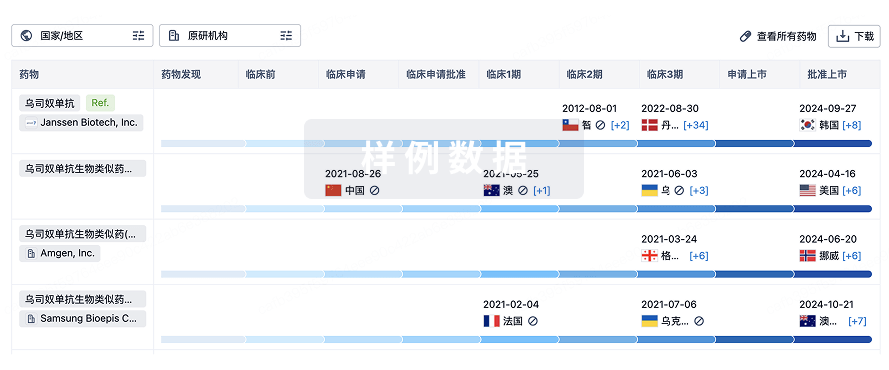
特殊审评
只需点击几下即可了解关键药物信息。
登录
或

提出任何生物医药研究问题
让每一步生物医药决策都精准制胜
基于十亿级生物数据与全球情报的精准 AI,赋能早期药物发现
立即开始免费试用!
智慧芽新药情报库是智慧芽专为生命科学人士构建的基于AI的创新药情报平台,助您全方位提升您的研发与决策效率。
立即接入生物医药数据包
智慧芽新药库数据也通过智慧芽开放平台,以MCP或API服务形式对外开放。立即使用我们的MCP服务定制您的LLM智能体。
生物序列数据库
生物药研发创新
免费使用
化学结构数据库
小分子化药研发创新
免费使用