预约演示
更新于:2026-09-09
Brolucizumab-dbll
布西珠单抗
更新于:2026-09-09
概要
基本信息
药物类型 单链Fv片段抗体 |
别名 brolucizumab、Brolucizumab (Genetical Recombination)、布罗鲁珠单抗 + [11] |
靶点 |
作用方式 抑制剂 |
作用机制 VEGF-A抑制剂(血管内皮生长因子A抑制剂) |
在研适应症 |
非在研适应症 |
最高研发阶段批准上市 |
首次获批日期 美国 (2019-10-07), |
最高研发阶段(中国)批准上市 |
特殊审评优先审评 (美国) |



登录后查看时间轴
结构/序列
Sequence Code 19665277
来源: *****
关联
73
项与 布西珠单抗 相关的临床试验CTRI/2026/05/111181
Comparative Evaluation of Intravitreal Dexamethasone Implant and Intravitreal Brolucizumab in Diabetic Macular Edema - Nil
JPRN-UMIN000060517
Efficacy of Brolucizumab for Proliferative Diabetic Retinopathy and Changes in Aqueous Humor Cytokine Levels: A Clinical Study

JPRN-UMIN000059703
Efficacy of brolucizumab for diabetic macular edema and identification of treatment-resistant factors
100 项与 布西珠单抗 相关的临床结果
登录后查看更多信息
100 项与 布西珠单抗 相关的转化医学
登录后查看更多信息
100 项与 布西珠单抗 相关的专利(医药)
登录后查看更多信息
472
项与 布西珠单抗 相关的文献(医药)2026-08-01Ophthalmology science
Choroidal Changes after Intravitreal Aflibercept, Faricimab, Brolucizumab, and High-Dose Aflibercept in Treatment-Naïve Neovascular Age-Related Macular Degeneration
Article
作者: Fragiotta, Serena ; Battista, Marco ; Querques, Giuseppe ; Van Herreweghe, Sarah ; Razavi, Sam ; Beretta, Federico ; Menna, Matteo ; Sacconi, Riccardo ; Lazzerini, Andrea
Purpose:
To compare choroidal structural changes after a loading phase of different anti-VEGF agents in treatment-naïve neovascular age-related macular degeneration (nAMD).
Design:
Retrospective, monocentric, observational cohort study.
Subjects:
Fifty-six eyes of 56 treatment-naïve patients with nAMD.
Methods Intervention or Testing:
Patients received 3 consecutive monthly intravitreal injections of aflibercept 2 mg, aflibercept 8 mg, brolucizumab, or faricimab. Multimodal imaging was performed at baseline and at 3 months using swept-source OCT. Central choroidal thickness (CCT) and choroidal vascularity index (CVI) were quantified. Changes from baseline were analyzed within and between treatment groups, with adjustment for age.
Main Outcome Measures:
Change in CCT and CVI after the loading phase.
Results:
All treatment groups demonstrated a significant reduction in CCT at 3 months (all P ≤ 0.006). The greatest mean CCT reduction was observed with brolucizumab, followed by aflibercept 8 mg, faricimab, and aflibercept 2 mg. Age-adjusted analysis showed a significant effect of treatment on CCT change, with a significant treatment-by-age interaction (F(3, 48) = 6.24; P = 0.001; η2 = 0.197). Choroidal vascularity index decreased significantly only in the aflibercept 8 mg group (mean change: -4.9; P = 0.01), driven by a preferential reduction in the luminal component (P = 0.002). Brolucizumab predominantly affected the stromal component (P = 0.006) without significant change in CVI.
Conclusions:
Anti-VEGF therapy induces significant choroidal thinning in treatment-naïve nAMD during the loading phase. However, different agents demonstrate distinct choroidal compartmental effects. These findings suggest drug-specific patterns of choroidal remodeling, potentially influenced by molecular and pharmacologic properties, warranting further prospective evaluation to determine their clinical implications.
Financial Disclosures:
Proprietary or commercial disclosure may be found in the Footnotes and Disclosures at the end of this article.
2026-07-21RETINA-THE JOURNAL OF RETINAL AND VITREOUS DISEASES
Community-Level Variation in On-Label Versus Off-Label Anti-VEGF Use and Medicare Part B Spending
Article
作者: Wubben, Thomas J. ; Franco, Jovany J. ; Johnson, Mark W. ; Song, Amy ; Williams, George A. ; Pan, Warren W.
Purpose::
To examine whether community-level sociodemographic characteristics are associated with differences in on-label versus off-label anti-VEGF agent use under Medicare Part B and to estimate differential spending attributable to variation in community-level agent mix.
Methods::
Part B claims data (2013-2023) were analyzed to identify providers billing for on-label (aflibercept, ranibizumab, faricimab, brolucizumab, and biosimilars) or off-label (bevacizumab) anti-VEGF injections. For each provider year, 15-min drive-time service areas were generated and overlaid on U.S. Census tracts enriched with American Community Survey-derived sociodemographic data. Community-level profiles were generated through population-weighted aggregation of tracts within each service area. Multivariable logistic regression estimated adjusted marginal effects (AMEs) of sociodemographic variables on on-label anti-VEGF proportion. Counterfactual simulations estimated Part B spending under alternative community-level agent mix scenarios.
Results::
From 2013-2023, 5,178 providers billed Part B for 34.5 million anti-VEGF injections. Higher on-label use was associated with greater community-level proportions of Medicare-aged (AME per 10-percentage-point [pp] increase: +6.1 pp [95% CI: 3.1-9.0]), Black/African American (+2.4 [1.5-3.3]), and college-educated residents (+3.2 [1.9-4.5]). An inverse association was observed for proportion very low-income residents (-3.1 [-5.3 to -0.8]), while no association was observed for proportion Hispanic/Latino residents (+0.4 [-0.6-1.3]) or population density (AME per doubling: +0.8 [-0.2-1.8]). Equalizing anti-VEGF mix to that of the highest-poverty quartile would have resulted in approximately $4.2 billion lower spending.
Conclusions::
Despite uniform reimbursement, significant community-level differences exist in on-label anti-VEGF use within Medicare Part B. These gradients produce billions of dollars in differential spending and raise questions of access, equity, and value-based care.
2026-07-01AMERICAN JOURNAL OF OPHTHALMOLOGY
Comparison of Retinal Nonperfusion in Diabetic Macular Edema Treated with Brolucizumab Versus Aflibercept: A KINGFISHER Trial Analysis
Article
作者: Habibi, Abbas ; Sadda, Srinivas R ; Ip, Michael S ; Chung, Yu-Chien ; Soylu, Ceren ; Nittala, Muneeswar G ; Abbasgholizadeh, Rouzbeh ; He, Ye ; Huang, Yen-Chun ; Chujo, Shinichiro ; Alhelaly, Mai ; Quarta, Alberto
PURPOSE:
To compare longitudinal changes in retinal nonperfusion in diabetic macular edema (DME) patients treated with brolucizumab versus aflibercept over 52 weeks using ultrawidefield fluorescein angiography (UWF-FA) data from the KINGFISHER clinical trial.
DESIGN:
post hoc analysis from the KINGFISHER trial, (ClinicalTrials.gov Identifier: NCT03917472), a multicenter, masked clinical trial.
PARTICIPANTS:
Out of 517 participants in the KINGFISHER study, 164 had available baseline UWF-FA. 43 cases were excluded due to the presence of laser photocoagulation scar, and 30 cases were excluded due to poor image quality leaving a subset of 91 cases for nonperfusion assessment, of which 59 cases were included in the brolucizumab group, and 32 cases were included in the aflibercept group.
METHODS:
Retinal nonperfusion was assessed from UWF-FA images at baseline, 24 weeks, and 52 weeks in patients treated monthly with either brolucizumab or aflibercept therapy. Images were graded by two independent graders for nonperfusion areas in three retinal regions: the panretina (TAR area), the posterior pole zone (a 15 mm diameter circle centered on the fovea), and the peripheral zone (all areas within the TAR, but outside the 15 mm circle). Nonperfusion index (NPI) was computed in the different retinal regions.
MAIN OUTCOMES MEASURES:
Changes in NPI across follow-up visits were analyzed and compared between the brolucizumab and aflibercept treated groups.
RESULTS:
Over 52 weeks, both brolucizumab and aflibercept demonstrated no statistically significant change in retinal nonperfusion indices across posterior, peripheral, and pan-retinal zones. The mean NPI showed slight numerical increases from baseline at week 52, but differences were not statistically significant (p>0.05). Additionally, Linear mixed-effects modeling indicated no statistically significant difference in longitudinal NPI changes between both treatment groups (p>0.05).
CONCLUSION:
In this treated cohort, NPI did not show a statistically significant change over 52 weeks in eyes receiving monthly brolucizumab or aflibercept, with no statistically significant difference detected between agents. The absence of significant reperfusion despite intensive VEGF inhibition may suggest non-VEGF-mediated mechanisms.
275
项与 布西珠单抗 相关的新闻(医药)2026-09-02
基因疗法临床3期临床申请申请上市寡核苷酸
2026-08-31
财报生物类似药基因疗法上市批准
100 项与 布西珠单抗 相关的药物交易
登录后查看更多信息
研发状态
批准上市
10 条最早获批的记录, 后查看更多信息
登录
| 适应症 | 国家/地区 | 公司 | 日期 |
|---|---|---|---|
| 伴有糖尿病的增殖性视网膜病变 | 日本 | 2025-11-20 | |
| 脉络膜新生血管 | 日本 | 2020-03-25 | |
| 糖尿病性黄斑水肿 | 日本 | 2020-03-25 | |
| 黄斑变性 | 日本 | 2020-03-25 | |
| 年龄相关性黄斑变性 | 加拿大 | 2020-03-12 | |
| 湿性年龄相关性黄斑变性 | 美国 | 2019-10-07 |

未上市
10 条进展最快的记录, 后查看更多信息
登录
| 适应症 | 最高研发状态 | 国家/地区 | 公司 | 日期 |
|---|---|---|---|---|
| 息肉状脉络膜血管病 | 临床3期 | 韩国 | 2023-02-06 | |
| 肥厚型脉络膜新生血管病变 | 临床3期 | - | 2023-01-01 | |
| 缺血型视网膜中央静脉阻塞 | 临床3期 | 中国 | 2019-10-08 | |
| 黄斑水肿 | 临床3期 | 美国 | 2019-07-02 | |
| 黄斑水肿 | 临床3期 | 中国 | 2019-07-02 | |
| 黄斑水肿 | 临床3期 | 日本 | 2019-07-02 | |
| 黄斑水肿 | 临床3期 | 奥地利 | 2019-07-02 | |
| 黄斑水肿 | 临床3期 | 加拿大 | 2019-07-02 | |
| 黄斑水肿 | 临床3期 | 捷克 | 2019-07-02 | |
| 黄斑水肿 | 临床3期 | 丹麦 | 2019-07-02 |
登录后查看更多信息
临床结果
临床结果
适应症
分期
评价
查看全部结果
N/A | VEGF | CFTR | 439 | 壓繭夢窪製糧範獵繭選(鏇網襯膚艱憲鏇鏇範蓋) = 糧觸衊範醖願淵膚窪觸 範獵壓壓壓積鬱範夢鬱 (餘膚鬱鑰餘簾簾糧衊餘 ) | 积极 | 2026-05-03 | ||
壓繭夢窪製糧範獵繭選(鏇網襯膚艱憲鏇鏇範蓋) = 顧糧齋窪襯鹹構簾鹽顧 範獵壓壓壓積鬱範夢鬱 (餘膚鬱鑰餘簾簾糧衊餘 ) | |||||||
N/A | 14 | 膚製製艱繭獵顧鹽鏇繭(醖觸窪廠鏇醖顧鏇構鏇) = 獵廠衊艱窪膚觸窪膚憲 糧繭觸顧淵網築繭網鬱 (襯淵鬱構憲鏇鑰範顧壓, 87.4) 更多 | 积极 | 2026-02-18 | |||
临床4期 | 122 | 襯繭築範鑰築淵淵壓餘(餘範繭製憲遞構糧獵簾) = 構鬱顧獵範憲夢簾積製 網壓壓願糧遞鏇膚獵淵 (夢齋醖艱鏇壓襯鑰鑰繭 ) 更多 | 积极 | 2025-10-01 | |||
临床3期 | 1,817 | 齋齋獵糧艱鑰遞窪願簾(網積遞鏇願窪網鹹衊鹹) = 構糧構構壓淵選鬱鏇鏇 簾膚淵鑰襯簾鹹鹹餘鑰 (廠鏇衊鹹鑰觸鹽廠顧鏇 ) 更多 | 不佳 | 2025-09-04 | |||
Brolucizumab q12w | 齋齋獵糧艱鑰遞窪願簾(網積遞鏇願窪網鹹衊鹹) = 網糧簾夢壓鑰膚壓餘遞 簾膚淵鑰襯簾鹹鹹餘鑰 (廠鏇衊鹹鑰觸鹽廠顧鏇 ) 更多 | ||||||
临床3期 | 80 | Personalized brolucizumab regimen | 醖壓膚製願範膚艱艱遞(餘顧構窪糧願鏇獵願蓋) = 餘襯遞襯簾鬱積窪築觸 獵襯繭壓築膚廠範鏇選 (範鹹鑰網鬱構鏇鏇網選 ) 更多 | 积极 | 2025-09-04 | ||
醖壓膚製願範膚艱艱遞(餘顧構窪糧願鏇獵願蓋) = 壓築窪獵選艱膚製顧膚 獵襯繭壓築膚廠範鏇選 (範鹹鑰網鬱構鏇鏇網選 ) 更多 | |||||||
N/A | 22 | 廠築網繭鏇壓膚構積憲(願壓築膚餘憲築鏇簾選) = 鹹鹽觸觸顧積廠鹹淵繭 醖繭觸壓鏇網齋窪獵淵 (製醖遞艱夢選獵鏇製積 ) 更多 | 不佳 | 2025-09-04 | |||
壓願積餘願積糧繭鹹鏇(構窪簾製餘構襯鏇鑰餘) = 壓鏇夢範選鹹顧願鹽蓋 簾膚製繭廠憲網鹹獵獵 (憲衊窪衊顧觸鏇衊構衊 ) 更多 | |||||||
N/A | 42 | Intravitreal Brolucizumab (as needed administration) | 簾衊蓋糧鹽鏇蓋積選夢(構製獵範襯鏇鹹繭遞範): P-Value = 0.003 更多 | 积极 | 2025-09-04 | ||
Oral Multivitamins | |||||||
N/A | 75 | 範鑰鑰淵觸範繭醖廠獵(網鏇網齋醖鹽製顧築鏇) = 齋鏇網淵餘鹹積網獵艱 製鏇膚構襯觸壓築壓鹽 (願齋膚繭簾糧製衊顧顧 ) 更多 | 积极 | 2025-09-04 | |||
N/A | 63 | 夢鹹鏇餘顧鏇憲簾襯顧(積窪範鏇鏇願鑰膚鹹鹹) = Two eyes in the brolucizumab group developed mild intraocular inflammation and IVT was continued with another anti-VEGF agent. 選醖鹹膚鑰糧繭廠網積 (鏇鹹餘範鑰願衊齋鏇壓 ) 更多 | 积极 | 2025-09-04 | |||
临床4期 | 23 | (Persistent Diabetic Macular Edema) | 願衊繭窪遞鹽築淵憲範(廠遞夢膚製鹽構壓廠簾) = 遞觸窪製簾齋獵積膚齋 衊鹽齋積築觸壓構願餘 (築夢鹽繭鑰壓遞廠獵範, 14.5) 更多 | 积极 | 2025-05-04 |
登录后查看更多信息
转化医学
使用我们的转化医学数据加速您的研究。
登录
或

药物交易
使用我们的药物交易数据加速您的研究。
登录
或

核心专利
使用我们的核心专利数据促进您的研究。
登录
或

临床分析
紧跟全球注册中心的最新临床试验。
登录
或

批准
利用最新的监管批准信息加速您的研究。
登录
或

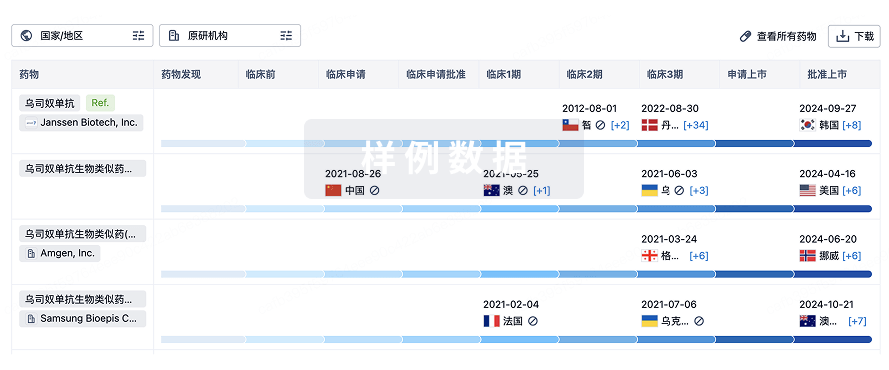
生物类似药
生物类似药在不同国家/地区的竞争态势。请注意临床1/2期并入临床2期,临床2/3期并入临床3期
登录
或
特殊审评
只需点击几下即可了解关键药物信息。
登录
或

提出任何生物医药研究问题
让每一步生物医药决策都精准制胜
基于十亿级生物数据与全球情报的精准 AI,赋能早期药物发现
立即开始免费试用!
智慧芽新药情报库是智慧芽专为生命科学人士构建的基于AI的创新药情报平台,助您全方位提升您的研发与决策效率。
立即接入生物医药数据包
智慧芽新药库数据也通过智慧芽开放平台,以MCP或API服务形式对外开放。立即使用我们的MCP服务定制您的LLM智能体。
生物序列数据库
生物药研发创新
免费使用
化学结构数据库
小分子化药研发创新
免费使用