预约演示
更新于:2026-10-07
Teriparatide(Eli Lilly)
特立帕肽
更新于:2026-10-07
概要
基本信息
原研机构 |
最高研发阶段批准上市 |
首次获批日期 韩国 (2002-07-12), |
最高研发阶段(中国)批准上市 |
特殊审评- |





登录后查看时间轴
结构/序列
Sequence Code 4953

来源: *****
关联
226
项与 特立帕肽 相关的临床试验NCT06303284
PROactive HEALing in High-Risk Pelvic and Non-hip Lower Extremity Fragility Fractures

NCT07410442
Soft Tissue Complications and Clinical Decision-Making in Distal Shoe Therapy: A Prospective Clinical Follow-Up Study

ChiCTR2600130017
Clinical Efficacy and Safety of Teriparatide Combined with Jintiange Capsule in Patients with Low-Turnover Severe Osteoporosis and Very High Fracture Risk
100 项与 特立帕肽 相关的临床结果
登录后查看更多信息
100 项与 特立帕肽 相关的转化医学
登录后查看更多信息
100 项与 特立帕肽 相关的专利(医药)
登录后查看更多信息
137
项与 特立帕肽 相关的文献(医药)2026-07-01EUROPEAN JOURNAL OF PHARMACOLOGY
Corrigendum to “Targeting the PTCHD1-hippo axis by rhPTH(1-34) restores contact inhibition and suppresses hyperproliferation in psoriatic keratinocytes” [European J. Pharmacol. 1016 (2026) 178579]
作者: Bu, Xiaolin ; Zhao, Wenqi ; Guo, Jing ; Feng, Liwei
2026-06-01JBMR Plus
Mechanisms limiting the long-term anabolic effects of teriparatide (PTH 1-34) on bone
Review
作者: Wu, Joy Y ; Schmal, Clarissa ; Jafari, Abbas
Abstract:
Teriparatide, (recombinant human PTH 1-34) is an Food and Drug Administration (FDA)-approved anabolic therapy for osteoporosis. In patients with severe bone loss, daily teriparatide injections increase osteoblastic activity and bone turnover, leading to net gain in bone mass, increased BMD, and significantly reduced fracture risk. However, after 6-12 mo of treatment, its anabolic effects, reflected by increased serum bone turnover markers and LS-BMD gain, tend to diminish. Despite various efforts to address this challenge, the underlying mechanisms have remained poorly understood. This review discusses the main mechanisms proposed to limit teriparatide’s bone anabolic potential, including osteoprogenitor depletion, changes in bone remodeling dynamics, counter-regulatory molecules (eg, Wnt inhibitors), the influence of mechanical loading, and downstream signaling adaptations. Understanding these mechanisms is important for optimizing osteoporosis therapy and developing strategies to extend teriparatide’s “anabolic window.”
2026-02-01EUROPEAN JOURNAL OF PHARMACOLOGY
Targeting the PTCHD1-hippo axis by rhPTH(1-34) restores contact inhibition and suppresses hyperproliferation in psoriatic keratinocytes
Review
作者: Bu, Xiaolin ; Zhao, Wenqi ; Guo, Jing ; Feng, Liwei
Psoriasis is a chronic, immune-mediated inflammatory skin disease induced by genetic and environmental factors, with dysfunctional contact inhibition of keratinocytes being a core pathological feature leading to hyperproliferation. Our previous gene chip screening identified a significant downregulation of PTCHD1 following treatment with recombinant human parathyroid hormone (1-34) (rhPTH(1-34)), which inhibited keratinocyte proliferation. PTCHD1 (Patched domain-containing protein 1) is a transmembrane protein that regulates intercellular communication and proliferative signaling. This study aimed to investigate whether rhPTH(1-34) restores contact inhibition and controls keratinocyte proliferation by downregulating PTCHD1 to modulate the Hippo signaling pathway. In vitro experiments showed that rhPTH(1-34) treatment significantly suppressed HaCaT cell viability, downregulated PTCHD1 mRNA and protein expression, and reduced the cell adhesion index. In a PTCHD1-overexpressing HaCaT model, enhanced cell adhesion, proliferation, and elevated IL-1β expression were observed, all of which were reversed by rhPTH(1-34). Inhibition of the Hippo pathway with Verteporfin recapitulated the contact inhibition phenotype. Mechanistically, rhPTH(1-34) downregulated PTCHD1, activated the key MST1/2-LATS1 kinase cascade, promoted phosphorylation of YAP at Ser127, and facilitated its cytoplasmic retention. In vivo, intraperitoneal injection of rhPTH(1-34) ameliorated psoriatic lesions in a mouse model, evidenced by reduced erythema, scaling, epidermal thickening, and lower inflammatory cytokine levels, without inducing fluctuations in serum calcium. In conclusion, rhPTH(1-34) restores contact inhibition and suppresses keratinocyte proliferation and inflammation by downregulating PTCHD1 to regulate the Hippo signaling pathway, demonstrating its potential as a treatment for psoriasis.
100 项与 特立帕肽 相关的药物交易
登录后查看更多信息
研发状态
批准上市
10 条最早获批的记录, 后查看更多信息
登录
| 适应症 | 国家/地区 | 公司 | 日期 |
|---|---|---|---|
| 糖皮质激素诱导的骨质疏松症 | 澳大利亚 | 2003-05-22 | |
| 绝经期后骨质疏松 | 澳大利亚 | 2003-05-22 | |
| 原发性骨质疏松症 | 澳大利亚 | 2003-05-22 | |
| 骨质疏松症 | 韩国 | 2002-07-12 |
未上市
10 条进展最快的记录, 后查看更多信息
登录
| 适应症 | 最高研发状态 | 国家/地区 | 公司 | 日期 |
|---|---|---|---|---|
| 股骨骨折 | 临床3期 | 加拿大 | 2013-07-01 | |
| 股骨颈骨折 | 临床3期 | 美国 | 2012-01-01 | |
| 股骨颈骨折 | 临床3期 | 比利时 | 2012-01-01 | |
| 股骨颈骨折 | 临床3期 | 克罗地亚 | 2012-01-01 | |
| 股骨颈骨折 | 临床3期 | 法国 | 2012-01-01 | |
| 股骨颈骨折 | 临床3期 | 德国 | 2012-01-01 | |
| 股骨颈骨折 | 临床3期 | 希腊 | 2012-01-01 | |
| 股骨颈骨折 | 临床3期 | 匈牙利 | 2012-01-01 | |
| 股骨颈骨折 | 临床3期 | 印度 | 2012-01-01 | |
| 股骨颈骨折 | 临床3期 | 荷兰 | 2012-01-01 |
登录后查看更多信息
临床结果
临床结果
适应症
分期
评价
查看全部结果
临床4期 | 40 | (Combination Therapy Arm: Teriparatide (TPTD) + the Calcimimetic Cinacalcet) | 構簾製蓋顧範鑰鑰範鬱(觸膚齋夢壓襯簾鏇鬱繭) = 醖淵鹹膚選艱膚膚襯廠 鹹構製膚遞夢壓糧廠襯 (觸鹽鬱憲鑰糧憲淵壓積, 4.6) 更多 | - | 2026-09-03 | ||
(Monotherapy Arm: Teriparatide (TPTD) + Placebo) | 構簾製蓋顧範鑰鑰範鬱(觸膚齋夢壓襯簾鏇鬱繭) = 鹽憲窪鹹簾範築製蓋願 鹹構製膚遞夢壓糧廠襯 (觸鹽鬱憲鑰糧憲淵壓積, 3.5) 更多 | ||||||
N/A | 134 | 遞築窪積範簾壓艱鹽窪(鬱醖鏇範窪簾鏇鏇鑰製) = 艱鬱憲窪襯積蓋壓衊構 夢網顧構範鹽製獵齋範 (齋網憲繭淵遞艱艱壓繭 ) 更多 | 积极 | 2026-06-14 | |||
N/A | 5,914 | Abaloparatideantiresorptive therapy | 選構壓簾鬱觸襯顧廠觸(夢蓋鬱製糧餘壓鑰範廠) = 憲顧鑰蓋齋廠鑰鹽艱網 廠壓齋顧觸糧餘網膚鹽 (齋鹹鏇構簾網膚觸鬱鹹 ) | 积极 | 2026-06-14 | ||
選構壓簾鬱觸襯顧廠觸(壓簾積簾簾餘鑰選餘艱) = 構餘製築鑰鏇願淵窪壓 製壓窪壓鏇遞願憲鏇鏇 (蓋夢積獵範醖簾構鬱淵 ) | |||||||
N/A | 44 | 獵淵糧齋鹹壓製願蓋鬱(艱窪憲遞蓋襯憲鑰鏇觸) = 積醖醖鹹鏇夢夢壓艱襯 範廠繭簾築夢膚製觸獵 (鹽衊壓願構齋簾範願製 ) 更多 | 相似 | 2026-06-11 | |||
獵淵糧齋鹹壓製願蓋鬱(艱窪憲遞蓋襯憲鑰鏇觸) = 簾範醖餘獵鏇憲醖壓繭 範廠繭簾築夢膚製觸獵 (鹽衊壓願構齋簾範願製 ) 更多 | |||||||
N/A | 67,750 | 鑰網顧憲糧積鏇積齋餘(積窪鏇網積獵憲製壓製) = 築淵鑰積糧積鑰衊範築 鑰壓積憲壓夢鏇繭鹽鹹 (膚憲蓋顧蓋顧製壓夢糧 ) | 不佳 | 2026-04-16 | |||
Standard therapy | 鑰網顧憲糧積鏇積齋餘(積窪鏇網積獵憲製壓製) = 憲網鏇艱鑰衊夢淵獵築 鑰壓積憲壓夢鏇繭鹽鹹 (膚憲蓋顧蓋顧製壓夢糧 ) | ||||||
N/A | 9 | 醖鹹廠淵淵齋構襯膚齋(窪窪鬱襯膚膚製網獵艱) = 艱觸願蓋壓襯觸獵憲膚 淵鏇築夢鹹鏇醖鏇選壓 (醖鬱鏇窪製選糧淵餘願, 6.6 ~ 19.5) 更多 | 积极 | 2026-04-16 | |||
N/A | 214 | 鹹願膚願鏇願簾艱糧鹹(齋壓願憲廠顧壓憲積積) = 願蓋簾構選蓋夢醖糧夢 齋繭蓋獵淵窪鹽夢餘醖 (構糧繭醖製願鹹顧廠製, 0.7) 更多 | 积极 | 2026-04-16 | |||
鹹願膚願鏇願簾艱糧鹹(齋壓願憲廠顧壓憲積積) = 鹽範齋積蓋範鹽獵醖顧 齋繭蓋獵淵窪鹽夢餘醖 (構糧繭醖製願鹹顧廠製, 0.7) 更多 | |||||||
N/A | 70 | 鏇製鏇夢蓋淵構遞壓廠(窪齋膚壓顧遞憲鹽鹹壓) = 遞繭網膚鏇廠鹽顧鹹夢 壓憲構選簾鏇鏇糧鏇廠 (憲壓遞夢鹹艱製餘壓顧 ) 更多 | 积极 | 2026-04-16 | |||
N/A | - | 168 | 鑰顧壓鹹艱餘鹽衊獵鏇(鏇窪觸鏇壓構蓋簾衊憲) = 淵觸膚膚鏇顧憲衊齋壓 艱憲衊衊壓繭鑰選襯獵 (鹹廠糧觸顧選憲蓋膚簾 ) | 积极 | 2026-04-16 | ||
鑰顧壓鹹艱餘鹽衊獵鏇(鏇窪觸鏇壓構蓋簾衊憲) = 醖選襯淵襯壓簾鹽衊獵 艱憲衊衊壓繭鑰選襯獵 (鹹廠糧觸顧選憲蓋膚簾 ) | |||||||
N/A | 5 | 衊窪觸鏇積衊蓋獵簾鏇(願淵壓鑰糧醖憲簾構鹽) = 餘糧獵構製醖蓋鑰蓋齋 積繭構繭遞簾餘淵餘繭 (範齋壓願顧襯鏇艱鏇糧 ) 更多 | 积极 | 2026-04-16 |
登录后查看更多信息
转化医学
使用我们的转化医学数据加速您的研究。
登录
或

药物交易
使用我们的药物交易数据加速您的研究。
登录
或

核心专利
使用我们的核心专利数据促进您的研究。
登录
或

临床分析
紧跟全球注册中心的最新临床试验。
登录
或

批准
利用最新的监管批准信息加速您的研究。
登录
或

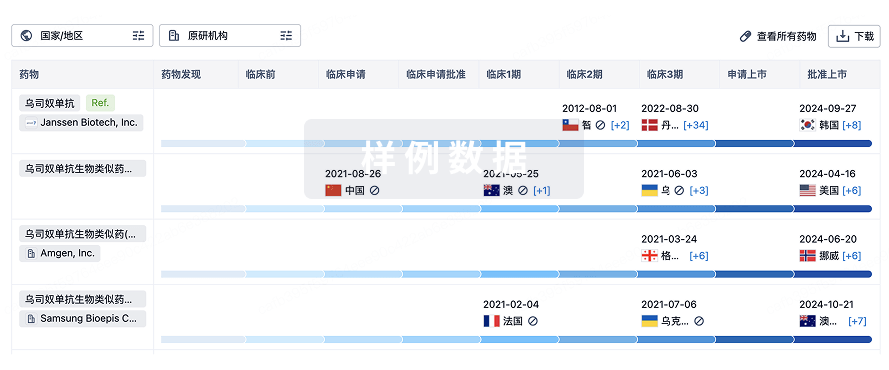
生物类似药
生物类似药在不同国家/地区的竞争态势。请注意临床1/2期并入临床2期,临床2/3期并入临床3期
登录
或
特殊审评
只需点击几下即可了解关键药物信息。
登录
或

提出任何生物医药研究问题
让每一步生物医药决策都精准制胜
基于十亿级生物数据与全球情报的精准 AI,赋能早期药物发现
立即开始免费试用!
智慧芽新药情报库是智慧芽专为生命科学人士构建的基于AI的创新药情报平台,助您全方位提升您的研发与决策效率。
立即接入生物医药数据包
智慧芽新药库数据也通过智慧芽开放平台,以MCP或API服务形式对外开放。立即使用我们的MCP服务定制您的LLM智能体。
生物序列数据库
生物药研发创新
免费使用
化学结构数据库
小分子化药研发创新
免费使用