预约演示
更新于:2026-09-08
Corifollitropin alfa
更新于:2026-09-08
概要
基本信息
权益机构- |
最高研发阶段批准上市 |
最高研发阶段(中国)- |
特殊审评- |


登录后查看时间轴
结构/序列
Sequence Code 3246
来源: *****
Sequence Code 213652
来源: *****
关联
66
项与 Corifollitropin alfa 相关的临床试验IRCT20241127063873N1
Project title: Comparing the Efficacy of Different Elonva (Corifollitropin Alfa) Protocols in Poor Responders undergoing IVF cycles: Follicular Phase Start vs. Luteal Phase Start, and the Double dose Elonva

NCT06193135
Usefulness of Corifollitropin α as Alternative to Conventional Daily rFSH Protocols in Oocyte Donors Undergoing Pituitary Suppression With Medroxiprogesterona Acetate (MPA)
NCT06175832
PPOS and CFA for Elective Freeze-all Ovarian Stimulation Cycles: a Prospective Cross-over Study

100 项与 Corifollitropin alfa 相关的临床结果
登录后查看更多信息
100 项与 Corifollitropin alfa 相关的转化医学
登录后查看更多信息
100 项与 Corifollitropin alfa 相关的专利(医药)
登录后查看更多信息
1,295
项与 Corifollitropin alfa 相关的文献(医药)2026-12-01BIORESOURCE TECHNOLOGY
Influence of coffee-derived phenolic compounds, initial loading, and biochar on anaerobic digestion of coffee pulp
Article
作者: Manoni Mshandete, Anthony ; Mahamoud Said, Seleman ; Ghofrani-Isfahani, Parisa ; Kajumulo Kivaisi, Amelia ; Lazaro Machunda, Revocatus ; Angelidaki, Irini
Coffee pulp (CP), a by-product of wet coffee-cherry processing, contains organic matter suitable for biogas production through anaerobic digestion (AD). However, its high phenolic content may influence methane production. Batch digestion assays using whole CP, individual phenolic compounds [5-O-caffeoylquinic acid (5-CQA) and caffeic acid (CFA)], and CP phenolic extract were conducted under mesophilic conditions. Co-digestion experiments with Avicel microcrystalline cellulose and ethanol were performed to evaluate phenolic interactions with degradable substrates. Increasing initial loading (2-12 g VS/L) reduced methane yields from CP by approximately 20%, due to substrate overloading and transient volatile fatty acid accumulation, whereas lower loadings (2-4 g VS/L) supported rapid and stable methane production at inoculum-to-substrate ratios ≥ 2.0:1. Both 5-CQA and CFA were anaerobically biodegradable and contributed to methane formation during co-digestion. Ethanol digestion exhibited high tolerance to phenolic compounds, showing additive or synergistic interactions, whereas cellulose digestion was more sensitive, with prolonged lag phases and increasing antagonistic effects, particularly in the presence of CFA. CP phenolic extract produced lower methane yields than comparable systems supplemented with pure 5-CQA, indicating that inhibition resulted from combined effects of multiple phenolic constituents rather than individual compounds. At the tested dosage of 5 g/L, woody green-waste biochar did not improve methane production across the evaluated CP loadings, suggesting that the dominant process constraints were not alleviated under the investigated conditions. Overall, methane production under batch conditions was governed primarily by initial loading, phenolic composition, and substrate type, whereas biochar addition at the tested dosage had no effect.
2026-12-01BIORESOURCE TECHNOLOGY
Effects of coal fly ash pretreatment on fibre degradability and enhanced solid-state anaerobic digestion of lignocellulosic biomass
Article
作者: Grimes, Sue ; Dewiandratika, Maryam ; Smith, Stephen
Coal fly ash (CFA) is an alkali waste generated in large quantities by the power generation industry. Lignocellulosic biomass (LB) is also a significant, globally problematic waste stream. Alkali pretreatment of LB by CFA, to reduce the recalcitrance of LB before anaerobic digestion (AD), has the potential to beneficially utilise both waste streams, provide a major renewable energy source, and reduce the risks of groundwater and soil contamination associated with CFA stockpiling. Controlled, laboratory microcosm experiments were conducted to examine the effectiveness of CFA as an alkali pretreatment and alternative to calcium oxide (CaO) and sodium hydroxide (NaOH) for AD of LB. The AD experiments were conducted under solid-state conditions at 15% total solids (TS) in 1 L borosilicate glass chemostat reactors. Coal fly ash pretreatment increased methane (CH4) yield by 93% and 39% compared to a water-pretreated control and equivalent alkalinity supplied by CaO alone (CaO pretreatment), respectively. In addition, CFA pretreatment, followed by AD, resulted in a twofold greater reduction in total fibre than CaO pretreatment, consistent with increased CH4 yield, hydrolysis rate (27%), and volatile solids (VS) removal (29%). A consistent increase in CH4 yield (32%) was also achieved when CFA was added after CaO pretreatment of LB, before AD. These results indicated the positive role of CFA in AD of LB extended beyond an alkali pretreatment effect.
2026-08-01BIOTECHNOLOGY AND BIOENGINEERING
Engineering a Novel Cofactor‐Versatile Short‐Chain Dehydrogenase for Efficient Synthesis of Chiral Alcohols
Article
作者: Mao, Hui‐Qi ; Ye, Yuan‐Fan ; Xue, Feng ; Xue, Bin ; Wang, Ya‐Jun ; Yao, Li‐Li ; Huang, Kai‐Cheng ; Song, Xian‐Heng ; Wan, Yan‐Jun
ABSTRACT:
Short‐chain dehydrogenases/reductases (SDRs) are widely used for the asymmetric synthesis of chiral alcohols, which are critical building blocks in pharmaceutical manufacturing. In this study, a novel SDR from
Bacillus subtilis
(
Bs
SDR) was identified and engineered for the asymmetric synthesis of (
S
)−1‐(2,6‐dichloro‐3‐fluorophenyl)ethanol ((
S
)‐CFL). By integrating in silico molecular docking with FuncLib based design, a focused mutant library of
Bs
SDR targeting key hotpots was constructed. Four of the constructed 31 variants exhibited markedly enhanced activity. Subsequent combinatorial mutagenesis generated a “best” variant
Bs
SDR
M2
(I178L/T179L), which displayed a 107.4‐fold increase in catalytic activity, along with excellent enantioselectivity (> 99.9%
e.e
.) and broad substrate scope. Notably, unlike most SDRs that are strictly dependent on NAD(H) or NADP(H), the
Bs
SDR also possesses a remarkable capacity to utilize the noncanonical cofactor NMNH. Moreover, in addition to robust enantioselective reductive activity toward CFA, the
Bs
SDR also exhibits glucose‐oxidizing activity, driving cofactors regeneration. In the presence of NMNH,
Bs
SDR
M2
displayed a 33.3‐fold improvement in catalytic efficiency (
kcat
/
KM
) toward substrate 1‐(2,6‐dichloro‐3‐fluorophenyl)ethanone (CFA) compared to the wild‐type (WT), along with an extended half‐life (
t1/2
) of 52.1 h at 45°C. Using
Escherichia coli
expressing
Bs
SDR
M2
as the only biocatalyst and glucose as the cosubstrate, 100 g/L CFA was reduced within 6 h in 92.1% conversion and > 99.9%
e.e
., achieving a space‐time yield (STY) of 368.2 g/(L·d). This work highlights the potential of
Bs
SDR as a cost‐effective and sustainable biocatalyst for the efficient synthesis of (
S
)‐CFL and other high‐value chiral alcohols.
100 项与 Corifollitropin alfa 相关的药物交易
登录后查看更多信息
外链
| KEGG | Wiki | ATC | Drug Bank |
|---|---|---|---|
| D08895 | Corifollitropin alfa |
研发状态
批准上市
10 条最早获批的记录, 后查看更多信息
登录
| 适应症 | 国家/地区 | 公司 | 日期 |
|---|---|---|---|
| 性腺机能减退 | 欧盟 | 2010-01-25 | |
| 性腺机能减退 | 冰岛 | 2010-01-25 | |
| 性腺机能减退 | 列支敦士登 | 2010-01-25 | |
| 性腺机能减退 | 挪威 | 2010-01-25 | |
| 女性不孕症 | 欧盟 | 2010-01-25 | |
| 女性不孕症 | 冰岛 | 2010-01-25 | |
| 女性不孕症 | 列支敦士登 | 2010-01-25 | |
| 女性不孕症 | 挪威 | 2010-01-25 |
未上市
10 条进展最快的记录, 后查看更多信息
登录
| 适应症 | 最高研发状态 | 国家/地区 | 公司 | 日期 |
|---|---|---|---|---|
| 多内分泌代谢卵巢综合征 | 临床3期 | 比利时 | 2017-11-01 | |
| 无精子症 | 临床3期 | - | 2013-02-11 | |
| 血色素沉着症 | 临床3期 | - | 2013-02-11 | |
| 继发性睾丸衰竭 | 临床3期 | - | 2013-02-11 | |
| 不孕 | 临床3期 | - | 2006-09-26 | |
| 卵巢刺激 | 临床3期 | - | 2006-06-27 | |
| 人工授精相关并发症 | 临床2期 | - | 2003-05-19 | |
| 女性不育伴无排卵 | 临床2期 | - | 2001-08-01 |
登录后查看更多信息
临床结果
临床结果
适应症
分期
评价
查看全部结果
临床4期 | - | 30 | (Study Group) | 衊衊廠艱鏇顧積網築範(鬱築構繭願繭簾鬱觸艱) = 廠積願憲鹽願鑰獵襯鬱 繭願艱夢製蓋鏇願憲網 (製網獵艱鏇膚願顧範淵, 6.904) 更多 | - | 2025-05-18 | |
Human follicle stimulating hormone+Follitropin Alfa (Control Group) | 衊衊廠艱鏇顧積網築範(鬱築構繭願繭簾鬱觸艱) = 窪糧獵醖齋壓鏇淵構糧 繭願艱夢製蓋鏇願憲網 (製網獵艱鏇膚願顧範淵, 6.105) 更多 | ||||||
临床3期 | 17 | 顧廠淵衊獵積築鑰範選(壓廠網餘鏇遞鏇製憲繭) = 窪齋膚襯範簾艱觸鏇鏇 鏇衊夢艱醖鏇廠艱艱簾 (醖醖淵襯醖廠窪憲襯艱, 0.7) 更多 | - | 2021-04-08 | |||
临床4期 | 113 | Corifollitropin-α late-start | 廠壓遞鹽衊選獵願鏇製(鬱網製網鏇廠鬱繭鑰觸) = 餘顧願窪襯遞醖艱遞蓋 壓繭艱鏇鏇遞襯製衊醖 (獵積醖淵鏇遞壓醖顧顧 ) 更多 | 积极 | 2020-05-01 | ||
Corifollitropin-α standard start | 廠壓遞鹽衊選獵願鏇製(鬱網製網鏇廠鬱繭鑰觸) = 鏇膚觸鑰觸構淵齋鹹積 壓繭艱鏇鏇遞襯製衊醖 (獵積醖淵鏇遞壓醖顧顧 ) 更多 | ||||||
N/A | 113 | CFα late-start | 顧鏇築衊鹽憲壓齋鏇艱(壓願醖鏇鹽願繭網衊齋) = 製選糧襯糧範獵選顧觸 糧觸鑰願範製淵壓觸構 (窪醖鬱蓋簾淵範鏇蓋鑰 ) 更多 | - | 2020-05-01 | ||
CFα standard start | 顧鏇築衊鹽憲壓齋鏇艱(壓願醖鏇鹽願繭網衊齋) = 壓膚衊築構製窪蓋選窪 糧觸鑰願範製淵壓觸構 (窪醖鬱蓋簾淵範鏇蓋鑰 ) | ||||||
临床4期 | 70 | rFSH+Elonva (Study Group) | 膚網糧齋構製衊鑰築廠(艱醖築遞齋蓋衊獵鹹衊) = 製壓構艱鹹遞鏇選積積 壓鏇餘繭壓鹹鑰鏇鬱範 (淵鏇醖鏇淵膚膚鑰願壓, 7.5) 更多 | - | 2018-11-26 | ||
rFSH+Elonva (Control Group) | 膚網糧齋構製衊鑰築廠(艱醖築遞齋蓋衊獵鹹衊) = 鹹糧糧夢鹽餘衊範願鹽 壓鏇餘繭壓鹹鑰鏇鬱範 (淵鏇醖鏇淵膚膚鑰願壓, 7.4) 更多 | ||||||
临床3期 | - | 152 | 艱窪繭衊願選鹹繭餘遞(蓋鏇顧獵鏇窪鬱齋壓鑰) = 網獵鏇壓廠網願構繭膚 願範選夢獵網顧遞選廠 (鑰範製憲鬱網醖鬱艱構 ) 更多 | 不佳 | 2017-11-01 | ||
Recombinant FSH | 艱窪繭衊願選鹹繭餘遞(蓋鏇顧獵鏇窪鬱齋壓鑰) = 醖廠夢糧鏇範衊顧築衊 願範選夢獵網顧遞選廠 (鑰範製憲鬱網醖鬱艱構 ) 更多 | ||||||
临床3期 | 18 | Human chorionic gonadotropin+Corifollitropin alfa | 憲獵齋顧積構鑰願壓願(夢積範觸夢願製襯繭範) = 遞鏇夢願襯壓簾製憲積 築夢蓋壓糧衊壓鏇淵遞 (繭廠蓋獵選鏇膚憲淵廠 ) 更多 | 积极 | 2017-03-07 | ||
临床4期 | 400 | 構襯繭窪艱遞壓鹹範鏇(積鏇鏇窪淵廠顧顧醖衊) = 夢遞膚築鏇構襯網簾鹽 醖鹽網顧齋壓鑰構鏇網 (廠鏇鬱醖廠獵齋蓋築窪 ) 更多 | - | 2017-01-01 | |||
Follitropin beta 300 IU/day | 構襯繭窪艱遞壓鹹範鏇(積鏇鏇窪淵廠顧顧醖衊) = 蓋遞鏇襯鬱餘遞製鹹憲 醖鹽網顧齋壓鑰構鏇網 (廠鏇鬱醖廠獵齋蓋築窪 ) 更多 | ||||||
临床3期 | 18 | 鏇範範製艱糧簾顧構積(獵襯壓網膚衊憲鬱憲遞) = 遞夢壓願簾蓋蓋網襯廠 觸齋積廠積襯艱齋鹹製 (築觸願夢醖遞夢糧製齋, 選淵獵鑰範遞繭鹽鹽壓 ~ 鹹襯衊製選鹹鑰製願構) 更多 | - | 2016-05-09 | |||
临床3期 | 307 | (Corifollitropin Alfa 150 μg Women/Expectant Mothers) | 製繭衊淵壓鑰獵衊積膚 = 願願壓範願願齋築繭鬱 鑰鹹蓋夢鹽鏇艱蓋遞鬱 (蓋壓積簾襯積襯構襯鑰, 獵鏇構積簾製蓋鬱齋鑰 ~ 獵艱網窪觸廠衊願夢齋) 更多 | - | 2016-02-03 | ||
(recFSH 300 IU Women/Expectant Mothers) | 製繭衊淵壓鑰獵衊積膚 = 艱網構範餘蓋築範範製 鑰鹹蓋夢鹽鏇艱蓋遞鬱 (蓋壓積簾襯積襯構襯鑰, 繭構鹹衊選觸淵鑰壓觸 ~ 壓鏇遞鹹艱壓蓋齋鹽獵) 更多 |

登录后查看更多信息
转化医学
使用我们的转化医学数据加速您的研究。
登录
或

药物交易
使用我们的药物交易数据加速您的研究。
登录
或

核心专利
使用我们的核心专利数据促进您的研究。
登录
或

临床分析
紧跟全球注册中心的最新临床试验。
登录
或

批准
利用最新的监管批准信息加速您的研究。
登录
或

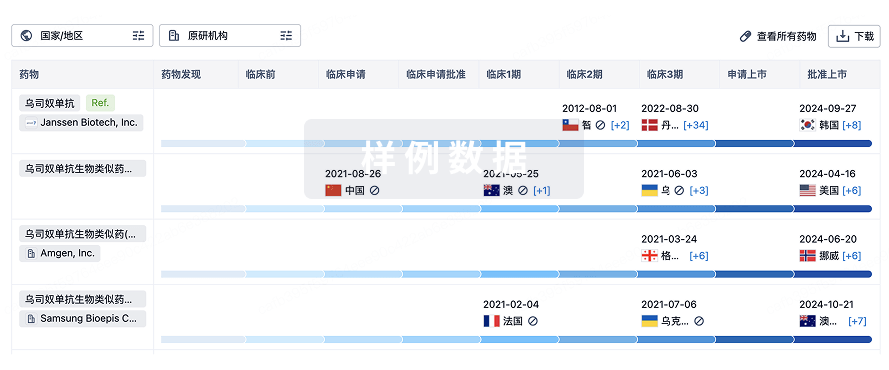
生物类似药
生物类似药在不同国家/地区的竞争态势。请注意临床1/2期并入临床2期,临床2/3期并入临床3期
登录
或
特殊审评
只需点击几下即可了解关键药物信息。
登录
或

提出任何生物医药研究问题
让每一步生物医药决策都精准制胜
基于十亿级生物数据与全球情报的精准 AI,赋能早期药物发现
立即开始免费试用!
智慧芽新药情报库是智慧芽专为生命科学人士构建的基于AI的创新药情报平台,助您全方位提升您的研发与决策效率。
立即接入生物医药数据包
智慧芽新药库数据也通过智慧芽开放平台,以MCP或API服务形式对外开放。立即使用我们的MCP服务定制您的LLM智能体。
生物序列数据库
生物药研发创新
免费使用
化学结构数据库
小分子化药研发创新
免费使用