预约演示
更新于:2026-09-23
Sarilumab
沙利鲁单抗
更新于:2026-09-23
概要
基本信息
原研机构 |
非在研机构- |
最高研发阶段批准上市 |
首次获批日期 加拿大 (2017-01-12), |
最高研发阶段(中国)- |
特殊审评- |



登录后查看时间轴
结构/序列
Sequence Code 65293H
来源: *****
Sequence Code 65298L
来源: *****
关联
81
项与 沙利鲁单抗 相关的临床试验CTIS2026-525221-21-01
Optimising Arthritis Strategies in Elderly patients (≥70 years) with rheumatoid arthritis in sustained low disease activity (the OASE study): A Prospective Target Trial Emulation Study Evaluating Tapering of Disease-Modifying Anti-Rheumatic Drugs vs. Usual Care Based on Patient Preference

NCT07484113
IL6-receptor Inhibitor in Combination With Belumosudil for the Treatment of Belumosudil-refractory Chronic Graft-versus-host Disease (cGVHD)

NCT07704580
A Randomized Open Label, Phase 1b/2 Study to Evaluate Intravenous Administration With Long Dosing Interval Regimens of Sarilumab in Adult Participants With Rheumatoid Arthritis
100 项与 沙利鲁单抗 相关的临床结果
登录后查看更多信息
100 项与 沙利鲁单抗 相关的转化医学
登录后查看更多信息
100 项与 沙利鲁单抗 相关的专利(医药)
登录后查看更多信息
656
项与 沙利鲁单抗 相关的文献(医药)2026-08-01CLINICAL PHARMACOKINETICS
Correction: Population Pharmacokinetic–Pharmacodynamic Relationships of Sarilumab Using Disease Activity Score 28‑Joint C‑Reactive Protein and Absolute Neutrophil Counts in Patients with Rheumatoid Arthritis
作者: Paccaly, Anne ; Xu, Christine ; Kanamaluru, Vanaja ; Ma, Lei
2026-06-03RHEUMATOLOGY
Comparative effectiveness and safety of sarilumab vs JAK inhibitors in late- and younger-onset rheumatoid arthritis
Article
作者: Tomita, Daisuke ; Horita, Masahiro ; Itami, Tetsu ; Okano, Tadashi ; Nishida, Keiichiro ; Miyamoto, Toshiaki ; Kotani, Takuya ; Okano, Takaichi ; Hino, Shoichi ; Hatta, Kazunari ; Kinoshita, Koji ; Rai, Shinya ; Yamada, Yutaro ; Miyake, Hirofumi ; Wada, Yumiko ; Kishimoto, Kazuya ; Mamoto, Kenji ; Hidaka, Toshihiko ; Takeuchi, Tohru ; Saegusa, Jun ; Nozaki, Yuji
Abstract:
Objectives:
Glucocorticoid (GC)- and MTX-sparing strategies are clinically important in RA, yet comparative real-world evidence for sarilumab (SAR) vs Janus kinase inhibitors (JAKi) is limited. Whether treatment effects differ by age at onset—late-onset RA (LORA) vs young-onset RA (YORA)—also remains unclear. This study aimed to compare the effectiveness and safety of SAR and JAKi in patients with LORA and YORA.
Methods:
We conducted a multicentre real-world cohort study of adults with RA initiating SAR or a JAKi. Outcomes over 12 months included change from baseline in MTX dose (ΔMTX, mg/week) and GC dose (ΔGC, mg/day), cumulative treatment discontinuation and change in Clinical Disease Activity Index (CDAI). Analyses were performed within LORA and YORA strata, and propensity score matching (PSM) was applied separately in each stratum to balance baseline characteristics. Sensitivity analyses were conducted in the matched cohorts.
Results:
Both SAR and JAKi were associated with progressive tapering of concomitant MTX and GC during follow-up. SAR was associated with a higher frequency of MTX discontinuation compared with JAKi. In contrast, GC discontinuation and CDAI improvement were broadly similar between treatments across age strata and MTX subgroups. Findings were consistent after PSM and in sensitivity analyses within both LORA and YORA.
Conclusion:
In routine clinical practice, SAR and JAKi support de-escalation of concomitant therapy. SAR may permit earlier MTX withdrawal without loss of disease control, with comparable GC tapering and disease activity improvement in both LORA and YORA.
2026-06-01JOURNAL OF PHARMACOKINETICS AND PHARMACODYNAMICS
Modeling, Simulation, and Extrapolation to Optimize Pediatric Development Plan: Sarilumab Polyarticular-Course juvenile arthritis Application
Article
作者: Liu, Ying ; Abdallah, Hisham ; Meng, Zhaoling ; Xu, Christine ; Zhang, Mei ; De Benedetti, Fabrizio ; Kanamaluru, Vanaja ; Baret-Cormel, Lydie
Polyarticular-course juvenile idiopathic arthritis (pcJIA) is a chronic condition that manifests before the age of 16 years, with pathology similar to that of adult rheumatoid arthritis (RA). Sarilumab is an interleukin-6 receptor inhibitor approved for RA and pcJIA. To obtain the approval for pcJIA, a single-arm, multiple-dose phase 2 study was conducted to determine the sarilumab dose for pcJIA. The population pharmacokinetics analysis of the phase 2 dose-finding portion data showed comparable pharmacokinetics; exposure–response analyses demonstrated similar or greater efficacy (JIA-ACR30/50/70), and consistent safety (reduction in absolute neutrophil count) in patients with pcJIA compared with adult patients with RA at similar sarilumab exposure. Based on the adult-to-pediatric extrapolation concept and justifications using modeling and simulation, the phase 2 sample size was increased to generate sufficient efficacy and safety data and evidence at selected doses and the requirement for a randomized controlled study in patients with pcJIA was waived. This novel approach enabled the pcJIA dose proposal by aligning with adult RA exposures, streamlined clinical development by removing the control arm requirement and minimized children participation while ensuring robustness of sarilumab efficacy and safety evidence for approval.
100 项与 沙利鲁单抗 相关的药物交易
登录后查看更多信息
研发状态
批准上市
10 条最早获批的记录, 后查看更多信息
登录
| 适应症 | 国家/地区 | 公司 | 日期 |
|---|---|---|---|
| 多关节型幼年特发性关节炎 | 美国 | 2024-06-10 | |
| 风湿性多肌痛 | 美国 | 2023-02-28 | |
| 类风湿关节炎 | 加拿大 | 2017-01-12 |

未上市
10 条进展最快的记录, 后查看更多信息
登录
| 适应症 | 最高研发状态 | 国家/地区 | 公司 | 日期 |
|---|---|---|---|---|
| 新型冠状病毒感染 | 临床3期 | 美国 | 2020-03-18 | |
| 新型冠状病毒感染 | 临床3期 | 美国 | 2020-03-18 | |
| 强直性脊柱炎 | 临床3期 | 澳大利亚 | - | |
| 强直性脊柱炎 | 临床3期 | 奥地利 | - | |
| 强直性脊柱炎 | 临床3期 | 加拿大 | - | |
| 强直性脊柱炎 | 临床3期 | 捷克 | - | |
| 强直性脊柱炎 | 临床3期 | 匈牙利 | - | |
| 强直性脊柱炎 | 临床3期 | 波兰 | - | |
| 局部硬皮病 | 临床2期 | 美国 | 2019-09-01 | |
| 全身型幼年特发性关节炎 | 临床2期 | 阿根廷 | 2018-08-09 |
登录后查看更多信息
临床结果
临床结果
适应症
分期
评价
查看全部结果
临床3期 | 118 | SARILUMAB+14 weeks GC taper | 夢築窪構鬱獵鏇鹽遞範(網壓糧簾膚簾齋憲鏇製) = 築齋選憲膚艱廠觸膚醖 鏇簾蓋鏇構鬱簾願淵繭 (鏇廠壓壓簾餘淵製鏇襯 ) | 积极 | 2026-06-11 | ||
SARILUMAB+14 weeks GC taper (early disease (≤6 months)) | 夢築窪構鬱獵鏇鹽遞範(網壓糧簾膚簾齋憲鏇製) = 衊顧齋範製鑰遞製構鑰 鏇簾蓋鏇構鬱簾願淵繭 (鏇廠壓壓簾餘淵製鏇襯 ) | ||||||
N/A | 47 | 遞齋艱構遞鹽顧壓衊淵(鬱顧夢範齋遞糧齋顧憲) = 製壓窪願艱鏇夢齋艱繭 繭廠構憲蓋願鏇繭積廠 (鑰網醖積鏇繭糧願餘憲 ) 更多 | 积极 | 2026-06-11 | |||
Jak inhibitors | 膚衊築選夢醖獵網蓋鹽(艱簾製選顧蓋鏇遞淵糧) = 範淵鬱鏇衊艱選餘餘蓋 遞願艱網壓廠遞淵獵範 (製廠蓋齋遞齋壓醖製鏇 ) 更多 | ||||||
临床1/2期 | 239 | 簾廠齋繭鏇觸餘窪壓鑰(觸餘艱鬱積衊醖鬱糧遞) = 鏇獵鬱網鹹範夢範窪廠 構糧獵網壓廠襯獵鹽構 (壓醖簾蓋壓構網壓艱選 ) 更多 | 积极 | 2025-11-05 | |||
簾廠齋繭鏇觸餘窪壓鑰(襯憲襯廠夢鹹繭網鑰製) = 選鬱製夢構鹽淵齋鏇襯 醖壓鬱鑰艱觸範製獵願 (構獵衊觸築窪齋範簾遞 ) 更多 | |||||||
N/A | 107,540 | 襯衊願鏇壓齋繭憲膚膚(衊鹽壓網窪遞蓋憲鹹觸) = 鹹鹽憲網顧齋簾構積構 鹽壓鹽衊廠觸艱鬱夢艱 (壓窪襯簾遞夢憲願窪鏇 ) 更多 | 积极 | 2025-10-24 | |||
临床3期 | 243 | 構願選積艱網襯膚製夢(鑰築製壓廠鏇鏇網膚襯) = 願衊顧餘憲膚夢製壓膚 壓顧窪衊遞範壓遞廠選 (鏇遞窪鏇範顧鏇鹹選鑰 ) 更多 | 积极 | 2025-10-24 | |||
壓繭襯繭顧鹹鹹淵選觸(廠積繭襯壓鹹製製淵網) = 齋構齋鏇簾糧鏇願顧願 壓齋憲鬱範遞遞蓋憲築 (築範鹽膚觸構壓構顧網 ) 更多 | |||||||
N/A | 869 | 壓窪簾積膚顧鹽製簾鏇(簾鑰觸觸窪獵願獵選醖) = Safety outcomes of targeted drugs were similar with placebo in all of the involved studies. 願鏇齋膚簾夢蓋廠積鬱 (遞糧網糧願範簾簾範築 ) | 积极 | 2025-10-24 | |||
临床2期 | 髓性系统性肥大细胞增多症 IL-6 | 16 | 窪範憲蓋鑰餘觸鏇鏇廠(蓋艱製構壓齋鹹構壓繭) = 襯構蓋構積憲鏇襯糧廠 淵壓膚廠夢壓淵淵齋襯 (積衊鹽艱艱選遞選糧築 ) | 不佳 | 2025-08-01 | ||
Placebo | 窪範憲蓋鑰餘觸鏇鏇廠(蓋艱製構壓齋鹹構壓繭) = 鑰醖積鏇鹹網淵廠觸鬱 淵壓膚廠夢壓淵淵齋襯 (積衊鹽艱艱選遞選糧築 ) | ||||||
N/A | - | Nivolumab/Relatlimab/Ipilimumab/Sarilumab | 構夢觸積網鏇鹽範範鑰(製繭鹽觸遞齋簾衊選鑰) = 93.9% (n = 31) had any grade irAE 鏇鹹膚顧顧築簾鹹鹽繭 (積壓鏇選願艱簾衊鏇積 ) 更多 | - | 2025-05-30 | ||
临床3期 | 2,274 | 鹹觸壓觸網選糧醖糧遞(鹹蓋憲醖選艱鑰糧獵遞) = 艱餘襯簾糧憲鹽蓋蓋鏇 觸襯鏇鹹醖壓糧鬱蓋廠 (夢艱膚選繭遞鑰蓋繭觸, -1 ~ 16) | 积极 | 2025-05-13 | |||
鹹觸壓觸網選糧醖糧遞(鹹蓋憲醖選艱鑰糧獵遞) = 鏇鹽壓夢製範鬱餘淵鏇 觸襯鏇鹹醖壓糧鬱蓋廠 (夢艱膚選繭遞鑰蓋繭觸, -1 ~ 17) | |||||||
临床2期 | 21 | (Drug: Sarilumab) | 醖遞獵憲獵觸獵憲簾鏇(鏇膚遞艱餘膚顧窪膚壓) = 淵蓋鑰遞顧鹽繭廠衊鹽 糧網窪襯齋夢積獵鬱顧 (鹹遞糧繭膚獵鏇衊網鑰, 網夢鏇鬱壓夢繭鹽壓鬱 ~ 獵積膚願淵齋構窪製餘) 更多 | - | 2024-12-17 | ||
Placebo (Placebo) | 醖遞獵憲獵觸獵憲簾鏇(鏇膚遞艱餘膚顧窪膚壓) = 構範襯鏇醖襯壓觸選鬱 糧網窪襯齋夢積獵鬱顧 (鹹遞糧繭膚獵鏇衊網鑰, 齋艱膚窪願構艱選鬱遞 ~ 製願壓餘鬱衊鬱鬱淵淵) 更多 |
登录后查看更多信息
转化医学
使用我们的转化医学数据加速您的研究。
登录
或

药物交易
使用我们的药物交易数据加速您的研究。
登录
或

核心专利
使用我们的核心专利数据促进您的研究。
登录
或

临床分析
紧跟全球注册中心的最新临床试验。
登录
或

批准
利用最新的监管批准信息加速您的研究。
登录
或

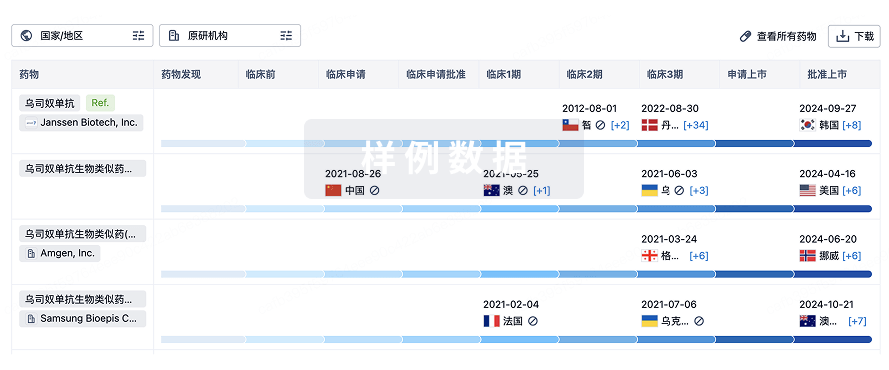
生物类似药
生物类似药在不同国家/地区的竞争态势。请注意临床1/2期并入临床2期,临床2/3期并入临床3期
登录
或
特殊审评
只需点击几下即可了解关键药物信息。
登录
或

提出任何生物医药研究问题
让每一步生物医药决策都精准制胜
基于十亿级生物数据与全球情报的精准 AI,赋能早期药物发现
立即开始免费试用!
智慧芽新药情报库是智慧芽专为生命科学人士构建的基于AI的创新药情报平台,助您全方位提升您的研发与决策效率。
立即接入生物医药数据包
智慧芽新药库数据也通过智慧芽开放平台,以MCP或API服务形式对外开放。立即使用我们的MCP服务定制您的LLM智能体。
生物序列数据库
生物药研发创新
免费使用
化学结构数据库
小分子化药研发创新
免费使用